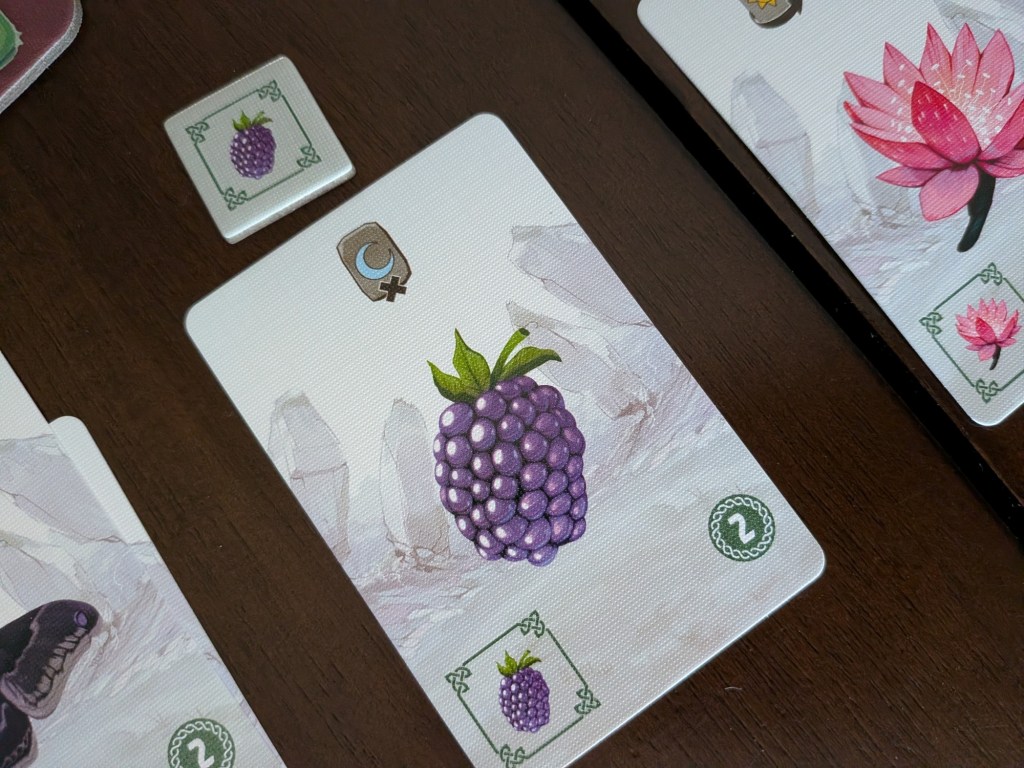

Carnuta is a set collection card game by design team Yohan Goh, Hope S. Hwang, and Gary Kim. Players are druids using the power of runes–the sun and moon variety–to create the world’s most powerful, impressive potions. Potions are made up of cards; cards with pictures of bird skulls and clovers and points on them. It’s a game that got its hooks in me with its unique setting and an immediately gravitational gameplay loop.
This is a very points-saladsy game, which may immediately turn some people off. One half of Carnuta’s core are its eggs and butterflies and other reagents plucked from a market. These cards provide ingredients and scoring goals that require (other) ingredients. I don’t always love this type of game, weary as I am of the feeling that I’m just shuffling cards around and scoring in a nondescript way.
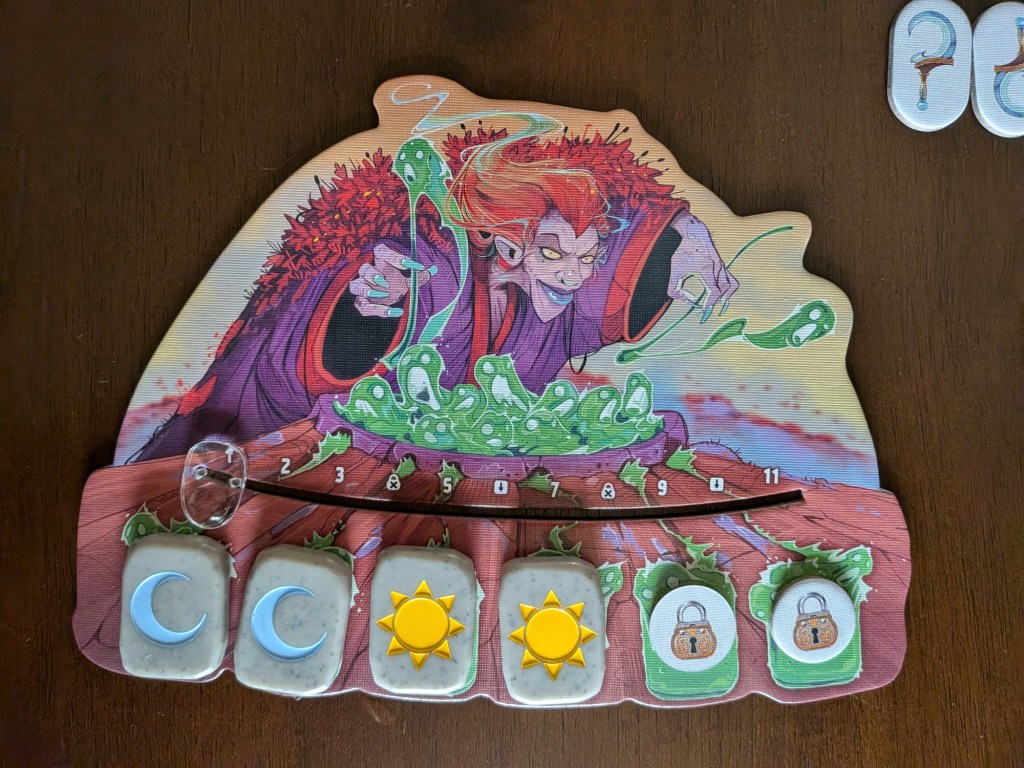
The magnificent art by Davide Tosello does a lot of the immediate heavy lifting to keep me engaged, though. Carnuta’s pointmania is nonetheless grounded in a cool, anime-but-naturalistic world. There’s a weathered frost druid huddled around his concoction, a green one draped in lichen and seemingly attached to her cauldron by vines, and an old dude carefully distilling what looks to be the power of the sun into his brew. None of these characters provide a unique power, but the player boards are extremely evocative and transport me into a mood–a mood to get some properly druidic ingredients into this draught.
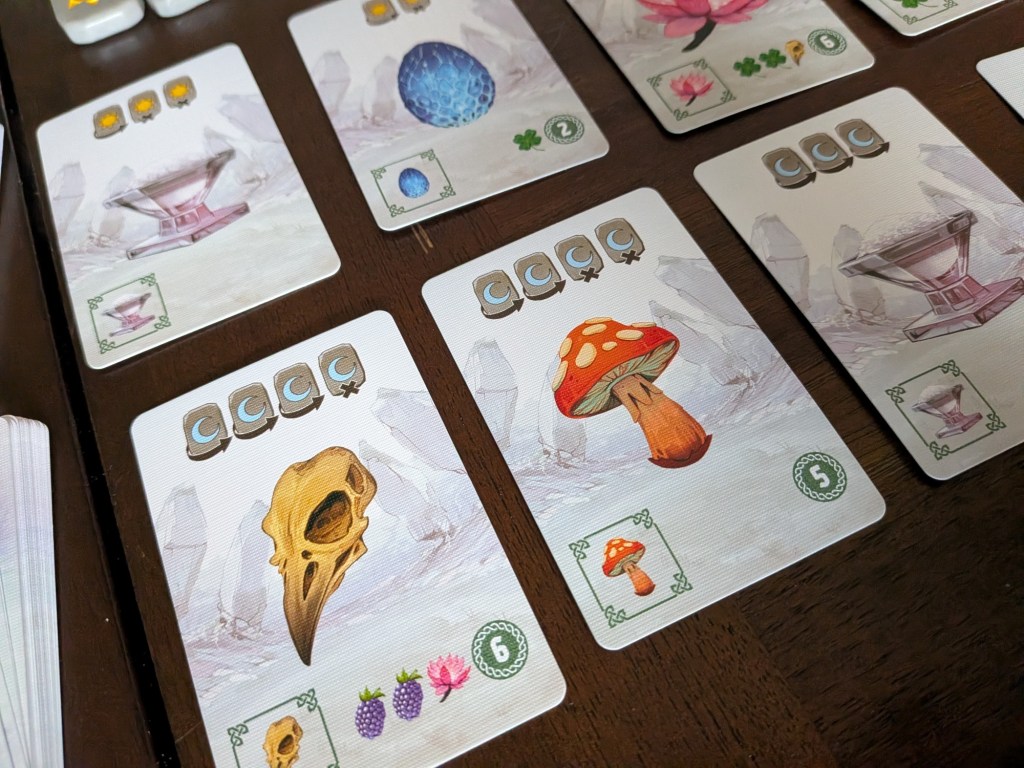
The gameplay itself is rhythmic. I bounce from one turn to the next, staying in tune with my bubbling tableau. In order to play ingredients into this potion, players must flip or discard a corresponding number of their runes–suns flip into moons and vice versa. This means there’s a careful give and take, a balance, maybe even a little dance to your economy. Maybe you play a card which has you flip four moons. Now you’ve got a tableau full of suns, and your options have completely inverted. If you’ve planned ahead, maybe by grabbing a couple of moon-heavy ingredients, you can keep the gravy and/or potion train going. There’s something magnetic, satisfying, and easy about this process.
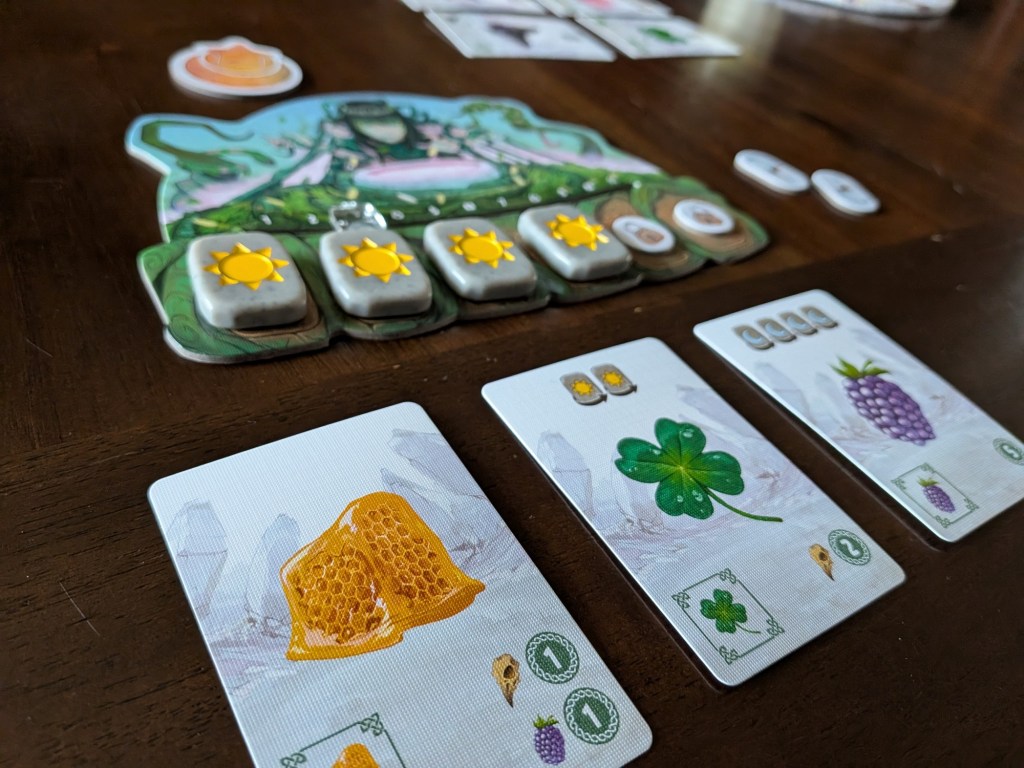
This little mechanism– your lunar currency being more often converted rather than spent–is my favorite part of Carnuta. It is the game mechanical equivalent of finding out that, after cooking one meal, you’ve got the exact ingredients leftover for another delicious dinner, and then the leftovers from that make a good lunch. It’s rewarding. It even makes you feel like bit of a genius.
Sometimes in Carnuta you do have to take an action to scoop back up runes. In the pursuit of the strongest potion, several more powerful cards will force you to discard some runes to the center of the table. But this, to extend the analogy, is like going to the grocery store for more stuff. If you’re at the grocery store after making the absolute most of your last trip, you feel good. If you’re at the grocery store because you fell one moon short of the crisp Pink Flower that your cauldron needs– bit of a bummer. There is an action to manually flip some of your runes, but it’s a painful action to be forced to take. You could do that for free if you had an ingredient to toss in!
Carnuta escalates quickly, too, so taking a turn off can be brutal. There’s many little things pushing you to play efficiently, and playing efficiently means putting stuff into your brew. The game ends once any player has eleven cards in their potion, which won’t take much longer than a dozen or so rounds. As a cauldron gets loaded, the druid themself gets more powerful; they can hold more runes and get bonus, free ingredients.
Because of the race element, you’re always trying to get more ingredients in the pot. You don’t have time to wait around for six berries and six cards that score berries. Besides, these runes are too capricious to rely on a berry-only build. There’s a joy to being adaptable, to cooking with whatever you’ve got, to grabbing a card now and never getting around to playing it because you are instead following where the moon flips are taking you.
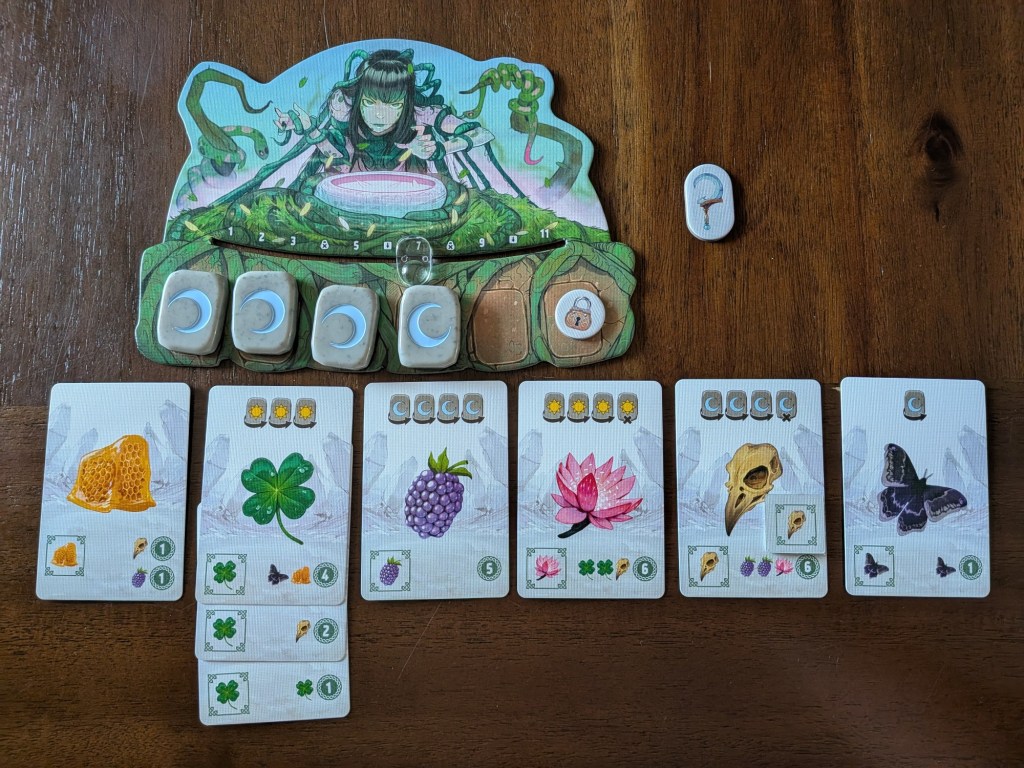
If maneuvering through the tight rune economy and grabbing what you need is the meat of the game, scoring is the vegetables. A good set collection game should end with players marveling at the final product or surprised by something their sets did at the very end, but that’s absent here. The excitement comes from filling your pot and jockeying for the right ingredients, not necessarily from relishing in the finished product. There are moments as the game winds down when actions feel prescribed or meaningless. Before that little end game chunk, the market feels open and my decisions matter, but then it winds down unceremoniously. I can’t help but feel like something is missing here, like Carnuta needed another trick or butterfly up its sleeve.
But I like Carnuta. Its tactility and interesting economy feel like a riff on Splendor that, while not as tight as that game, make for a unique, accessible experience. It’s a one-and-a-half trick pony, sure, but it’s one that has nevertheless held up for a dozen-odd plays.

Leave a comment