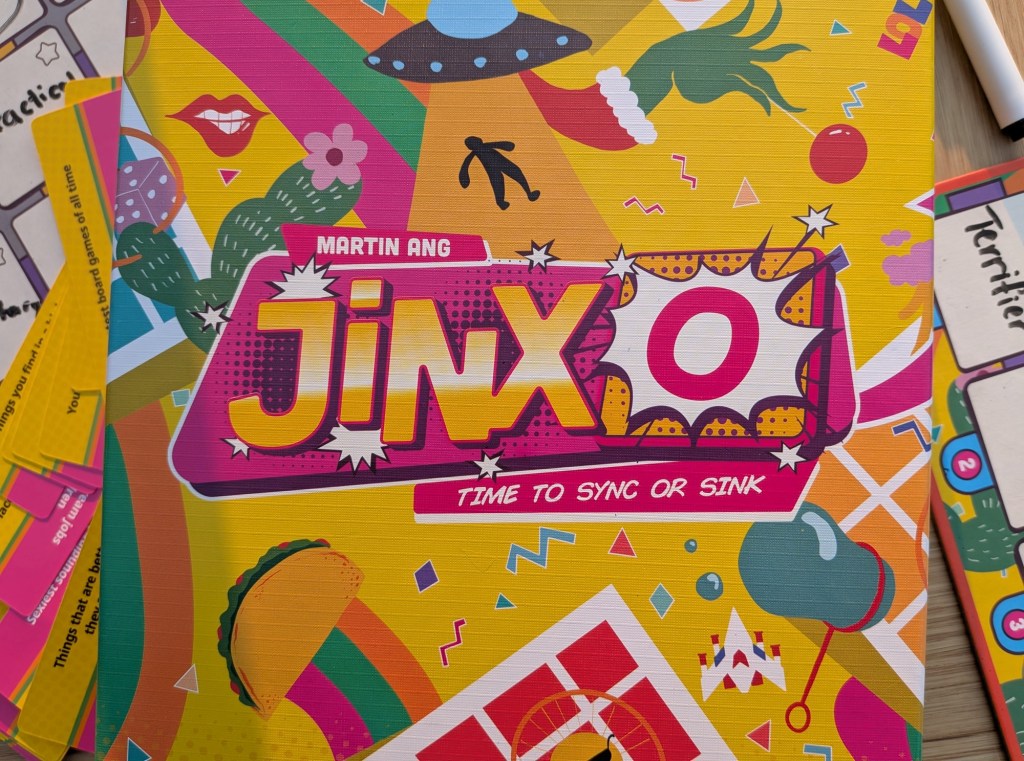

At time of writing, Martin Ang’s JinxO has recently earned itself the prestigious Spiel des Jahres. I first played JinxO, only slightly behind the curve, when it was merely nominated for that award.
A couple of plays in, I thought it was pretty good, but I’d seen these mechanics and this sort of game many times. Now, several plays later, I’m fully jumping on the bandwagon. If I had a Mana Worm award to give out, this would win it. It is my favorite game of the year and the best party game I’ve played in a long time.
At first blush, it doesn’t look like much. The premise and the presentation are both equally unassuming. You’ve got a blank tic-tac-toe board and a marker. Players will be given a prompt and the simple goal of writing three responses that will match other the other players’ responses.
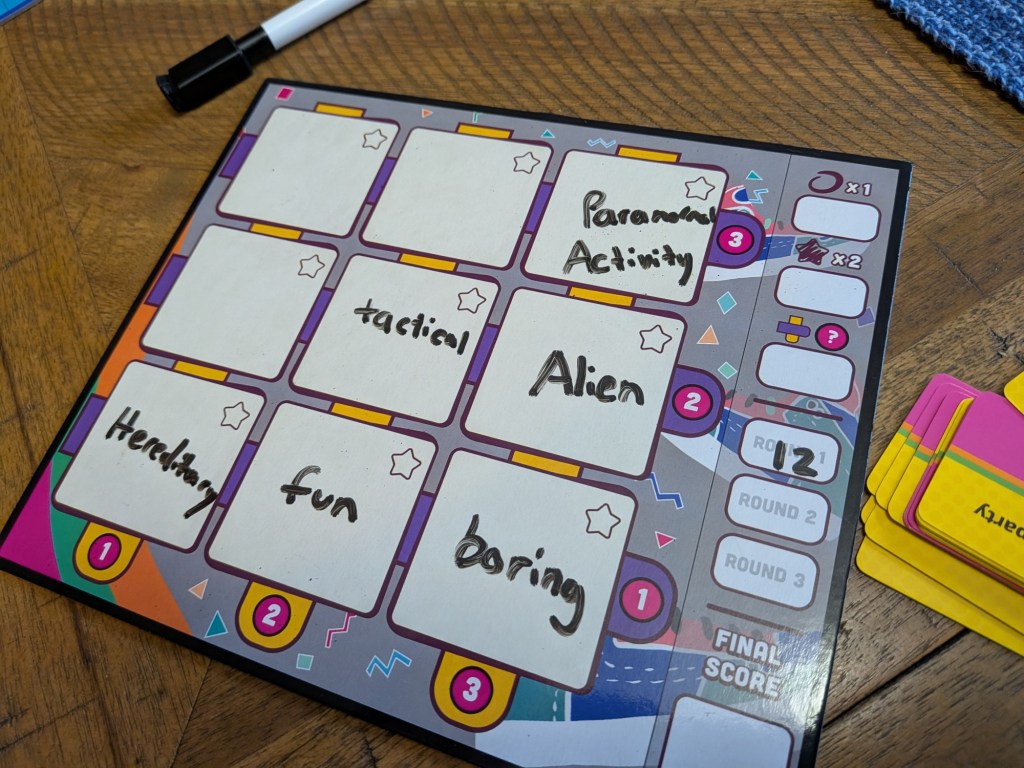
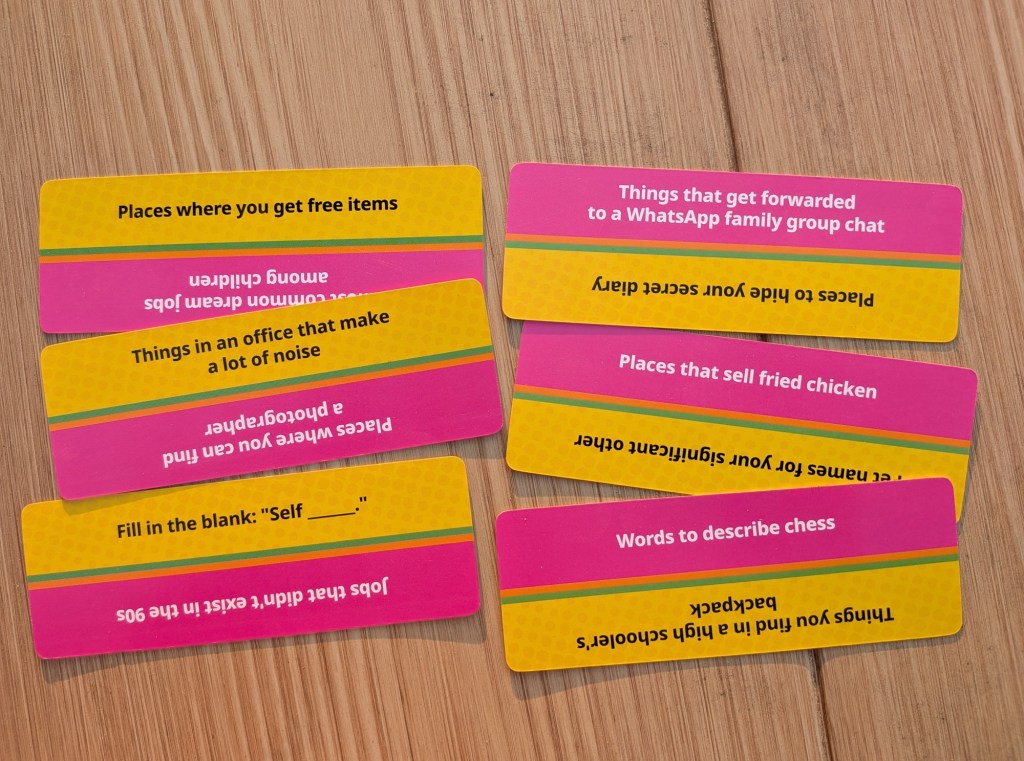
Someone might read out the prompt: “PG-13 Swear Words.” You, like I, may have a number of questions about what this prompt means. Is that the type of swear word that PG-13 films can contain? Is that PG-er renditions of more adult words? Is this a technical term that I’ve heretofore missed, like a cultural touchstone ship in the night? The slight confusion adds to the drama, but there’s no room for questions without tipping your hand unfairly. Write three responses; hope other people are on the same wavelength.
And then–you might be thinking, if you haven’t played– we see what everyone else wrote and check for matches? But no. Another prompt comes out. Maybe this one’s easier, maybe harder. Maybe this one is more concrete and you can put down some factually correct answers but, more likely, it’ll be the stuff of gristly, slippery opinion. Either way, your previous answers sit there and get further from their established context. The responses to three whole prompts fill up your board. Once each player’s board is loaded with nine words, absolutely brimming with anticipation and potential, does the round come to its rewarding finale.
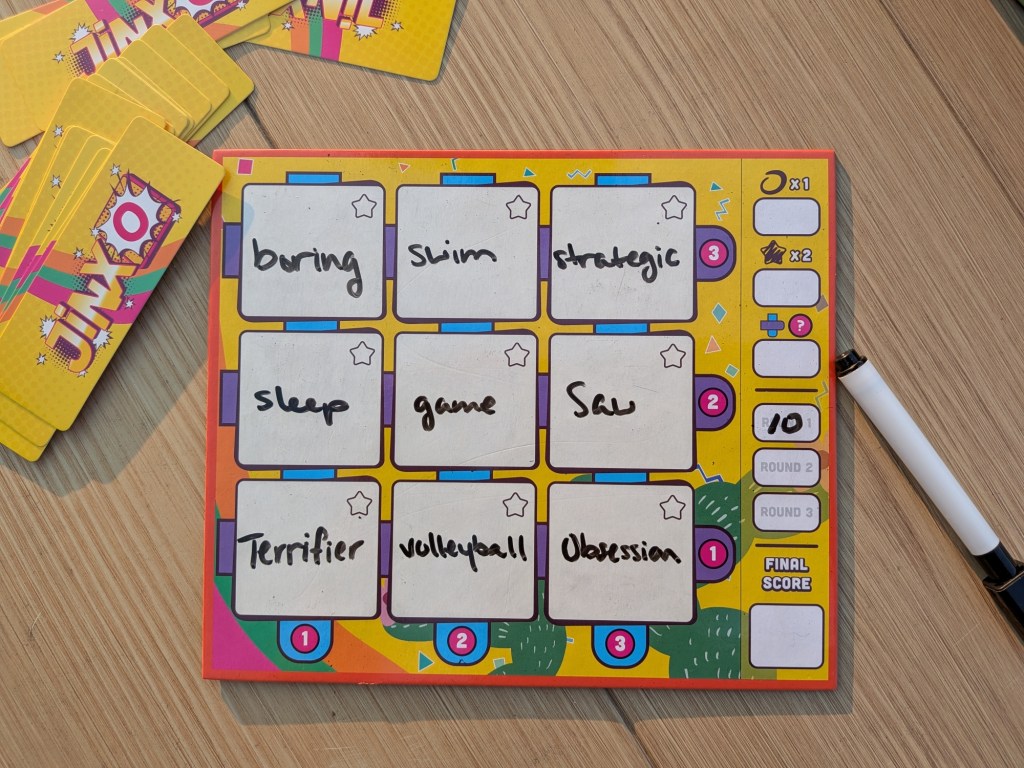
One at a time, players announce a word from their board, hoping to find a match. Each other player raises their hand (or in my family, a chorus of “yeeep” or “mhm”) if they have also written that word. If exactly one other person has it, that’s a Jinx worth two extra points–a lot of points in this economy. If no one matches, there’s a deafening silence, usually followed by “That’s a good one but…” or, better, a room full of giggles.
Sometimes, folks are laughing because the prompt or the response itself was funny. Usually, though, people are laughing because how did only one person write the word “hot” for the prompt “words to describe a volcano”? How did the rest of us conspire, accidentally, to avoid writing “Drake” for the prompt “popular rappers”? The laughs earned by JinxO are commiserating laughs–you got so unlucky that nobody else thought to write that very correct answer. But they’re also laughing at oneself–I didn’t write that because the stuff I wrote is, honestly, way worse. JinxO is the funniest game I’ve played in a long time, competing with the likes of Monikers.
JinxO is streamlined and ultra-accessible but it executes many little things right. The prompts are a magical mix of zany, difficult, and what I’d affectionately call “the hits” (the types of prompts you would expect but, crucially, only the ones you would miss if they weren’t in a game like this). The graphic design is compelling, too, providing more texture and personality than the flattened, mass-market party games it outcompetes.
There are bits of strategy here, too, for those Gamer enough to engage. Where you place your words does matter in a fine-print “number of points” sort of way, but this can be safely ignored when first taught to a parent or child. On future plays, however, word positioning and word order become the differences between first and second place, so players readily glom onto them.
Really, my family has glommed onto the entirety of JinxO. Our markers are all sadly running dry from repeat use. We have established little inside jokes, our own flow, and even our own meta. We love the format of going around in a circle, reading off one response at a time, and hearing the bemusement and relief and jeers from other players. On each player’s go, there’s a call-and-response of “yes!” and “pffft” and “what?!” that doesn’t get old.
The emotional highs of a perfect Jinx and, inversely, the hilarity of a complete whiff are incredible. Missing out on a row bonus and everyone else going “oh, yeah, I had that but erased it” is good every time. Stella: Dixit Universe has several of the same mechanisms and moments–it’s also an absolute gem that more people ought to play–but JinxO just does it better. JinxO feels like a more balanced, word-driven version of the artsy Stella, so it’s no wonder I fell in love.
While Stella can be broken by one player choosing to max out its push-your-luck mechanism, JinxO is resilient to players in all manner of moods. Someone playing to make others laugh and another thinking hard trying to win can coexist peacefully. That is exactly what my family needs from a game like this. It is a near-perfect party game, assuming your party fits into its somewhat narrow player count.
I wholeheartedly recommend this one. And it won that big award so, y’know, consider this recommendation peer-reviewed.

Leave a comment