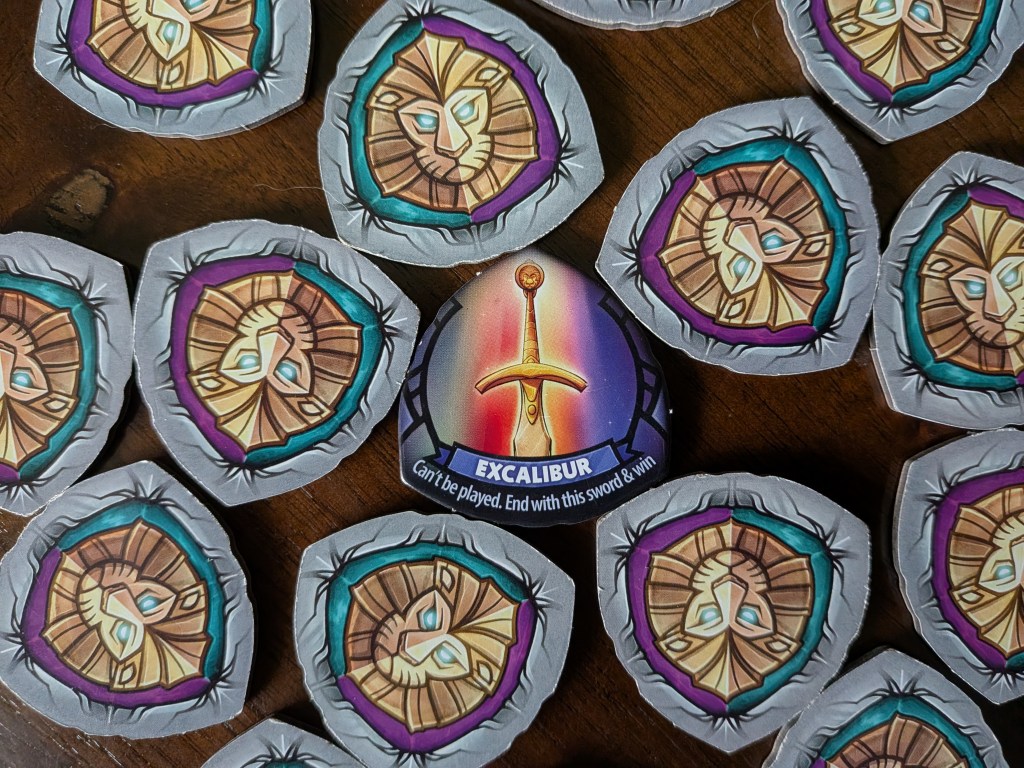

Cards on the table: I like Excalibur. I’ve had a whole lot of fun with it. It’s also–probably–trying to be too many things at once.
Excalibur has a lot of Love Letter in it. Each player has a hand of cards (they’re little tokens in my version, in more deluxe editions they’re acrylic or wood) and they will play one per turn. One of these cards reads “You win the game.” but cannot be played. At the end of the game, whoever has squirreled away the titular Excalibur wins. So far so Love Letter.
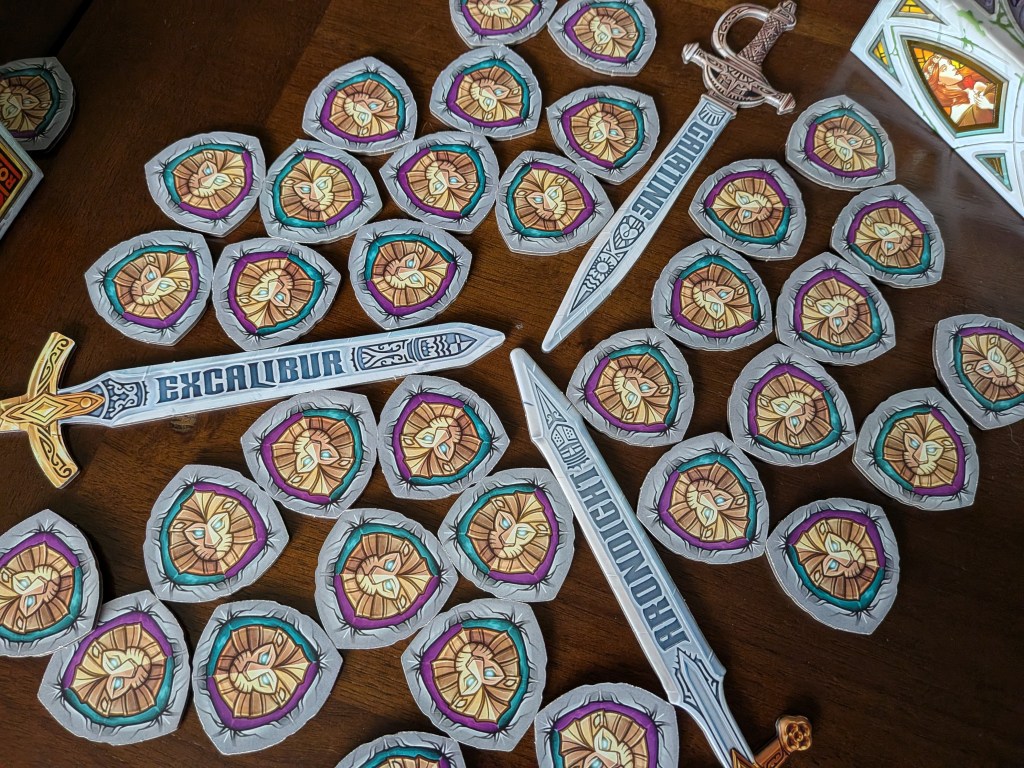
But this isn’t Love Letter, it’s a much more grandiose game. In Excalibur, there’s proper nouns and questionably necessarily (but possibly blinged-out) swords splitting up a middle area called Avalon. There a whole lot more cards doing a whole lot more things. Each card does something, but the Green Knight or Merlin– you may have heard of them– tend to do more than generic Priest or Peasant. It’s swingy and wears that on its sleeve.
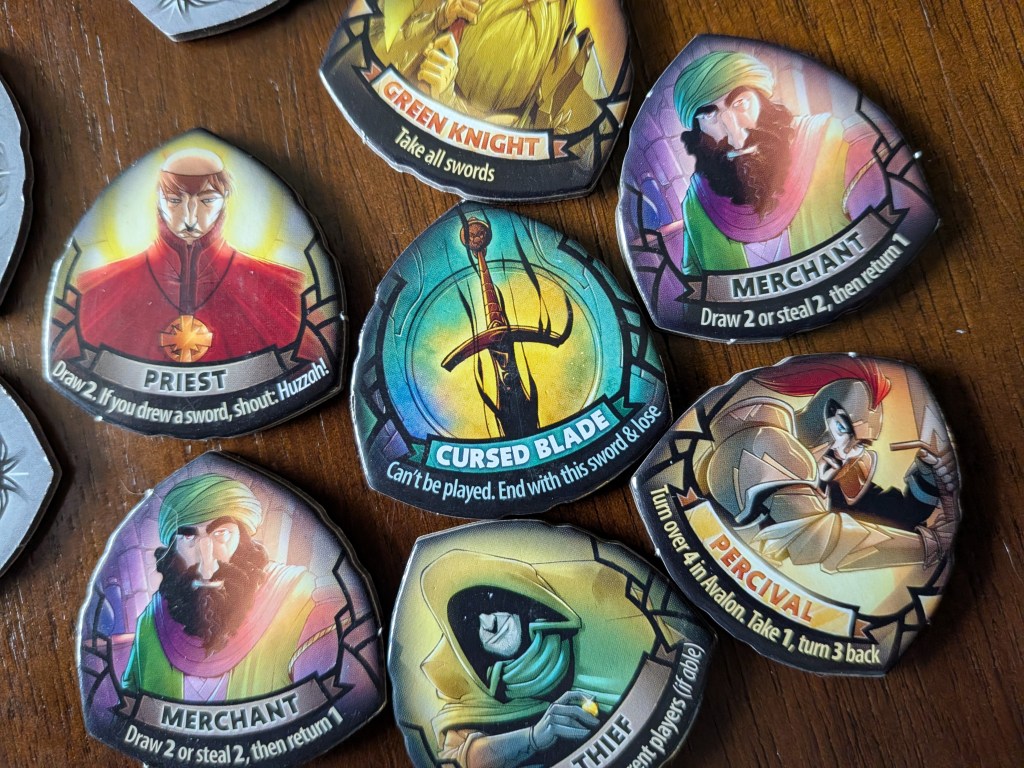
Agency is hard to come by, but the game gives players breadcrumbs to try. At the beginning, two players will secretly be dealt the sword chips which theoretically determine their fate–though long before any fate is to be sealed. There’s the aforementioned Excalibur which, of course, wins the game. But there’s also the Cursed Blade, an anti-Excalibur, which causes the player holding it to lose, even cutting through the winning Excalibur. Right out of the gate, knowing who has each sword is the ultimate currency of the game.
To that end, there’s a lot to do. Some chips let players peek at hands, shuffle them around, steal some, hide cards back into Avalon, shuffle Avalon itself my goodness, and more. Each player has about four chips at a time, so knowing what any player may or may not do is virtually impossible. But the trick is this: you don’t need to know all that. All you need to do is track Excalibur, hope no one else is able to, and use one of the myriad ways to swipe it into your hand at the last moment. Sometimes, this even works.
Other times, someone draws and plays Guinevere or Merlin on the last round so that all the swords (and planning) vanish into the ether–it’s a wash.
Like I mentioned up top, Excalibur is trying to do a lot. It’s Love Letter but half the cards are Mario Kart blue shells. Excalibur’s BGG description describes backstabbing and lying and playing like a deduction diehard. The game itself feels designed for the kid who would rather get a blue shell than a gold mushroom just for the chaos that will ensue. Critically, Excalibur doesn’t have any player elimination– there’s no way to “be in sixth” or, really, to be “doing bad.” It’s Mario Kart but we’re all marbles circling a plastic drain, hoping we time cutting into the middle hole at the right moment. If that description sounds like torture, this game isn’t for you.
Still, I have a good time with it. If I’ve lost track of Excalibur, or if I’ve ended up with the Cursed Blade and am waiting for someone to accidentally nab it from me, suddenly I’m playing a game akin to Magical Athlete. I play a chip because well, why not, it’ll do something cool! and wait for a lucky break to save me. When the lucky break eventually comes (because someone else misread that I definitely had Excalibur) it’s a great laugh! Maybe I’m meant to bluff or lie–trust me I try– but usually nobody has any incentive to believe anyone else, so they instead trust their own intuition and privately held knowledge. Putting on a poker face or trying to read someone’s true intentions are doable, I guess, in the same way trying to concoct a clever drafting strategy for Magical Athlete is.
I wish Excalibur leaned more into one of these two identities. Hot potato with deduction and poker faces sounds cool, but the overwhelming chaos devalues bluffing a bit too much. On the other end, the excitement of playing overpowered chips is tempered, ever so slightly, by the game telling you “hold onto these chips that do Nothing and Keep A Straight Face.” If it committed one way or the other, I could see Excalibur being an amazing game rather than just a pretty good one.


Leave a Reply