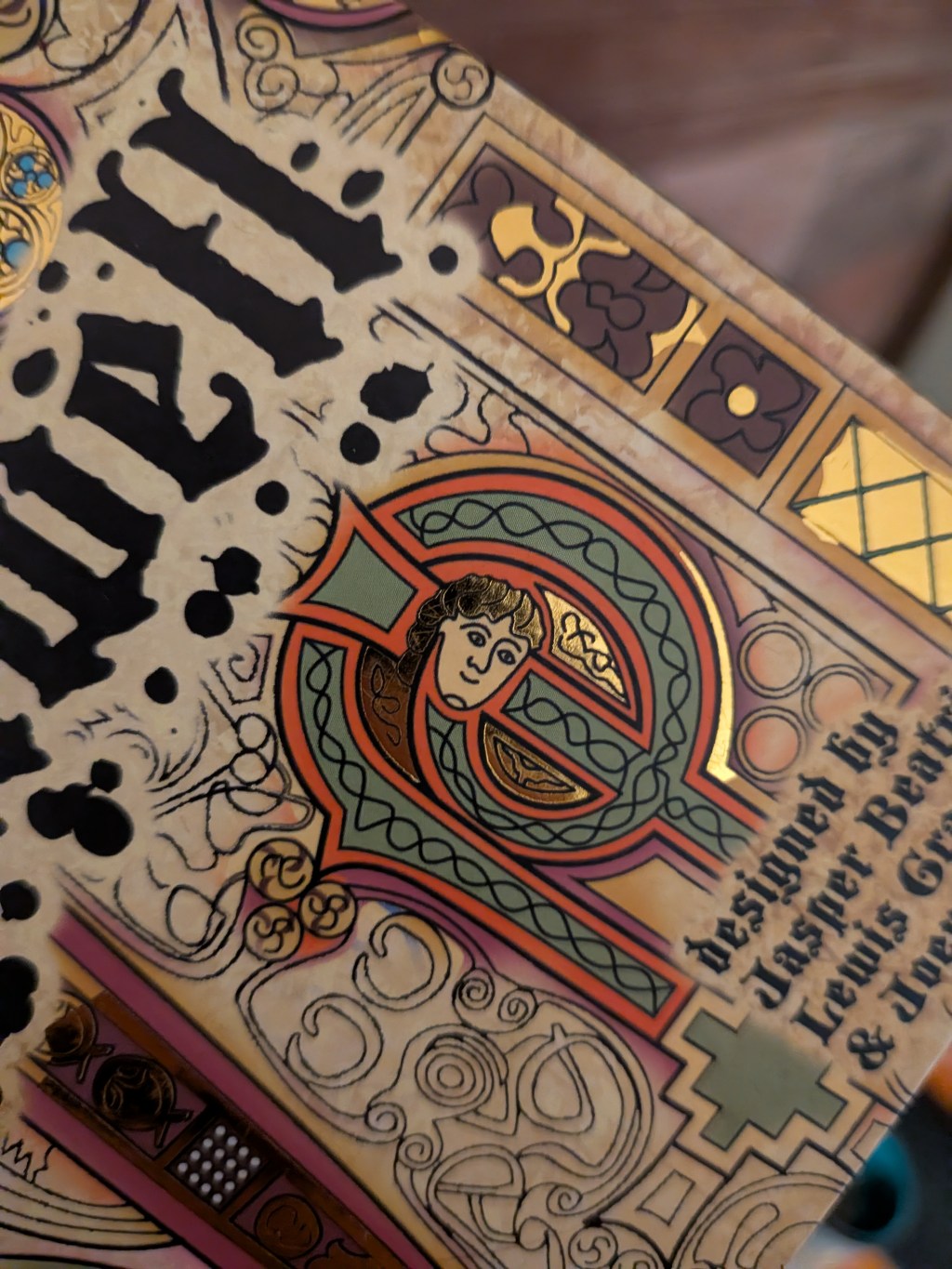

DVC games, and especially the design collective Jasper Beatrix, has been churning out interesting, mana worm-ass games. Every time I see one of these at the library or the local game store or a stray link on BoardGameGeek, I’m briefly stun-locked. Little accessible games with unique aesthetics, mechanics, and perspectives–that could be a general description of games targeted squarely at me. I’ve checked out TYPESET, I’ve longed for PACTS and Corvids, and I’ve now got my hands on Inkwell.
In Inkwell, players will be inking up three manuscripts. To do so, they will be drafting cubes from the titular inkwells and placing them on corresponding spots in their manuscript like a medieval coloring book. Along the way, players can select from smaller less ink-rich wells for extra bonuses like gold cubes or engine buildy technique cards. Players score, generally, for completing works and using whatever bonus colors are asked for.
The most popular comparison point for Inkwell is Azul. They are both elegant-looking games about drafting colorful squares and placing them in square-shaped holes in an attempt at filling up a square-shaped player board. Azul is a useful comparison, but the outright similarities end there. Despite appearances, Azul is cutthroat. It’s about perfect timing and battling for scarce materials while trying to get satisfying geometric scoring cascades. Tiling in Azul is about measurement, math, and patching holes.
By comparison, completing a manuscript in Inkwell is about vibes, looming self-imposed deadlines, and how much one can gild a lily for points. It’s totally different. One game is about dropping tiles to the floor in hurried frenzy, the other about building up a repertoire and slowly learning techniques to be marginally more efficient.
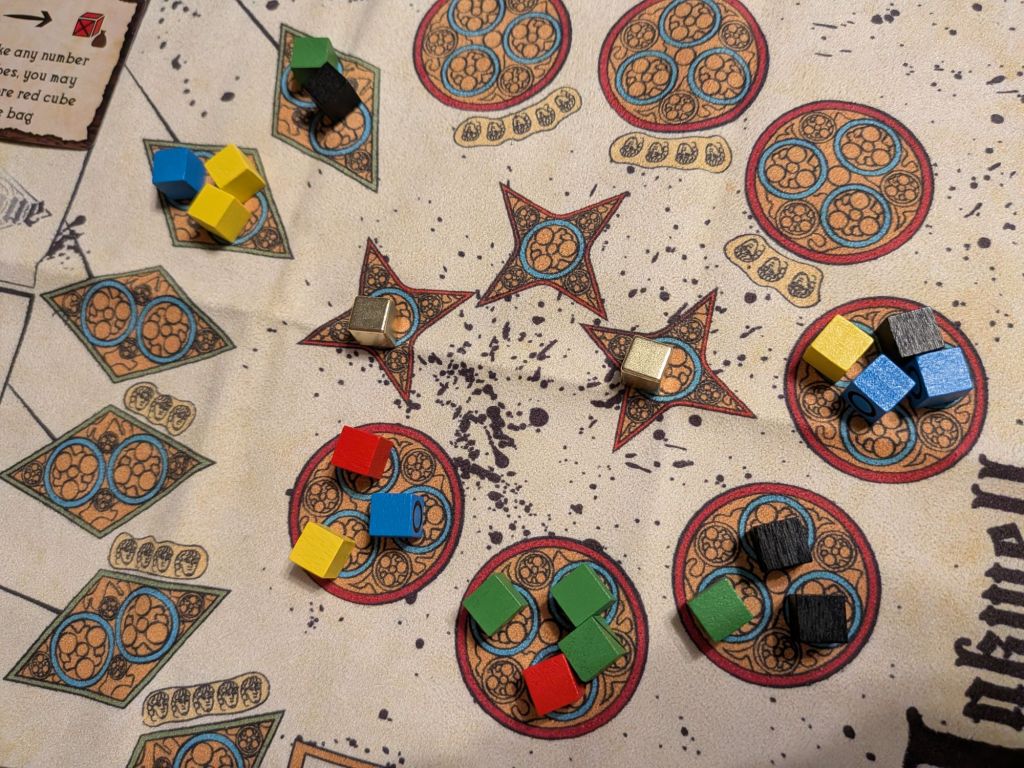
Another difference: Inkwell’s ink cubes aren’t half as scarce as Azul‘s tiles. There’s a handful of ink receptacles, all offering up some combination of black, yellow, blue, red, green, and the aforementioned wild golds. Each page requires a combination of all these colors and the wells get refilled frequently. Players score bonuses (a la Sagrada) for using their player color more often and for trying to cram more of a particular color into each artwork.
The wells keep refilling, but they aren’t infinite. Ostensibly, players are on a clock: the vigilant abbot circles the room, tapping his wristwatch (okay, in The Lore aka history, he probably wouldn’t have a wristwatch) whenever he has to refill a set of inkwells. Every few refills, each player has to score their current page, finished or not. Reading the rules, I imagined partially finished manuscripts rushed and turned in for half credit. I thought there would be scarcity of time, of resources, of using gold cubes not for bonus points but for the fact that my opponent was hoarding all the blue.
In practice, for the one and two player game anyway, the abbot’s pretty chill, actually. I do wonder if this would be different at higher player counts, but I can’t speak to that. He is refilling all the ink, keeping a watchful eye, making sure we don’t waste his time– sure, sure. But if we’re grabbing a respectable amount of cubes, picking up on a technique here and there, only stopping for a dollop of gold when we can afford to, the abbot’s impatience is a non-issue. He reins in everyone’s excesses (we can’t all grab from the same couple inkwells or else he will grow weary of refilling them), but rarely forces anyone to put out sloppy work.
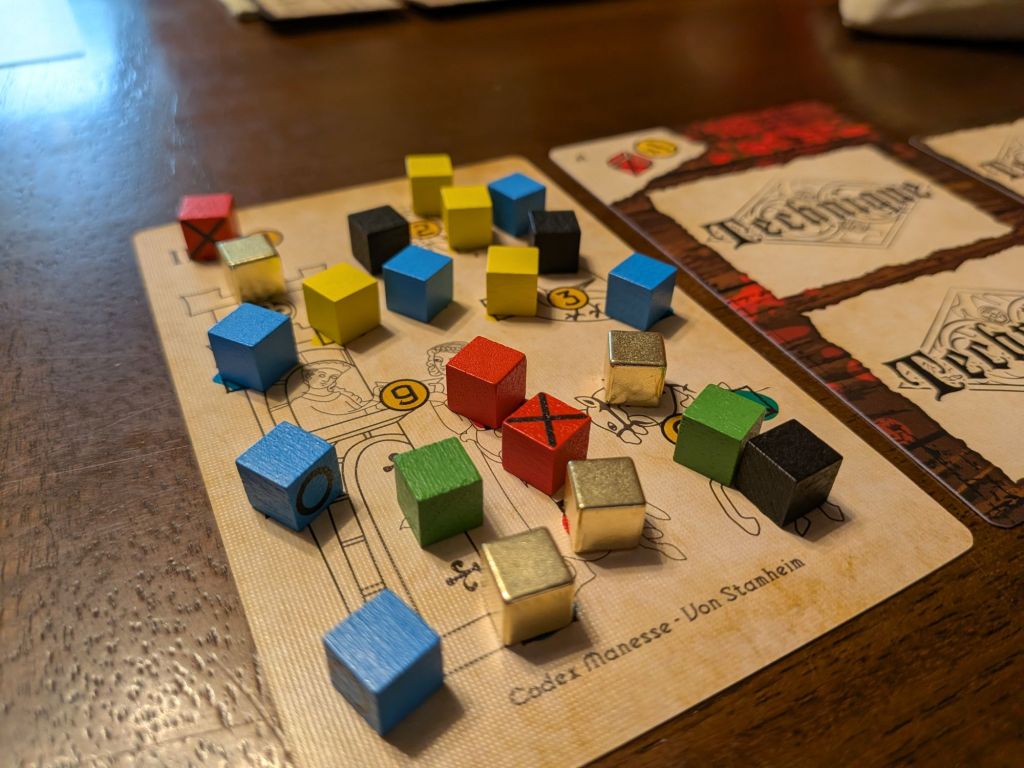
It’s relaxing and airy. Getting the job done and turning in a B- or greater assignment is simple enough (and that’s all you have to do, if you want) but matches are won or loss on the margins. The biggest of these margin-makers are techniques, which give fairly straightforward bonuses (e.g. get a red cube from the bag whenever you pick up a gold cube) that compound into small advantages.
The problem is that techniques tend to help me finish pieces quicker so I avoid the abbot, which in turn encourages me to slow down and add more embellishments for points, which itself feels antithetical to my go-faster techniques and the overflowing inkwells on offer. I’m alternating between the gas and the brakes, imagining that there must be a perfect, gentle cruising speed that I just can’t find.
If I finish early, I get a bonus gold cube. If I manage to eclipse the abbot’s pace, I’m barely interfacing with the game’s core tensions and it goes from breezy to bleh. When I take a cautious, slower approach, the game is pushing me to hurry up. Both slowing down and speeding up feel counterintuitive. If I engage with the cool decision trees, I find myself eventually stopped in awkward decision cul-de-sacs.
Is this a game about hurrying to deadlines and dipping your pen in another monk’s ink? Or is it about hanging out with your buds and making some cool pictures at leisurely pace? Probably a little of both, but it never fully settles into either role.
The art and the components of Inkwell fully commit to the bit, but the gameplay can’t get me to commit to the bit. It’s a pleasant game, and novel enough that I definitely plan to show it around, but I wonder what experience I’m meant to be having six or so games deep. It’s got me peckish looking for more Jasper Beatrix games, but I think I’ll have had my fill of this one before my tenth play.


Leave a Reply