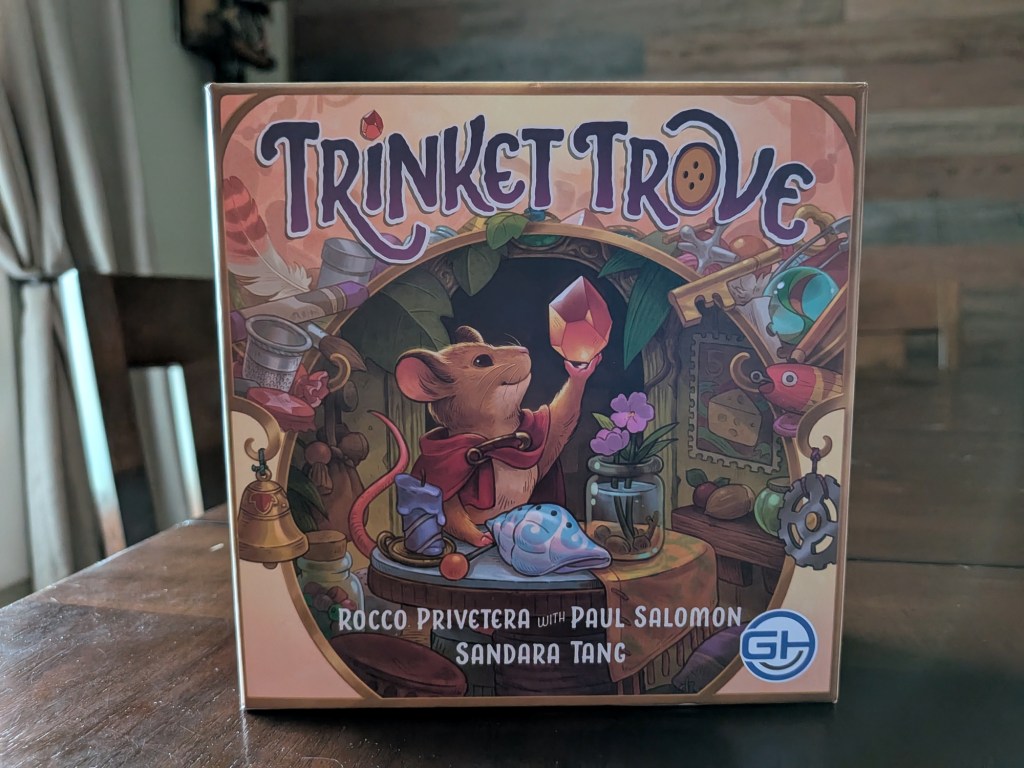

Trinket Trove is an accessible, cute bidding game. Creating an accessible auction game must be tough. Creating a bidding game that doesn’t result in some newer or inexperienced players getting completely destroyed must be tougher.
Auctions prey on the inability to correctly weigh the value of lots. I value a company or a resource token at some amount and my opponent evaluates them better. Auction games are cutthroat in this way–someone’s more right. If one player doesn’t have the understanding to reasonably approximate the value of a lot, they flounder, overspend, and let others get away with highway robbery. Ultimately, they lose.
You get what you sign up for. Auctions and games about money are usually sort of mean, requiring a couple humiliating losses to claw up to the skill floor. As rules-light as Reiner Knizia’s High Society is, there’s no appropriate moment in the teach to explain “such-and-such card might be worth about eight-thousand francs” without inevitably leading a newcomer astray. It almost defies teaching, and any advice given could be bad advice in the wrong scenario.
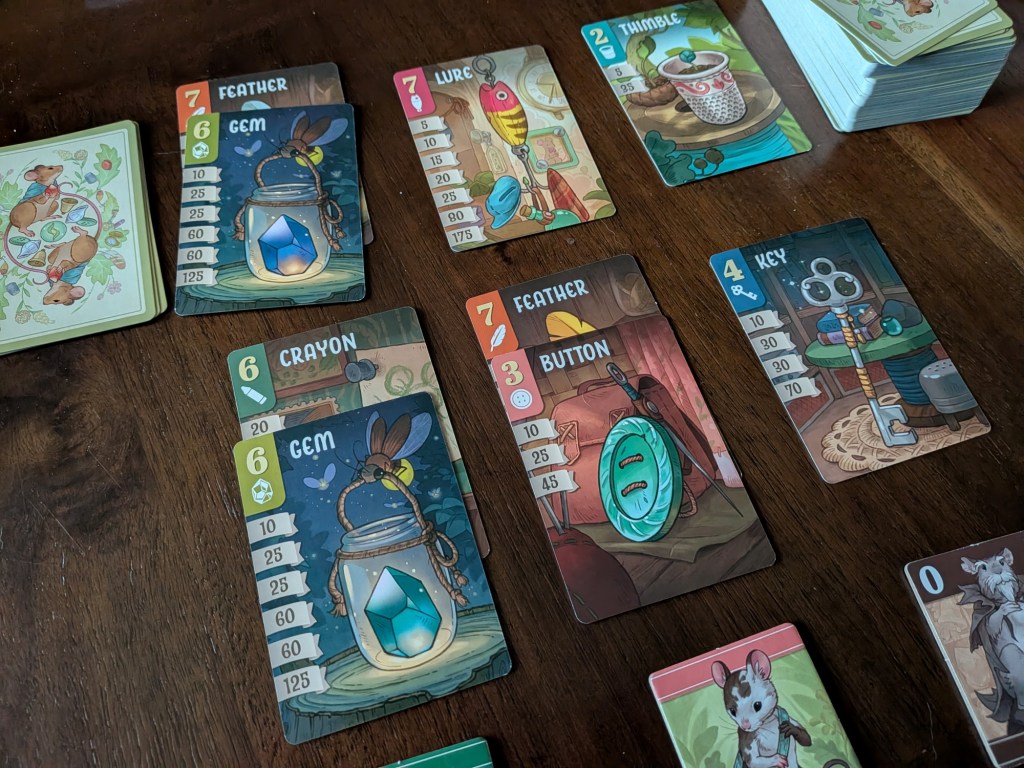
But here, in Trinket Trove, we have a couple mice coming to market. There’s no time for humiliation or economic ruin in the realm of wizened mice bartering for knickknacks. These mundane trinkets, in my mind purloined from some humans just off-screen, are traded amongst the mice. In this world, mice do not have money but (thankfully for our gameplay purposes) they’ve got a straightforward value placed on owning sets. As the cliche goes–and it turns out you can build a whole game out of this cliche–one man’s trash is another mouse’s complete set of lures worth oh my god how many points?
Each round a row of goodies is splayed out onto the table. Gears, crayons, hand mirrors, all manner of cute, tantalizing stuff to hoard. Players in turn order bid a set of trinkets from their hand onto the table, fighting for first dibs. After organizing our bids by most to least valuable, players take it in turns to grab two lots of their choosing. The catch is that by dumping a treasure trove at my feet, I’ve created a new lot that anyone other than me can take as one of their two winnings.
The result is a breezy but rewarding auction that bypasses the learning curve and taps into the easily-accessible desire to set collect. If I end up with a single button this round, I could toss it back into the pot next round, sweetening my bid without feeling like I’ve lost much of anything. Or maybe someone else puts yet another button into the mix, giving me pause and reason to consider a fresh button collection. The twin wolves of Greed and Caution loom over your dapper mouse.
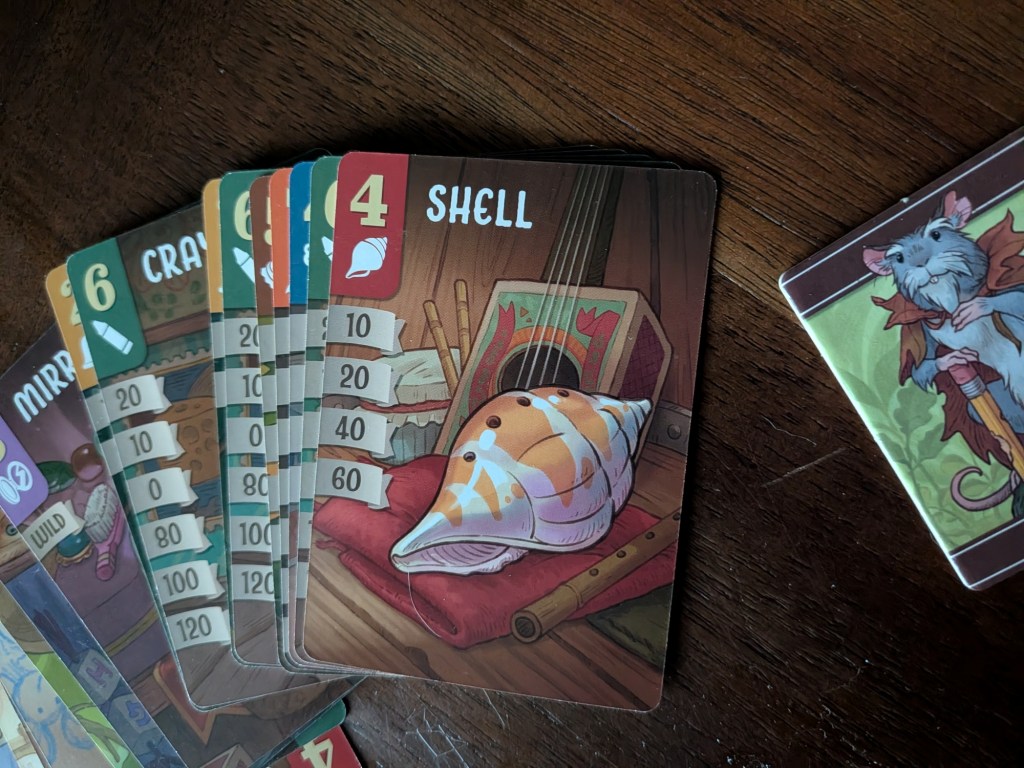
Do I really want to invest in bottlecaps, keeping another chunk of my hand out of bids? Can I get by with picking over others’ rejects? Do I want to go for big sets that only really score if fully complete, or do I just want a couple safe bets? Whenever I choose to divest of an item by throwing it to the market, the other players can make business-savvy deductions. I’ve deigned something an unworthy investment and, likely, someone will have an opposite evaluation.
I’ve described Trinket Trove with terms such as “investment,” but it has more set collection in its DNA than strict economy. The theme is bartering, but the game is collecting. The game it reminds me of the most is actually Sushi Go!.
Instead of outright tricking or outmaneuvering another player economically, good plays manifest as snaking into the gaps between what others want. In a drafting game like Sushi Go!, I see what other players are shooting for and try to find something I can collect uncontested. Trinket Trove obscures player intentions slightly more, but the information is all there.
If I’m feeling up to it I could track, more or less, what every person is likely collecting. With that information, I could make thoughtful decisions about what items to put into my lots. There’s some “I split/you choose”-type muscles working there, especially in the delightful and well-balanced two player variant. But I can choose how much effort to put in. Trinket Trove’s simple bid resolution means it’s hard to throw out a game-losing or even particularly bad bid. Players early in turn order can overbid, sure. However, they’ll likely spur other players to overbid, resulting in a game which balances itself rather than burying its players in their bad decisions.

In all, I have few criticisms of Trinket Trove. The scoring system and the collectibles are extremely functional but could have been more exciting. I love these trinkets for how they look– the card stock they are printed on, the gorgeous art by Sandara Tang, the variations in each piece, the warm and bright world they inhabit– but they’re all just worth some points. Some are riskier ways to get points than others, but the value of “any trinket whatsoever” is roughly equivalent. The sameness leads to no strategies feeling way worse, but few feel different. There’s drama to individual rounds, weighing whether to outbid an opponent or settle for scraps, but endgame scoring can be anticlimactic. Looking at your sleek collection of wares is less cool than counting up to one hundred seventy, as it turns out.
The occasional match does have a satisfying, memorable ending. Try getting a full set of fishing lures (an all-or-nothing set) and either falling short or getting the last lure on the last round. I wish more items lent themselves to a story of hubris like the lure or the pitfall-bearing crayon. Games where I had thimbles, bottlecaps, gears, and a couple gems blur together in my head. There are a lot of generic “pretty okay” trinkets where I remember the heartbreakingly-cute art more than how many points they gave. That’s a bit of a shame.
But I love getting to this table. Trinket Trove is the perfect little game if you, like me, love a market but dislike the endless shuffling around of money and regrets. Here, I have no regrets. Just uh, a not-very-good amount of points and stuff from a junk drawer that, frankly, I’m happy to have.

Leave a comment