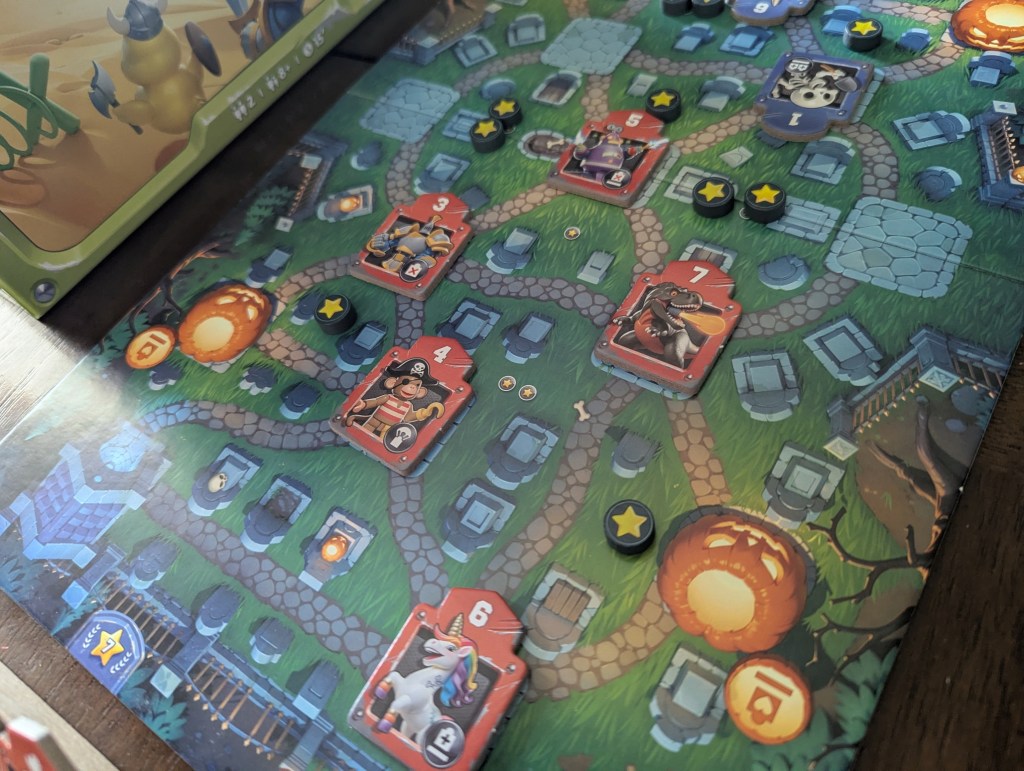

Paolo Mori and Alessandro Zucchini’s Toy Battle is nothing if not honest. Straightforward. This is an efficient war game staged between green molded soldiers, laser-armed robots, and the other denizens of a platonic ideal toy box. In other words: toys battling. The garish military metal contrasts the squeaky rubber duckies and matching inflatable tubes. The rainbow-flavored unicorn labeled “6” is defeated, as one might expect, by the plastic flame-shooting dino labeled “7.” There are territories to be annexed, little point tokens included, and an enemy headquarters practically begging to be captured. The whole thing would be neat and easy if it weren’t for the person sitting across from you twisting this neat battlefield (and by extension you) into a taut, impossible pretzel.
Getting into these pretzels is quick and, if you’re me, shockingly easy. After choosing one of the eight battlefields, player shuffle up their troop tiles, discard a few facedown, draw a few others onto their wooden rack, and begin their campaigns. On a players turn, they choose between the two available actions. The first action is to place one of their troops out onto a base, triggering that troop’s special ability. Deployed units must form a contiguous line back to the headquarters and cannot be placed on enemy troops with higher value. This means a player’s position must develop over time, snaking across the suddenly very-small and claustrophobic battlefield.
The other action is to draw troops onto the bench, refueling and hopefully gaining more options for later turns. A player wins when they either capture enough territories or the opponent’s headquarters.
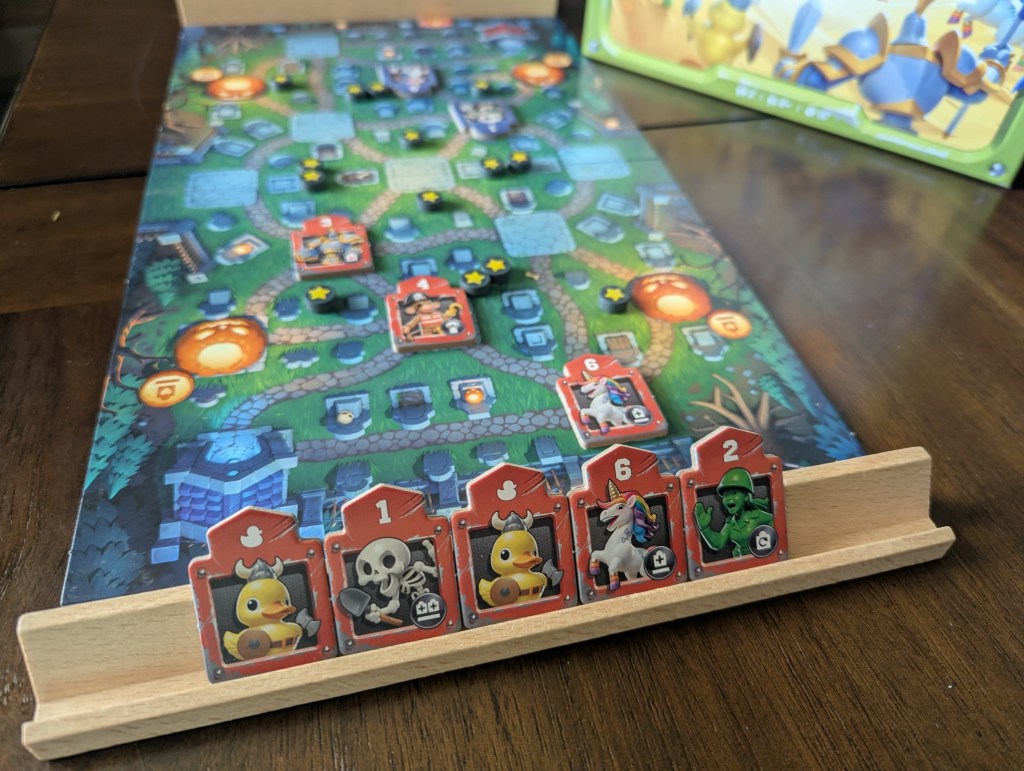
In Toy Battle, players are scrapping for tempo and the answer to “who is winning?” ping-pongs each turn. Each placed troop is a new threat; it expands the supply line, threatens to wrap around a territory, reaches like tendrils towards the opponent’s headquarters. Placing a troop, any troop, bats the ball ever-so-menacingly over onto the opponent’s court. Taking the “draw some troops” action is necessary–both players will take it at least a couple times every match–but it almost always feels like conceding a point.
Because of this tightness, the units that excite me to play are the ones that either draw me more dudes or remove an opponent’s dude. I care about the relative strength of each unit in maintaining territory, but only to a point. Primarily, I just want more dudes.
The lowest ranked unit, the skeleton, is easy to beat over but draws two troops. I’m more than happy to play him. The zapping robot 5 not only stands menacingly over half the cast of characters, it forces the opponent to discard a unit. If I place a 5 over an enemy-occupied choke point, I’ve effectively got two of their pieces for my one. Satisfying.
Mix in the unique battlefields, the two win conditions, a fresh draw of units and it’s easy to see how this game has gotten its Lego monkey hook into so many critics. The beginner battlefield, the Castle Field, allows players to recall units back onto their bench. Since every face-up troop is actively contributing to maintaining one’s position, the choice to pick something up is so, so difficult. The introductory field has me rethinking all those thoughts about tempo and what I’m willing to give up. As straightforward as Toy Battle is, there’s promise that skill and knowledge will be rewarded.
Nearly every game comes chockful of these skill testing moments, tempered by the luck of the draw. I place my opponent in checkmate, forcing them into a situation where they have to draw and I get to take two territories with one placement. I pour over a board-state where my opponent has my base all but captured and I try to find a sneaky way out somewhere else down their supply line. I play a skeleton and draw into the exact units I was looking for. A smart play can find my opponent flatfooted and force them into drawing units to find an answer. Maybe I’m the one on the backfoot so I buy myself a chance to exhale by airdropping a monkey straight onto their load-bearing skeleton’s head.
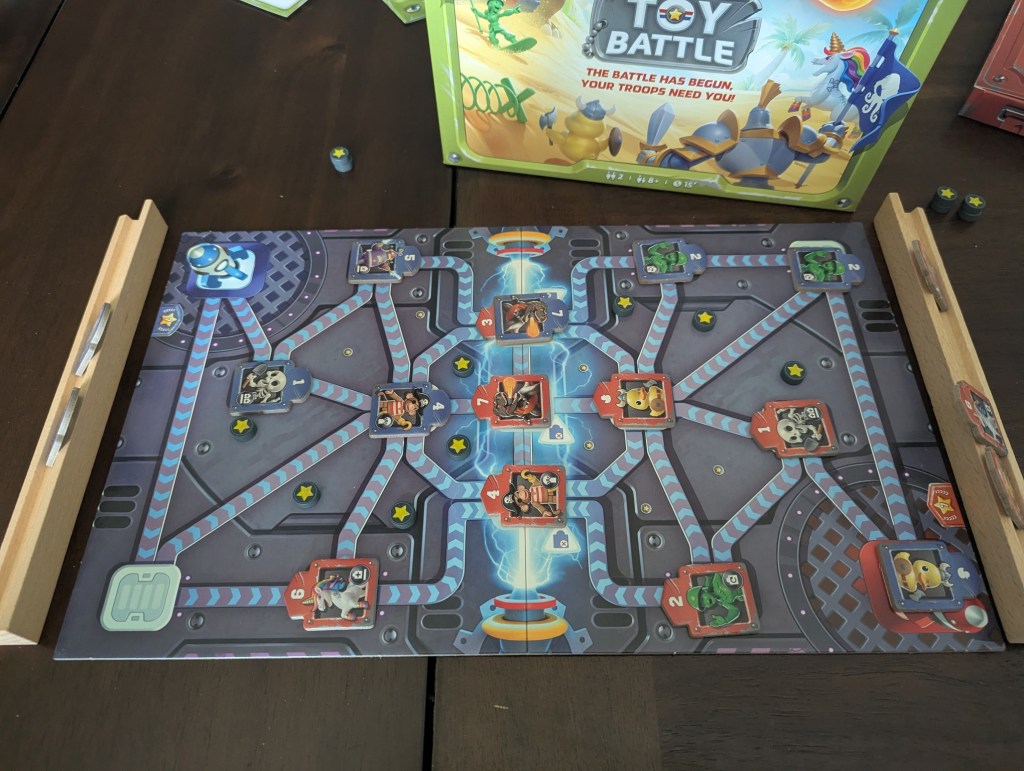
This isn’t to say Toy Battle is subtle or its battles are hard to grasp. The clear board state and the turn-by-turn action almost reads like an abstract game. Comparing it to abstracts, it’s a far stretch from Go and is a closer relative to, say, Santorini or Cairn. Traps are set and sprang in two turn windows. A good position crumbles because of an unfortunate draw. A lucky set of 2s, the unit which lets you immediately place another unit, can force a victory out of seemingly nowhere or end the game before it begins. Even the occasional war of attrition is over in ten or fifteen minutes. In a tie, the whittling down was probably closer to an awkward, impotent knife-fight than a cautious negotiation.
I don’t want to get into those wet noodle fights, but it’s sometimes inevitable. A draw heavy with parachuting monkeys and ducks feels like a package of troops that, at best, treads water. It can feel like I’m making the same tradeoffs, hoping for the same units, only wanting to play on the same few maps.
I love games about battling for tempo and forcing my opponent into unwinnable trades, but there are many great games I love about the same tension. Toy Battle’s advantage is that it gets to this tension with masterful efficiency. I don’t know if there’s an easier one to teach or play. However, I find myself missing that extra flourish from time to time.
Despite being a game about children’s play things, the battlefields and the toys themselves feel plastic and devoid of character. Without looking at the components, there’s two I can summon up as vividly imaginative: the battle-axe wielding rubber duck and the map bisected by two doohickeys shooting a laser. The toys and their toyishness do not push against the edges of a mechanical, harsh war; they wholly assimilate into it. The toys are not whimsical or very toylike. I can make out the edges of a funny irony there, but it’s a hollow one. The theme of “generic toys go to war” is, unfortunately, heavy on the “generic.”
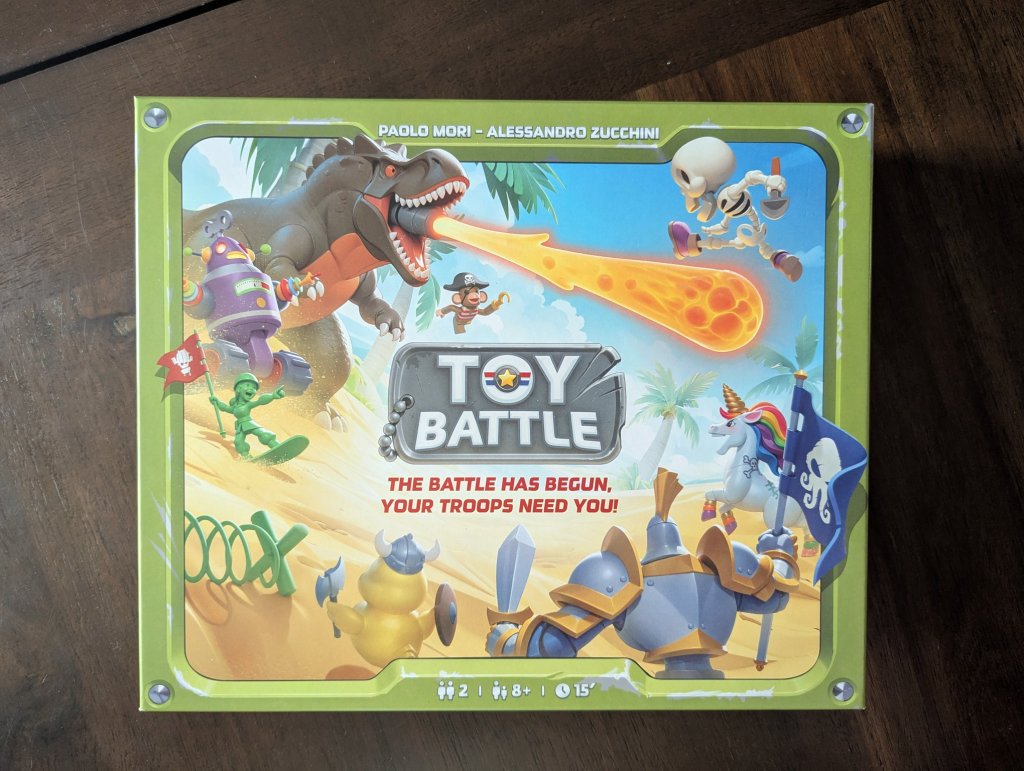
The gameplay ultimately does the heavy lifting of lugging this toy box across the finish line. Toy Battle is a tight, mini conflict simulation which delivers its core promise and got me hooked for a couple dozen plays. A few dud games aside, the average match is tense, quick, and swingy. There is plenty of joy to be mined from mastering its accessible systems, trying out its variable maps, and finding clever plays.

Leave a Reply