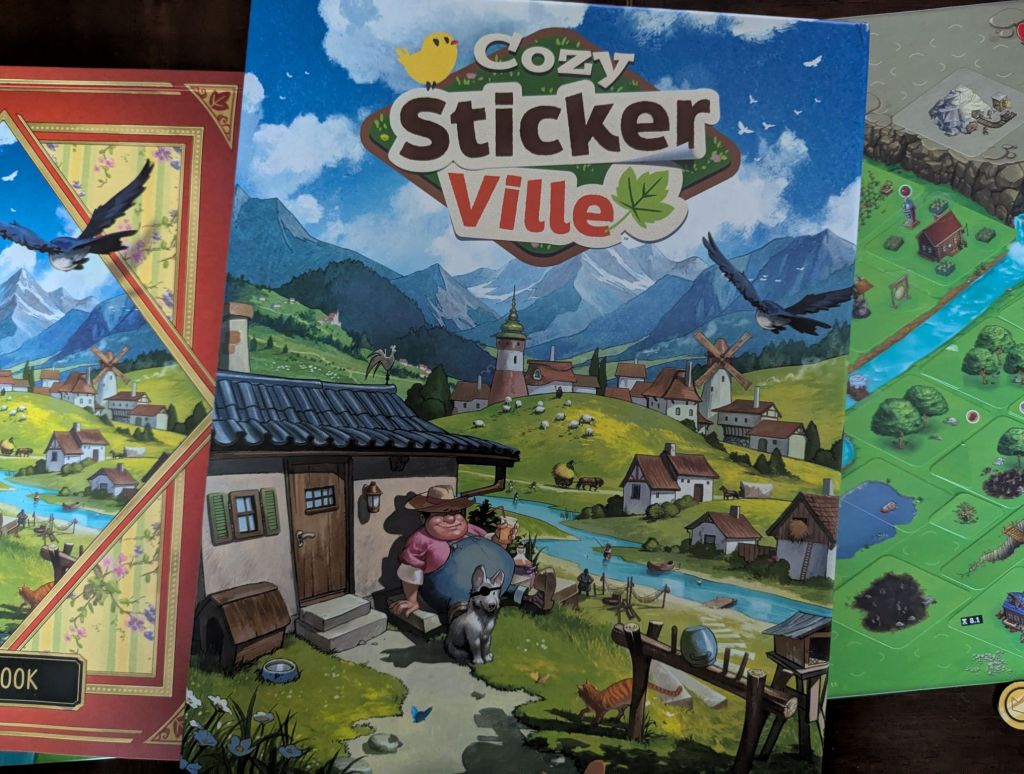

This review contains spoilers for several bits of Cozy Stickerville.
Cozy Stickerville’s story begins with a letter. Your dad is disappointed in you but he’s giving you one last chance to prove yourself not a failure. Here’s a deed and vague direction to do something on this empty tract of land. I get the sense he doesn’t care what you do, just that you do something and do it away from him. Make a barn or a friend, I dunno. Maybe he tried other, less enterprising ways of connecting with you and they didn’t work. Fair enough. He’s like if the deed-gifting grandpa from Stardew Valley was struggling to understand and keep in touch with his children. I don’t like him as much as that grandpa, but he’s trying, right?
My partner and I’s concerns in the budding years (sessions) of Cozy Stickerville were not with pleasing our fictional father. We basically forgot he existed. When the game gave us decisions to make, we weren’t going to be considering what was most prudent or what would make our dad proud. We were here to be cozy and place stickers. We wanted to make a stickerville we thought was cool. To that end, the game began delivering before we’d even taken the first turn. After placing eight initial stickers–a little house, a well, trees, an undeveloped weedy plot–we were off.
Cozy Stickerville reveals itself to players slowly. The rulebook gives away almost nothing, as if players should go in knowing as little about what could happen as possible. Corey Konieczka’s design sure looks small (despite its 800 stickers), but it could be anything. There’s mini-games, storylines, and very goofy, cute stickers to place and eventually you do get to place them. But it doesn’t start there. It starts slow. Our initial stickers, our first couple events, our first few actions spent grabbing a token or two–it isn’t a lot to write home about. You pick up sticks and think maybe your dad was right; this is pretty tough and we barely have anything to show for it. But there’s potential, right? Year one is workmanlike, but its chores establish the beats of a Cozy Stickerville year.
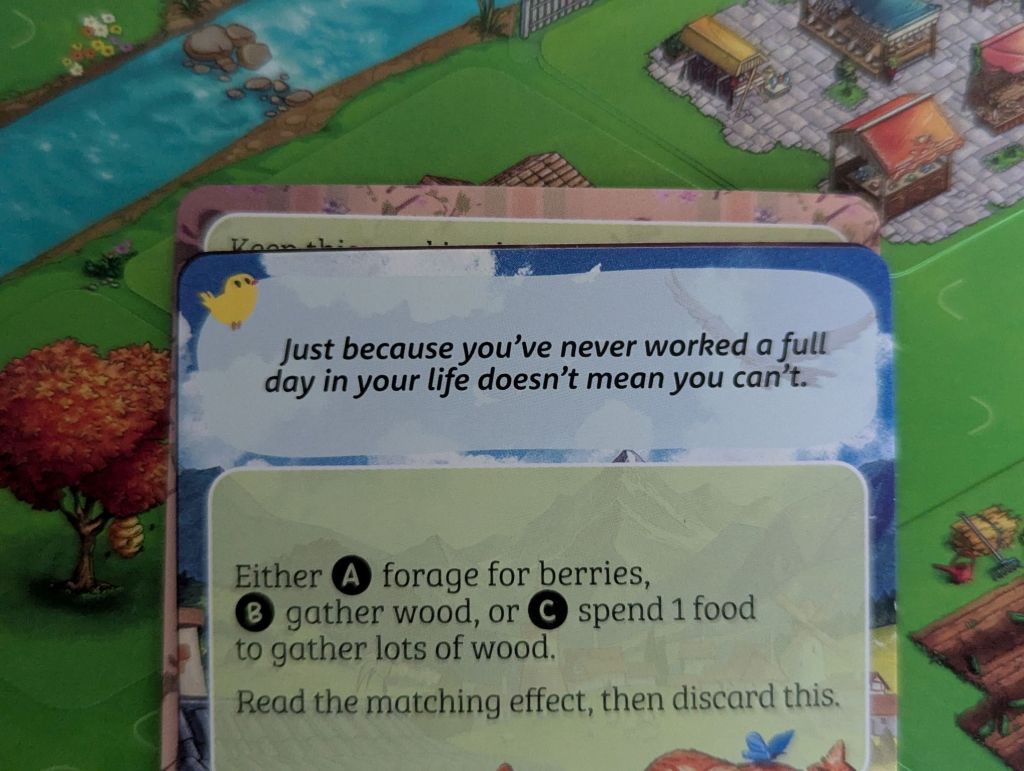
Each year is twelve turns. On a turn, one player takes an event card from the current year’s deck, reads it aloud (resolving it immediately or adding it to the existing card tableau), and then takes an action. Actions involve interacting with previously revealed cards or visiting a sticker on your ‘ville that has an associated storybook entry. Place building stickers, talk to residents, make decisions about the future of your town, all in this little structure that never gets confusing or overbearing.
After one action, it’s the next player’s turn. They’ll reveal another event and pick an activity from the steadily growing collection of stuff to do. Early on, players are given a list of long term goals, but how to achieve those is up in the air. This ambiguity gives players tacit permission to poke and prod around the world at their fancy. The most obvious objective is getting happiness stickers (probably because it resembles a victory point track) but how to get those isn’t signposted either. You’ll have to dawdle around and place stickers until the opportunities for happiness arise. Between the actions on the board and the tableau, there’s always something to do and the freedom to do it. Occasionally, an event card gives a deadline to be resolved by the end of the year, but these seem, at worst, like resource sinks meant to counteract hoarding.
There’s no losing in Cozy Stickerville. Or winning. You can choose to pursue or not to pursue a thread, and just as quickly abandon or complete it. Maybe I’ll spend my next four turns– every turn I have for a year in a three player game– talking to the new resident I’m interested in and resolving her storyline. Maybe I’ll spend all my time fishing, a push-your-luck mini-game to gather resources and work towards the master angler sticker I’m eyeing. Does the game care if I waste precious months getting that medal? Not really. In true sticker fashion, my reward for being a good fisherman is a couple stars. Time ticks onward, my twelve-turn year gone in about forty minutes.
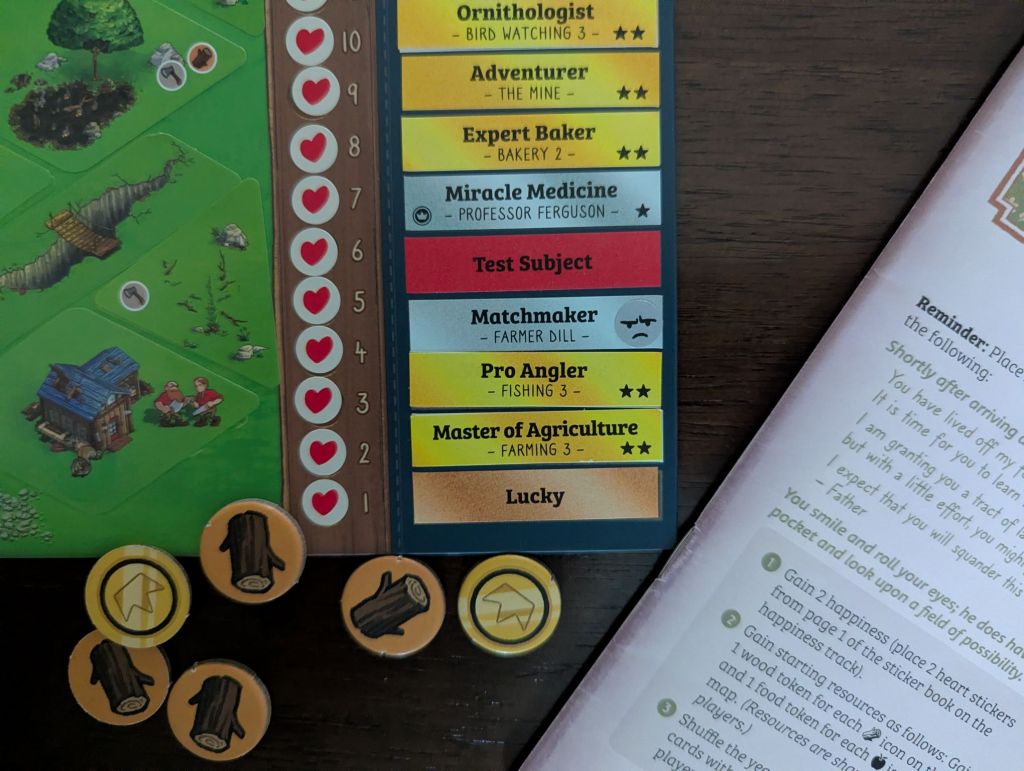
Fishing, it turns out, is one of the more involved ways to gather resources. Managing and acquiring resources is merely a stepping stone towards the next decision and the next sticker. The narrative choices aren’t much different from the resource ones in this way; pick A or B or C to figure what sort of stuff will be in your town.
Do I want a wolf pup in the village or do I not? It could be dangerous but maybe it’ll pay off having some protection. Either way, it’s cute; I want it. Now’s not the time for responsibility or roleplaying. Most of what I’m deciding reads as customization choices rather than consequential narrative ones. I’m picking what stickers I want, plain as. Conversations with neighbors buck this trend, painting interesting characters and quick-hit short Choose Your Own Adventure vignettes, but even those can feel like little tests to pass for resources or happiness. The event cards, for their part, were the far less interesting reads. Events chide the protagonist for their city-softness (bleh) or blandly praise the value of a good morning’s breakfast. Regardless, the writing in conversations was usually charming and funny; definitely worth engaging with.
Sometimes what I’m picking now will come back and have consequences. Take a shady loan, I’ll owe money later. If I spot someone cash, I will almost assuredly be paid back by karma if not the resident themselves. The story beats and tradeoffs are predictable but I don’t mind the obviousness of it. This predictability gives the players a fair sense of control and safety; it’s maybe the “cozy” aspect of the game I love the most. I’m not going to be utterly betrayed and rugpulled by a game called Cozy Stickerville, so I can trust the characters and spend my time without worry.
Viewing the game through this lens of free customization and sincere player empowerment, it is odd that there were a few instances of stickers added to the board against our will. It’s like the game feels the need to offer a token bit of resistance to keep pockets light and our wheels spinning in place. Do what you want but the world will impose its will–just a little bit. It doesn’t push back so much as it wobbles to the touch, maybe bumping back into you on accident. There’s a giant crack in the earth now. That tree burned down. There’s a guy here who we didn’t invite. I built a slightly less fun building because we decided to save our resources. My town is still 80% buildings and people I wanted and the fun is in placing them, but I also have to find room for those oddities. There’s a kind of friction.
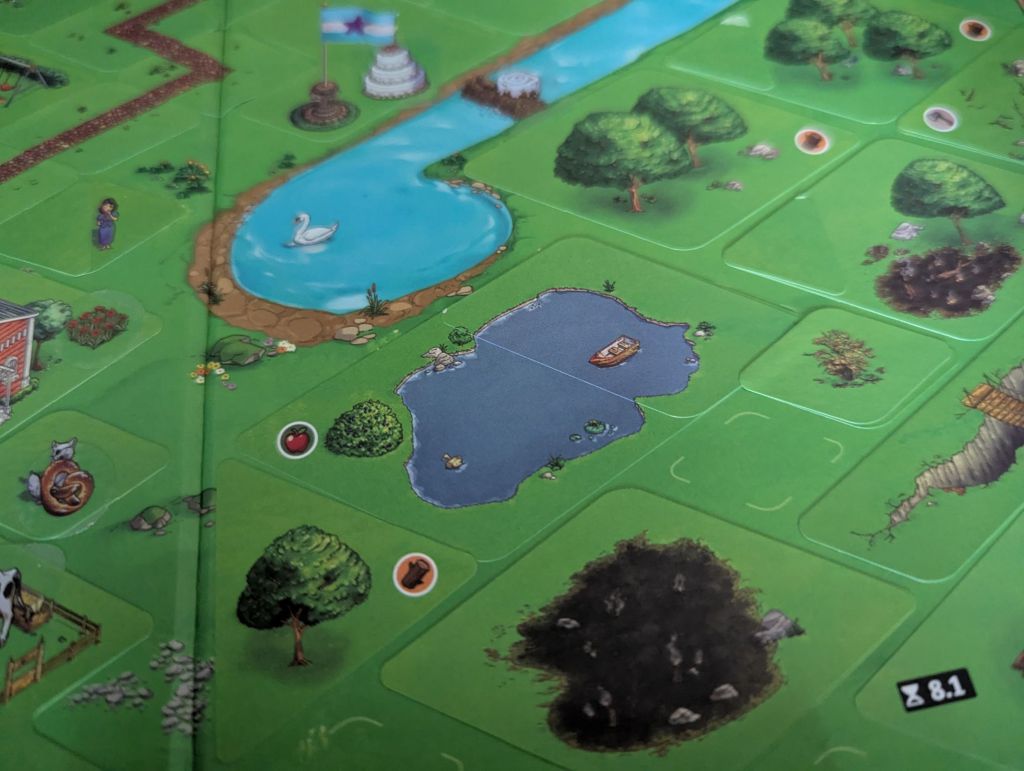
Is it enough to keep me engaged? To feel like there’s opportunity to fully express oneself within the system? Eh. Sort of. I enjoyed the transparent stickers, opportunities to overlay new elements on existing ones, recontextualizing part of town and making something resembling an artistic choice. I also enjoyed the story entries which would make me laugh by how over-the-top wholesome they were or make me smile at how silly it allowed itself to be. There’s joy in the loop of Cozy Stickerville: realizing there’s a cool new building to construct, finding the best place for the sticker, and gaining access to a new storyline.
I’ve seen many people play through Cozy Stickerville with kids, and I get it. Showing this to your kid, everything I just described probably adds up to way more than enough. My partner beamed at the opportunity to play it again with her younger brother–he’ll love it. But after ten sessions, a handful of hours, it hadn’t built into much of anything for me. It was a legacy box where new, interesting things would spring forth only occasionally, and only between turns of reading your dad didn’t warn you about how many sticks you’d be picking up followed by taking an action to grab One Food. I enjoyed placing the stickers, but I wanted just a little more surprise or pizzazz in the event cards.
I won’t spoil the ending but I expected it would react more specifically to what we did. I imagined the in-text version of a movie ending montage. Here’s what our neighbors went on to do with what we gave them; good job for helping that person or neglecting that one. Instead, every choice we made would get, on average, exactly one callback. Here’s a coin or a happiness in year seven for being a good guy in year five. I wanted a little more from my sandbox. Is that asking for Cozy Stickerville to be a different kind of game? Is it weird to want the game to react a bit more when poked? I don’t necessarily want added negative consequences, just more positive ones.
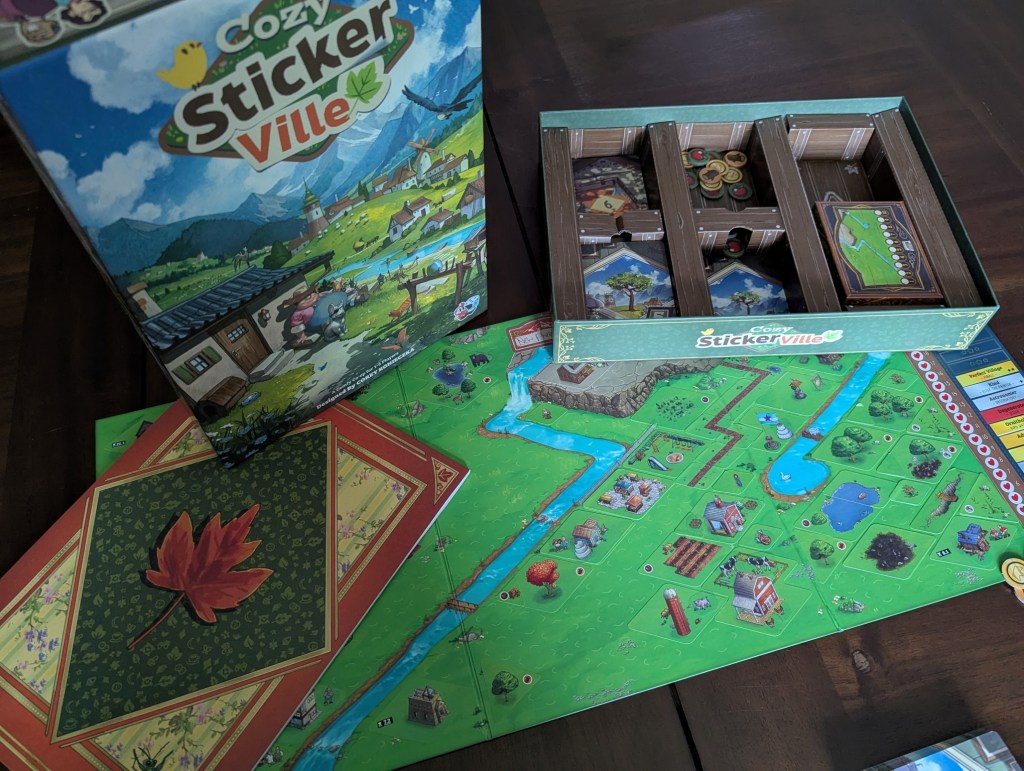
In the end, we are left with a board that is uniquely ours. It’s fun to look at. It is a record of all the storylines and promises we fulfilled and abandoned, little visual gags set up with transparent stickers, an unfinished road to nowhere. We did really well despite my slacking off, pulling in fish and chatting up painters. In cozy nothing-goes-wrong-ville, there’s room for improvement and an assurance that it’s okay when things do go wrong. The curmudgeon in me wonders if it’ll ever again see the light of day, but it’s neat. My partner adored nearly every second of it. I had a, dare I say, cozy time playing through it.

Leave a comment