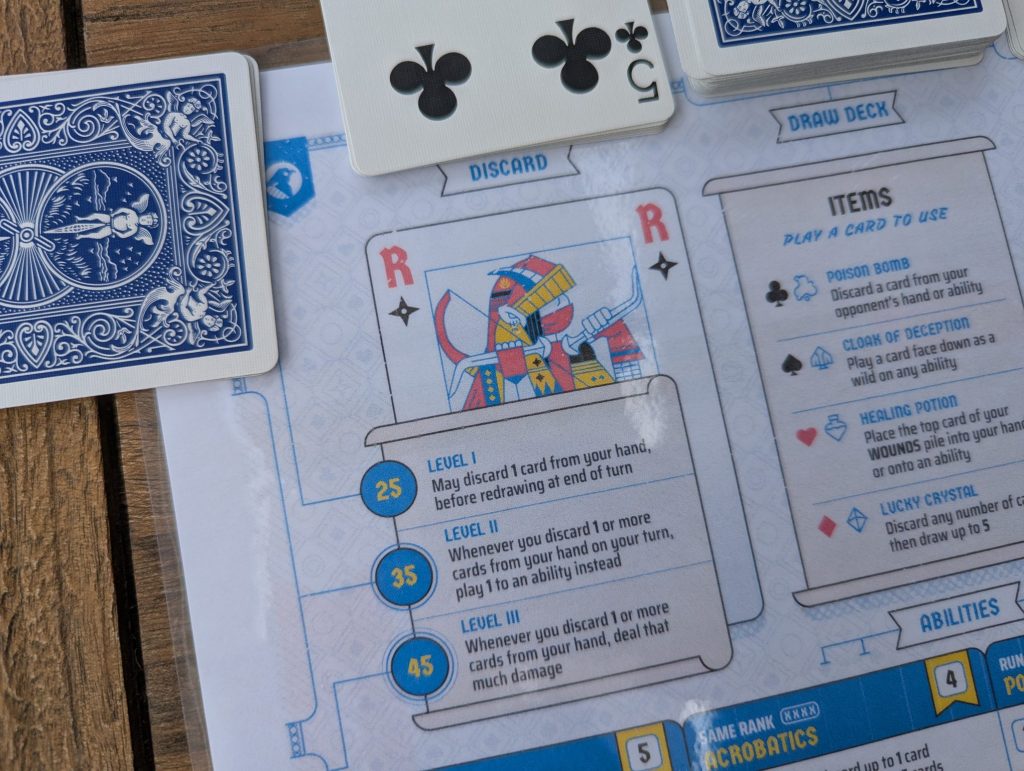

Balatro has inspired a lot of games in the nascent “gambling lookalike where you try to score a bajllion points” genre. In the world of video games, it’s become a bit of a thing to make or talk about. I’d like to propose we should be praising another key factor to Balatro’s success: the fifty-two card deck.
Have you heard of this thing? It’s got cool cards in it and everyone already knows what it’s called when you play five of them in the same suit. Heck, they know the whole deck list before they’ve sat down. Even non-gamers associate queens and hearts and aces with being clever and doing fun things. Playing a straight or a set of four aces– that’s cooler to me than any mind shattering number of points. I can think of lots of things we could be doing with poker hands rather than making numbers go up. We could be (just off the top of my head) druids shapeshifting or rogues stabbing each other.
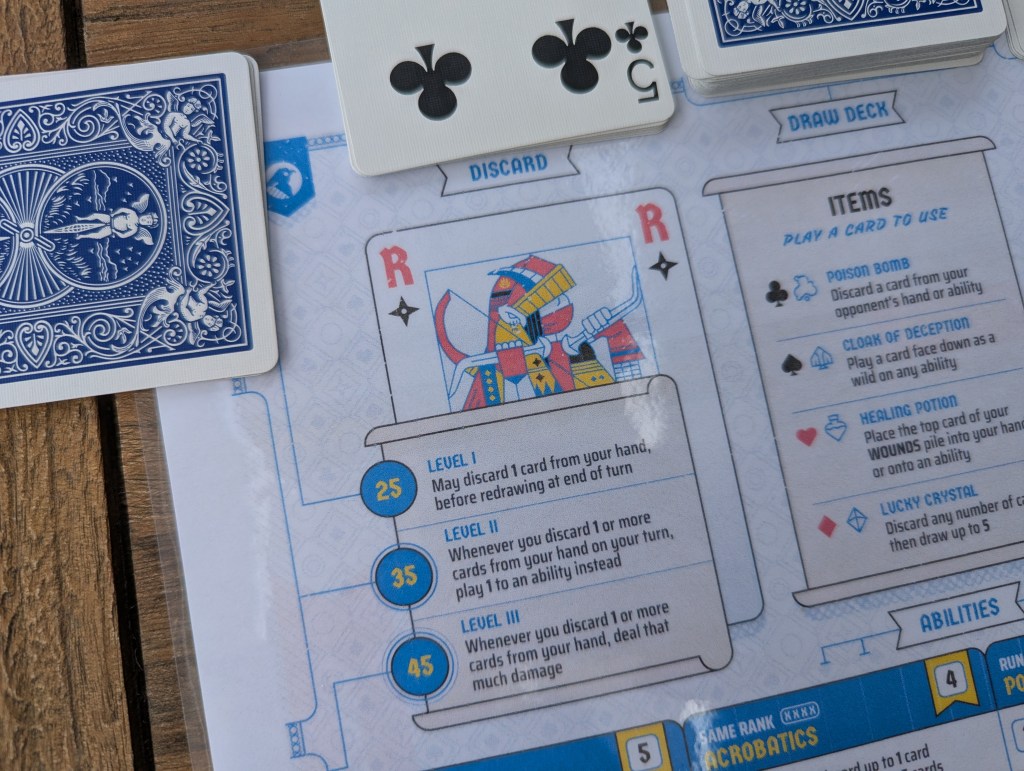
Oh, nice.
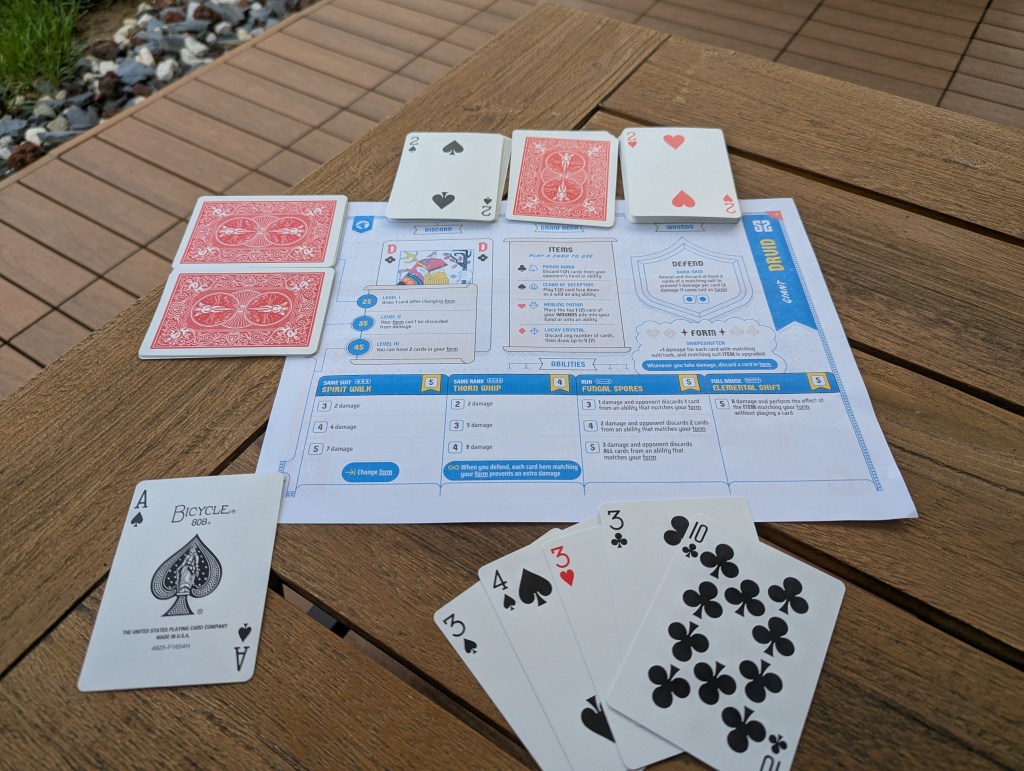
52 Duels takes the standard card deck and does what Dice Throne did to Yahtzee. Players select their character sheet from a small roster, shuffle up a standard deck of cards, and activate their suite of unique abilities by playing permutations of straights, flushes, and full houses to demolish their opponent’s deck. In twenty minutes of play time, I advance an interesting gameplan and my opponent does the same.
The variety of stuff to do evokes playing a TCG with hundreds of unique game pieces. It’s sort of incredible given the actual scope of this game: a deck you already have in your home and about four sheets of paper. Matthew Dunstan’s design and Rory Muldoon’s art and iconography provide each character their own identity while keeping them speaking the same game-mechanical language.
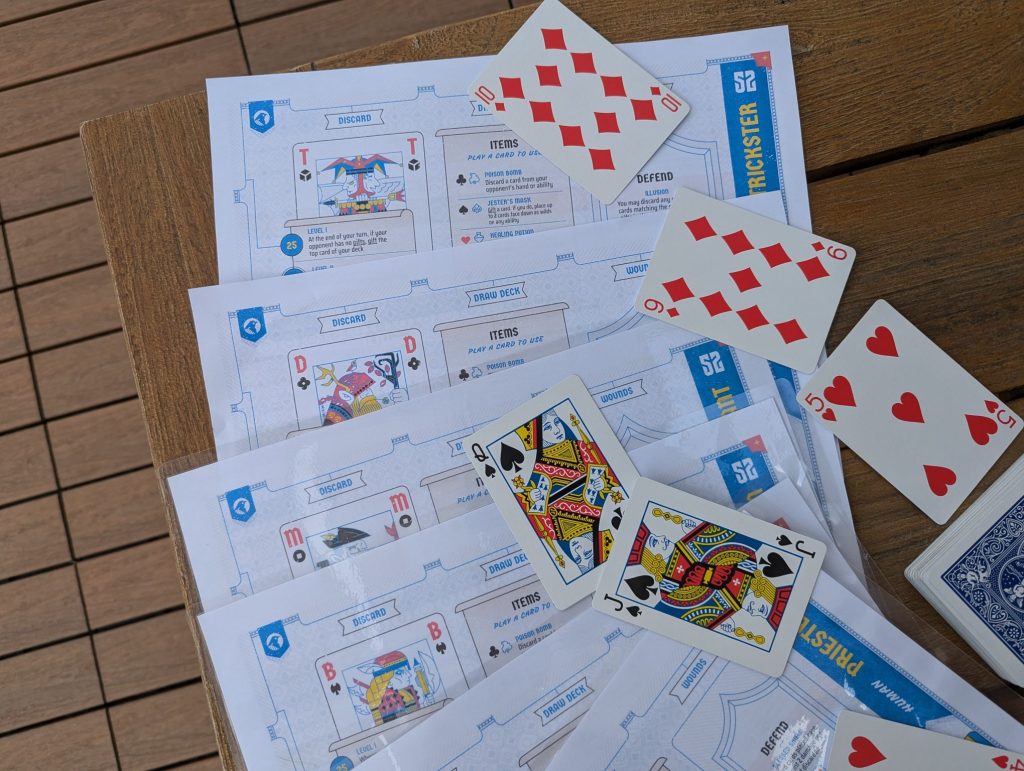
For one, each character broadly wants most of the same stuff to come out of their 52-card deck. Players draw five cards per turn, and these cards have many homes across the player board. They want high value cards to stash away for the level-up mechanic (more on that later), same-suited cards for one of their abilities, same-ranked cards for another, and a full house with which to dunk their opponent. Some characters care more about hearts or black cards, but these are complementary desires rather than full-on replacements. In other words: both players want good poker hands.
To make these hands, players will often seed two or three cards into one of their character sheet slots, heralding an ability’s eventual activation. I love this detail. I don’t need to draw into that aforementioned full house, I can build it over time. It is rare for someone to suddenly blast out a five-card ability straight from hand. Obviously, it could happen. More likely, though, the plan has to graduate from hand to sheet and come out in pieces. They’ll have to forego activating a lesser ability this turn to invest (gamble) in a stronger ability later, and so there’s time to react and plan accordingly.
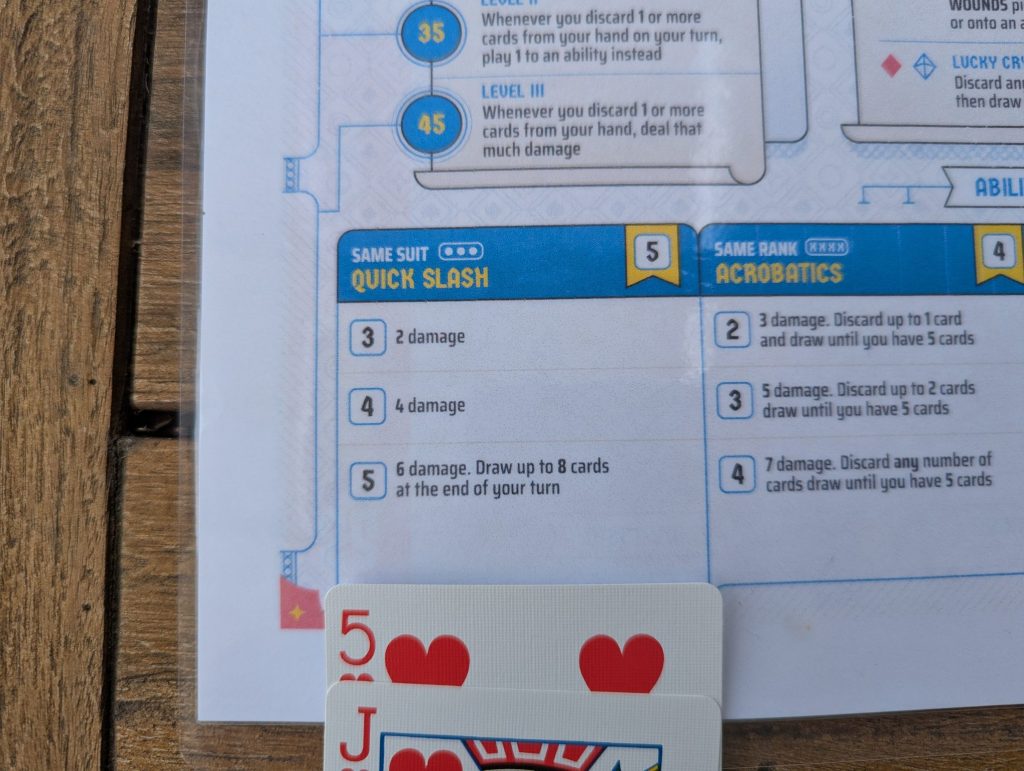
All characters also have access to a set of Items which give each suite its own secondary use. Spades can be discarded to play another card facedown as a wild. Hearts can heal the top card of the otherwise inaccessible Wound pile back onto an ability. Clubs can disrupt an opponent’s partially-charged ability and diamonds can be used to redraw your hand.
With only two actions per turn, none of these items are ever the most obvious or efficient way to spend your limited resources. The generic options shouldn’t be the best options. If the universal actions every character had access to were the most powerful, characters would play too similarly. But if my hand is particularly useless (as sometimes happens in anything where sets and straights are involved) or I need something that’s buried in the deck, I don’t mind playing an Item to inefficiently paper over my bad luck. And because both players have the same access to these items, it is easy to comprehend what tools your opponent has at their disposal to make their own luck.
The other way players will be using cards outside of abilities is by permanently spending them (their rank is their value) towards leveling up their character. When I use an item, I reluctantly toss away a four of spades so that I can do something aggressive this turn. On the other side of the spectrum, leveling up is drawing K-Q-10 and deciding I want to Be A Pacifist this turn to acquiring a game-warping ability for the rest of the game. The Berserker doubles all damage dealt permanently. The Priestess heals themselves every turn. All characters can level up three times, with each level up further defining what it is the character does and how they’ll do it. Any reluctance I have about locking some cards away is (mostly) dispelled when I read the neat effects I’ll gain from doing it.
Does it feel a little counterintuitive to throw all my high cards into the You’re Never Getting These Back card slot? Yeah, kinda. But it also means, especially early game, that high cards intuitively feel like high cards (except aces. They’re always low here. womp womp). Before I’ve developed a gameplan or decided to commit to fishing for either side of an open-ended straight, I want high cards. That’s how it should be. That’s Card Games ™.
I do have my nitpicks with 52 Duels, especially in niche interactions and what information gets left off character sheets. Too often, I find myself referencing the rules sheets or trying to best adjudicate how the timing between two effects resolve. It is not on the same level as say, Magic: The Gathering, or even the aforementioned Dice Throne, but it happens. The player sheets are clean and free from large blocks of text, but once per game I need to run to the FAQ or the newest errata to clear something up. When a character has their own keyword (the Priestess’s heal being different from the Healing Potion’s heal, for instance), I really wish that keyword’s explanation was somewhere on the character itself.
I also wish I liked the solo mode more. The solo opponents are easy enough to pilot. They play out their whole hand according to suit and eventually do actions reminiscent of what the player-character version of the nemesis does. But when my robot opponent draws four-fifths of a flush off the top of their deck or fully levels up in the first few turns, it can be crushing. When my human opponent gets lucky, I tend to be happy for them. That’s Card Games ™. But when I draw decent and the solo AI draws the nuts? I’m enjoying the randomness a lot less. Maybe I’m just wanting all hands of solitaire to be winnable when they’re not. Of course, I could just be bad at the game.
In a duel against another human, I’m easily more bought in. There’s the subtle mind games of blocking, the shared experience of groaning over bad draws, the fun of collectively learning the match-up. I begin to care about nuances like holding off damage against my opponent’s Priestess to limit their wound pile or predicting when my Rogue opponent will use black-suited cards to attack instead of defend.
When I deal ten damage to the robot, I feel nothing. But when I deal ten damage to my human opponent, I relish in sending each individual card to the shadow realm. Best of all, I don’t even have to ask to read fifteen lines of text on the card I just banished into oblivion. I have every card in my deck list and theirs memorized! That’s the king of hearts–my buddy, we go way back, good card— and he’s in the wound pile now.

Leave a Reply