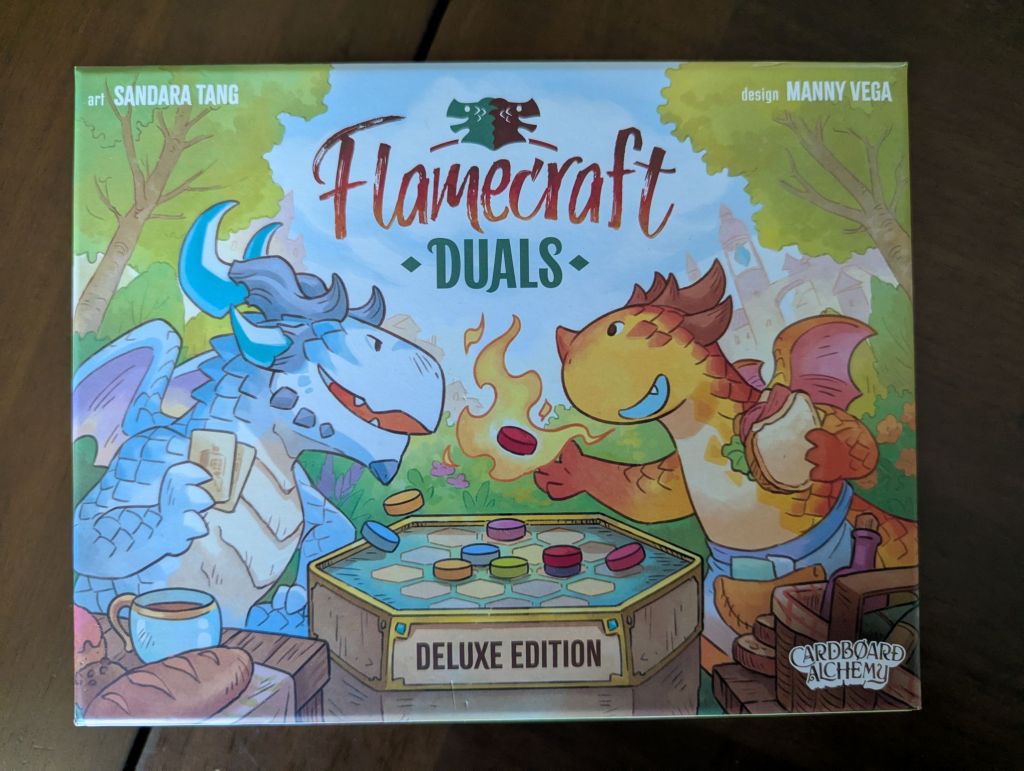

The original Flamecraft is a euro game where the economic engine, the lifeblood of the game, rejects ownership. Players place workers but have no further possession of them afterward. The dragons staff shops, belonging to no one and doling out goodies to everyone. The resources players accumulate are immediately and completely dumped back into the shared pool, making the mutual engine bigger yet more efficient. We own none of the city or its capital, but we score points for making it better for everyone.
On first impression, Flamecraft Duals has little in common with its bigger and more-peopled sibling. I went in with some expectations. It is an abstract game taking place on a tiny grid. Grids such as these, and the games played on them, are defined by zero-sum exchanges, cutting off opponents, claiming territory. These round discs, as cute as they are, were going to constrict my opponent and entrench my position. Imagine a battle played out in miniature; something more dragon-like for these usually polite dragons to be doing. The grid would exist to be carved up– my side and your side, I figure, when it’s all said and done. There’s pieces and cruelty and domination to be meted out.
I went in with these assumptions, I think, because we have all played our fair share of cutesy abstracts that secretly belied a sharp experience. boop., Azul, Calico; all of these trade in the hotly-contested genre of “cozy” despite actually being mean or difficult or both.
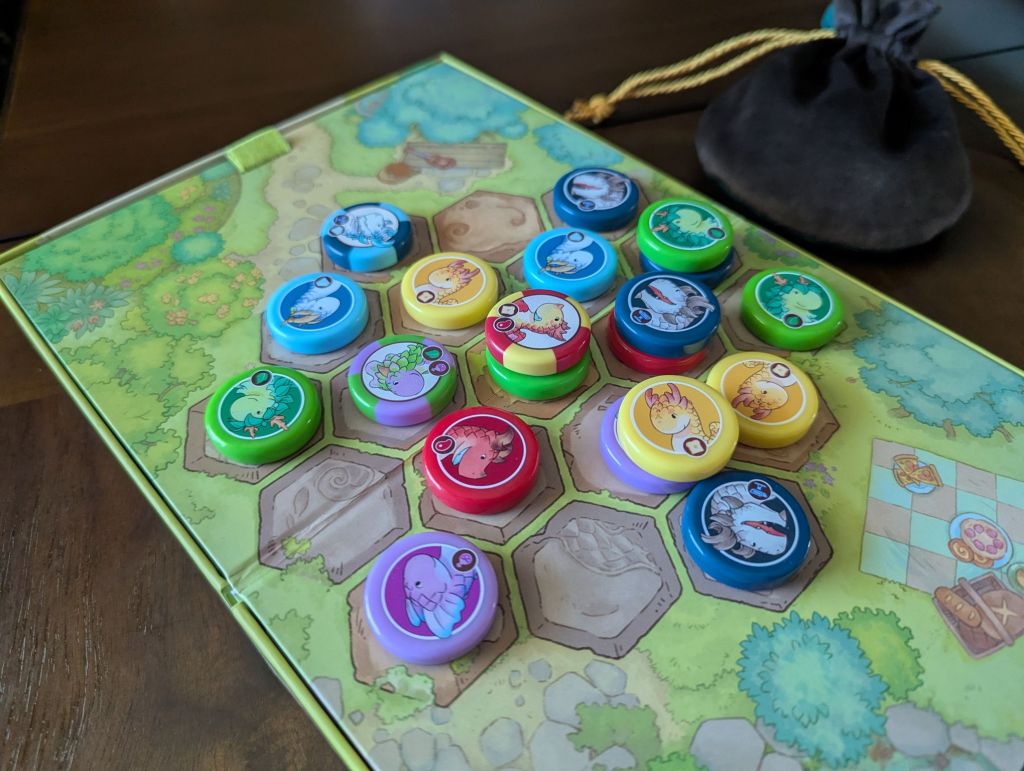
Flamecraft Duals might be the first cozy abstract I’ve played that isn’t doing a fake out. It has all the same friendly dragons and beautiful Sandara Tang artwork from the original Flamecraft. But it also flips a type of game predicated on domination, control, and ownership on its head. Flamecraft Duals’ board, far from a Go board ready to be carved into districts, is a shared playground. It is not to be divided, only built up with mutual opportunity.
Each turn begins with pulling a disc from the bag. A disc represents a dragon possessing the power to manipulate the board by adding some more discs or by moving discs around. Purple potion dragons swap any two dragons while the metal dragon lets you move any two adjacent stones one space each. Dragons can be stacked and accordingly unstacked. There are some two-colored dragons who perform dual functions. Each player has two shop cards, which are patterns they want to surface amidst the stacks of dragons. Whenever a shop card is scored, another is drawn.
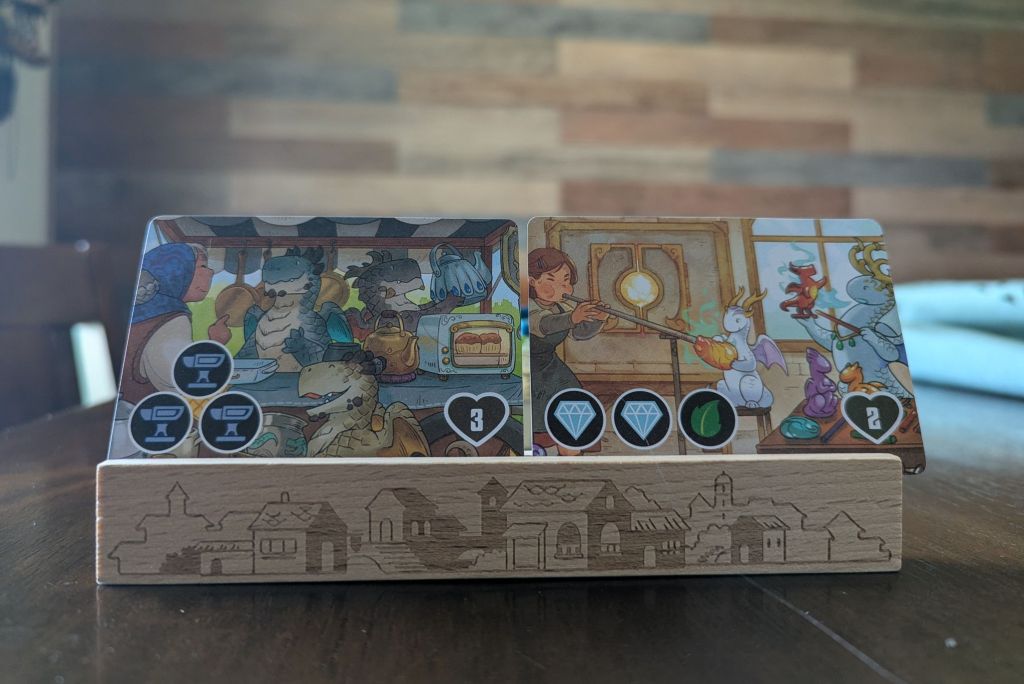
Initially, the grid is barren and full of holes. One dragon of each color seeds the board, but each shop requires, at minimum, two of a kind adjacent. For the first couple turns, scoring shops requires ingenuity and some luck, but quickly (and I do mean quickly), scoring a shop every single turn becomes expected. Dragons pile up and shift around but never in a way that’s intentionally disruptive to one player or another. Individual dragons shake up the board, but they are also always additive. Opportunities for creative shop-scoring only grow turn by turn, and so do players’ ambitions. Halfway through Flamecraft Duals, nobody is settling for “just” one pattern without at least peeking around for something extra.
I love that this feels, in a meaningful way, much like the growing set of shops at the heart of Flamecraft. It’s a huge credit to the design work of Manny Vega. Opportunities start sparse but, as each player individually chases their little objectives, blossom into more and more explosive turns. While Flamecraft was more concrete about this– literally expanding shops giving out increasing more free stuff and triggering more actions– Duals is equally giving but subtler.
A well-deployed metal dragon can carefully unspool a stack of dragons such that two shops are scored, and the five or six minutes spent finding that exact play is frequently rewarded. And, unlike so many other cute abstracts, no opportunity is robbed from an opponent. No checkmates, no intentional blocking, no stealing someone else’s perfect tiles. I am lining up dragons, so are you. If we both, coincidentally, need to line up some leaf dragons, more power to both of us. If one player leaves behind a couplet of red dragons now, it will only be a turn or two before their opponent inevitably needs those same dragons for their own pattern.
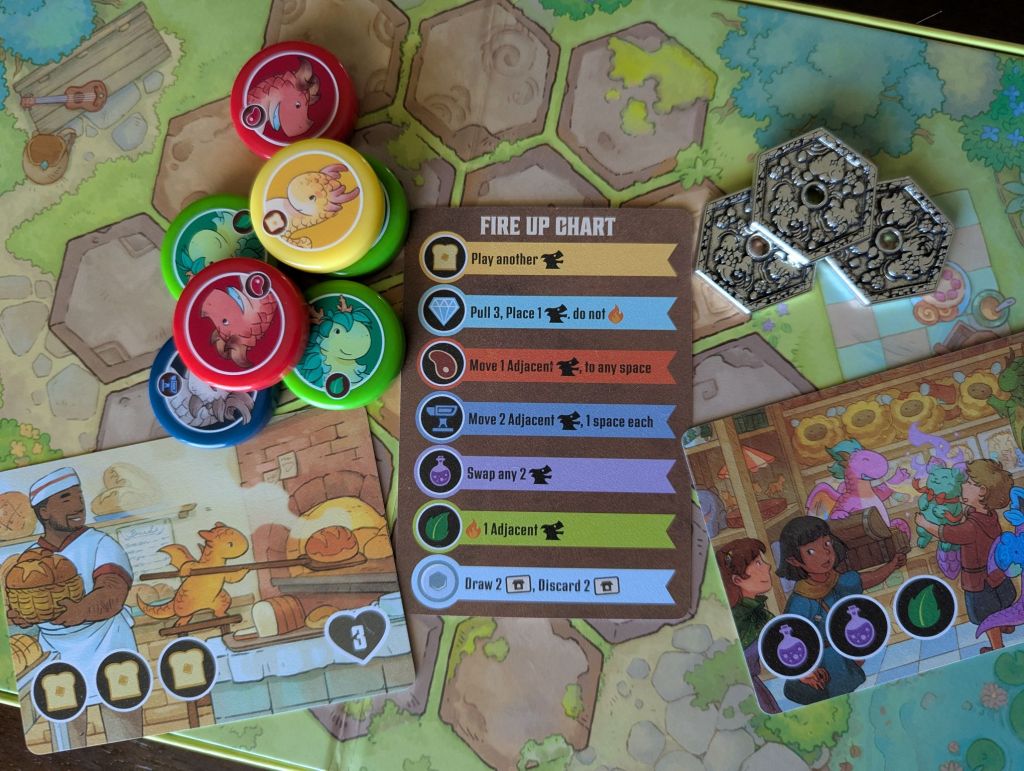
We are not playing “multiplayer solitaire.” We occasionally get in each other’s way not because we are sworn enemies but in the simple fashion that two people working towards the same goal sometimes get in each other’s way. We are coexisting on a shared grid with shared dragons, sometimes maneuvering around one another, cultivating the same garden. It is the same take on player interaction seen in the original Flamecraft, now refined and, well, abstracted.
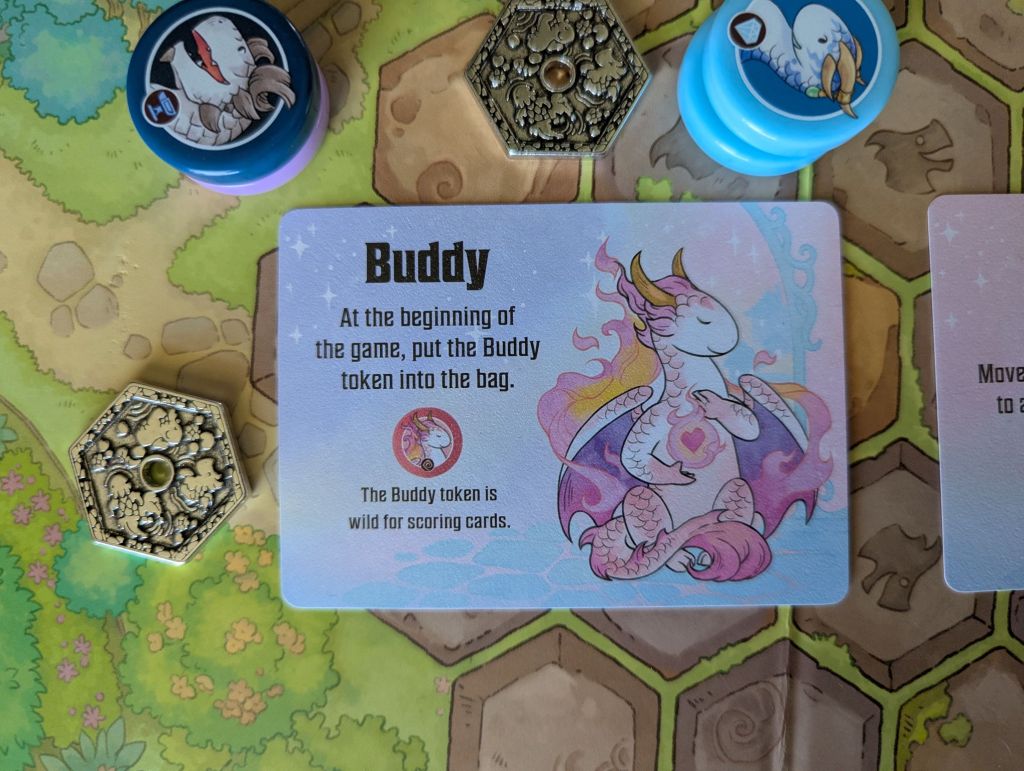
Flamecraft Duals has two included modules, Fancy dragons and the Fountain. Fancy dragons added secret objectives to the original Flamecraft, but here they act as powerful modifiers over the whole experience. I find the Fancy dragons to be a distraction from what I interpret to be the “true” Flamecraft Duals experience. Modifiers like three shops cards each, or additional utility for the included coins (which function to re-draw shop cards in the base game) are neat but tend to tug on the experience until it nearly breaks. One fancy dragon adds a pink chip that acts as all dragon types. It completely warped the game until my partner and I were scoring two shops every single round almost without fail. Was it satisfying? Yeah. Was I really getting at the heart and breadth of Flamecraft Duals? I don’t think so. I was mainly pushing around that pink chip all game, putting him to work at every shop I ever scored.
The fountain, which is required for the Solo variant, is a suitably sweet but thinky “advanced” mode. The fountain acts as a blocker, making the grid slightly more cramped. This tiny inhibitor comes with its upsides, though. The fountain adds a set of more ambitious, always-available scoring cards that allow the scorer to move the blocker and hand select their next stone. The community cards give insight into what an opponent could be going for, but with how powerful and chockful the board gets late in the game, actively trying to prevent them from scoring these cards is likely futile. More importantly, the four-in-a-row fountain cards expand player considerations, giving them reason to analyze the entire board more often rather than only the dragons that satisfy their immediate shop cards.
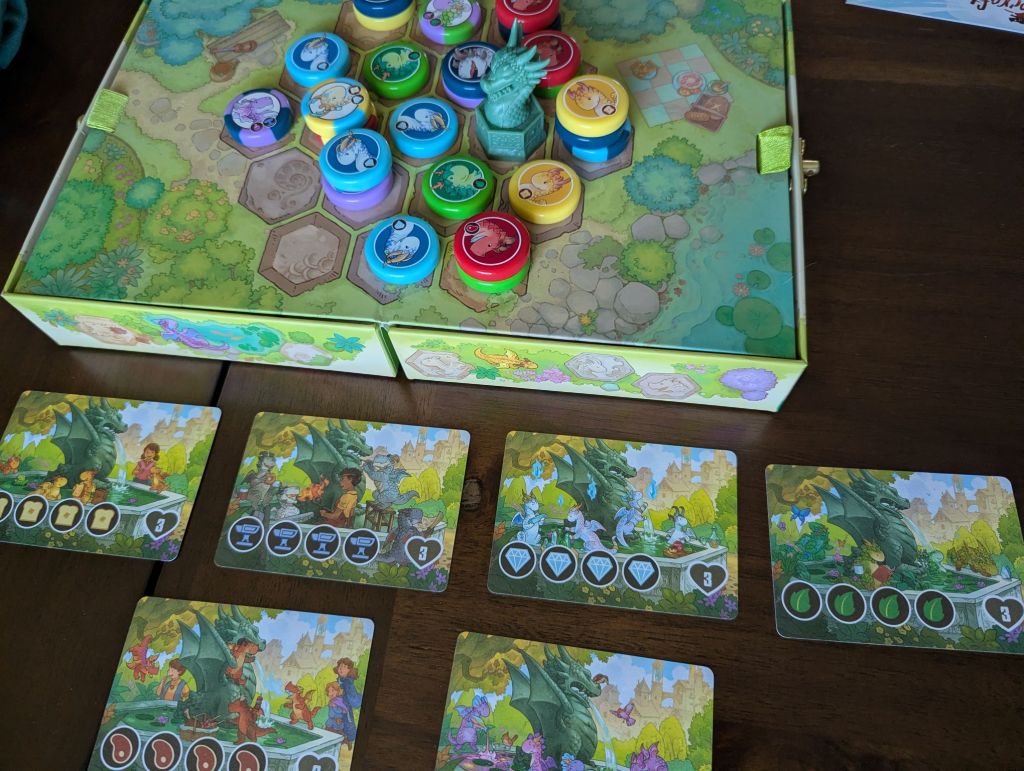
The solo mode, wherein fountain cards act as the primary objective, turns Duals into a delightful puzzle box. There’s a tug-of-war between just trying to survive and make it to the end (by finishing one shop per round while working towards fountain cards) and intentionally slowing down and milking the system for more points (risky if you run out of coins or discs). It reminds me of one of those New York Times daily games– a satisfying brainteaser I could see someone happily puzzling at for twenty minutes each morning. The early game luck of the draw does make some games strictly harder than others, an issue the main two-player mode does not suffer. Still, I think this is a system fully capable of supporting solo play and the included mode is more than the sum of its parts.
Will the solo mode, or the game in general, support infinite growth along the path to mastery? I have an inkling that it will not. For some, there may be too little resistance at all stages of playing Flamecraft Duals. Maybe there’s a reason why abstracts tend to allow players to stand in each other’s way as always-escalating obstacles. Duals relishes in opportunities to be easy, and I don’t think that’s a flaw. I want thinky turns and I want easy ones, too. That’s part of what a cozy feel-good game, y’know, feel good.
Sometimes I start my turn and, before I’ve made a move, one of my cards is completed. Half of everything I have to do this turn–already done. Maybe I drew into a lucky shop, or my opponent had a similar card and did it for me, something like that. Usually this happens deep into the game when the board is an embarrassment of riches. An easy turn follows, where I either work towards my second shop or just try not to mess up a good thing while it’s going.
On these turns it is clear: I do not have ownership of this grid, or these shops, or hardly even these points. I am trying to arrange these discs in my own beautiful scoring way, but the chips fall that way regardless of my intentions. We are assembling and redecorating a diorama of cute dragon discs. The engine has gotten powerful and the game is almost over. Maybe it’s a little random-seeming now, but collaborative choices built this landscape. It’s pretty cool that we’ve built this together.

Leave a comment