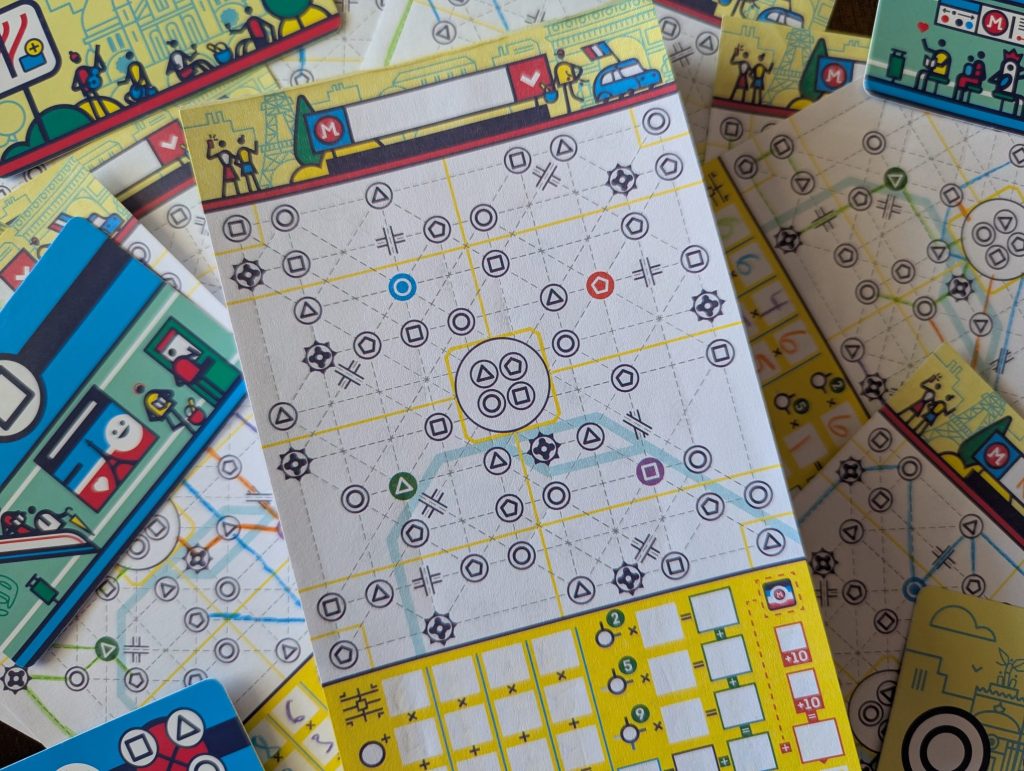

I got Next Station: Paris in Toronto on the same trip I rode the subway for the first time. At a board game cafe with my partner, we borrowed Next Station: Tokyo, plowed through the rules in four or five minutes, and had ourselves a good time. We folded up our completed subway maps– I think I had more points but she argued hers was more realistic due to her subway experience– and tucked them away for safekeeping. Later that trip, by some “coincidence” of my game-loving heart, we ended up at a boardgame shop and got Next Station: Paris. We would play it that night in our hotel room, flipping cards out onto the bed in the absence of a real table. As we played in these less-than-ideal spacious conditions, we mused that we might be able to play a round or two on the bus back home. I loved playing games at the board game cafe, I loved playing games haphazardly on that hotel bed, and I loved how few rules the game had while still striking me as so thematic and interesting.
Next Station: Paris has a delectably simple gameplay loop. Each round, you’re responsible for one colored pencil. This colored pencil represents the metro line you’ll be drawing this round. Cards are flipped out which indicate the next station your line must connect to. The objective is to get the subway line to cross and service many districts, while also servicing one district as much as possible. Your line cannot intersect other lines nor form a loop with itself. There’s also incentive to create interchange stations where metro lines connect. In Paris specifically, there’s also Parisian monuments and overhead crossings which give points for going through.
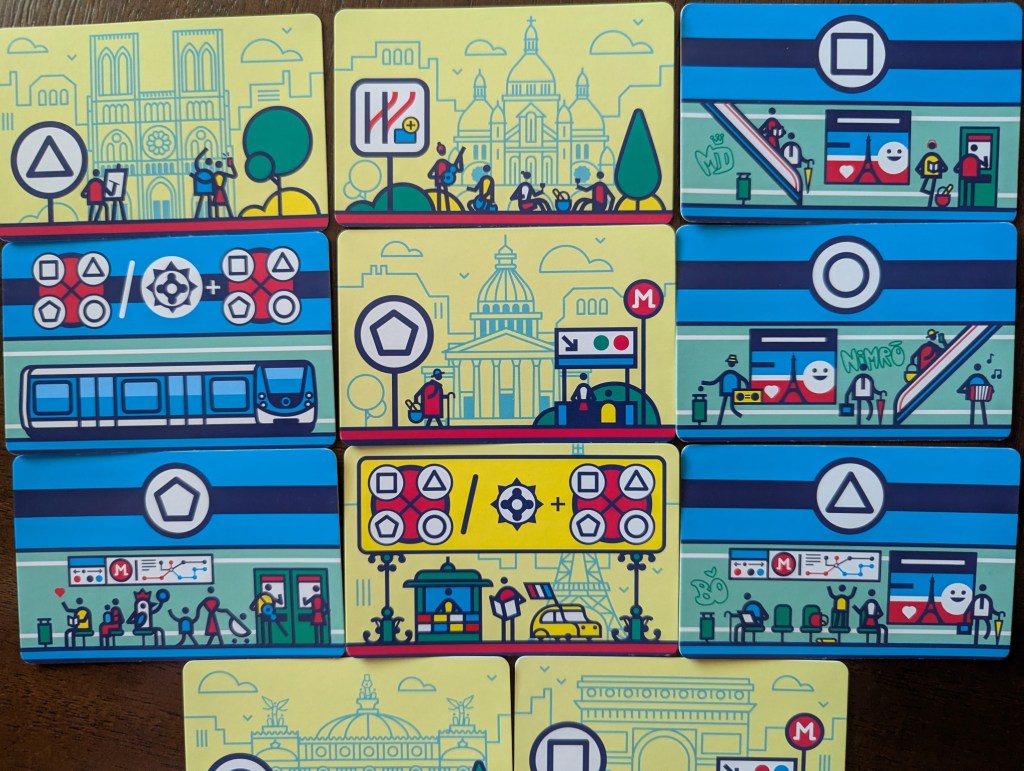
At first, it may seem like there’s not much here. On any given turn, “Draw a line to Square” may present as little as one option on how to expand the line. Draw a line, flip, draw a line, flip, and through Matthew Dunstan’s game design wizardry you’ve accidentally created a metro line that looks like a real map you’d see up on the subway screen. A guided tour through civil engineering. But the wizardry doesn’t end there. This is a well-oiled game on top of a delightful metro simulator.
If you engage with its systems, there’s a satisfying puzzle to crack, and the small handful of scoring opportunities start pulling you in different directions. You can be greedy, play it safe, go for different strategies– things associated with more meaty games, all within the framework of drawing a single line per turn. The central tension of your line needing to service one district well while also connecting a bunch of them does a lot of heavy lifting for your points, but there’s other considerations keeping things interesting. Next Station: Paris’s extra additions are, to my taste, the best of the Next Station trio.
Two cards in Next Station: Paris’s trim deck are Guided Tours which let you draw a line to any station. These add a good deal of flexibility, of course, but they’re also packed with an extra incentive if you intentionally build your line to take advantage of them. If you draw your wild line to a wild monument, which would seem like a redundant waste, you immediately get a bonus line exiting that station. In other words, it can either be used as a flexible wild or as an inflexible combo-extender. That’s some special sauce for a game with, like, four rules. While some other blank-and-writes revel in boxes combo’ing into other boxes, Paris is comparatively restrained. The metro is coming together thoughtful turn by thoughtful turn, not exploding out over the map like a spilled coffee.
Paris also has the central platform, which counts as all station-types and has numerous possible exits. Instead of its own special scoring rules, it uses the existing “bonus points for creating interchanges” rule and simply gives you a great opportunity to make such an interchange on the central platform. I can imagine a less elegant game planting an extra bonus or extra rule to get players to engage with the gimmick, but Next Station has no need. It is central, which is good, and has its own district, which is great. In the pursuit of making good lines, players will use the central platform naturally. Dunstan’s design is clean and uncomplicated like the straight lines drawn from station to station.
The scoring opportunities are pretty intuitive and even self-explanatory. Even if I’m playing with someone hanging out and drawing the line in the most aesthetic way, they’ll still score some points by following the flow of the game. Creating interchanges is satisfying, so is servicing a neighborhood, so is using the overhead lines, so is the freedom of connecting to the central platform and getting a wealth of options on the next turn.
The advanced mode shepherds players into doing more ambitious or skillful things; requiring players to make lines of predefined lengths or further incentivizing going out to the city gates. I find the advanced modules unnecessary, at least in my first dozen plays across the Next Station franchise. There’s more than enough points to find in the base game without the added ten here or there from shared objectives.
In Bernard Suits’s The Grasshopper, he describes the “well-played game” as a game where the aims of playing and the aims of winning are the same. To oversimplify: whether players are trying to win the game or trying to have fun playing, if the game is good, they’ll do the same things. By that definition, Next Station Paris is a very good game. The aesthetic player will not juice the scoring quite as much as their ultra-competitive peers, but they likely won’t be too far off.
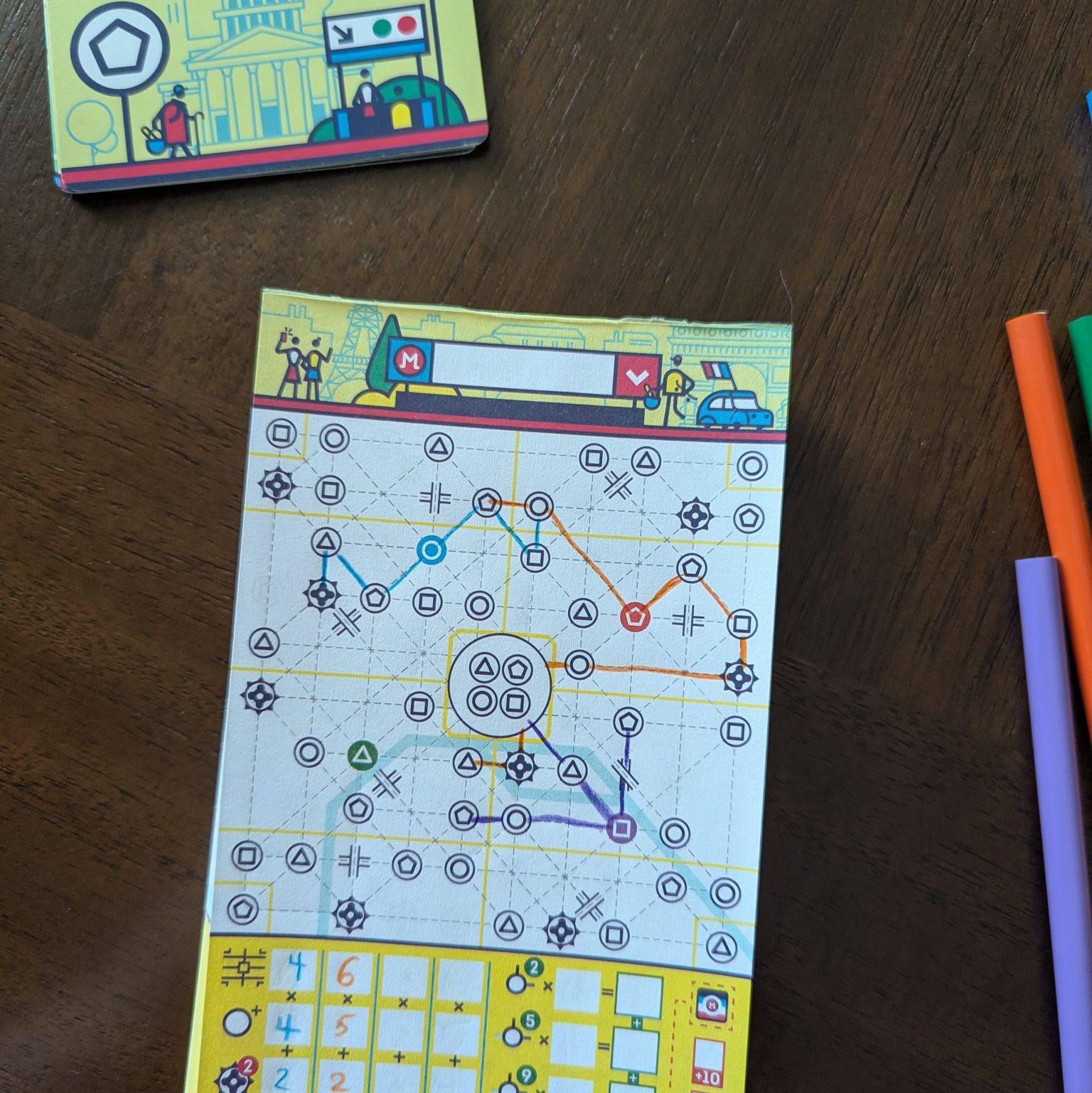
Win or lose, you are left with a pad of paper with your own vision of Paris. Blemishes and all. You’ve severely underserved an area or created at least one line whose purpose is inscrutable at best. The worst of your lines fell short due to poor planning or the cards coming out in the wrong order, but they were scrappy and aspirational all the same. Your best lines, though, you can imagine a million people riding those, heading to and from their board game cafes and burger joints and office jobs and tourist spots. If you’re anything like me, a subgame of discussion and comparison emerges when it’s all over. What real metro does my system resemble? How would a sad lil’ guy who lives at this station get downtown? Wait– which of these is the Louvre?


Leave a comment