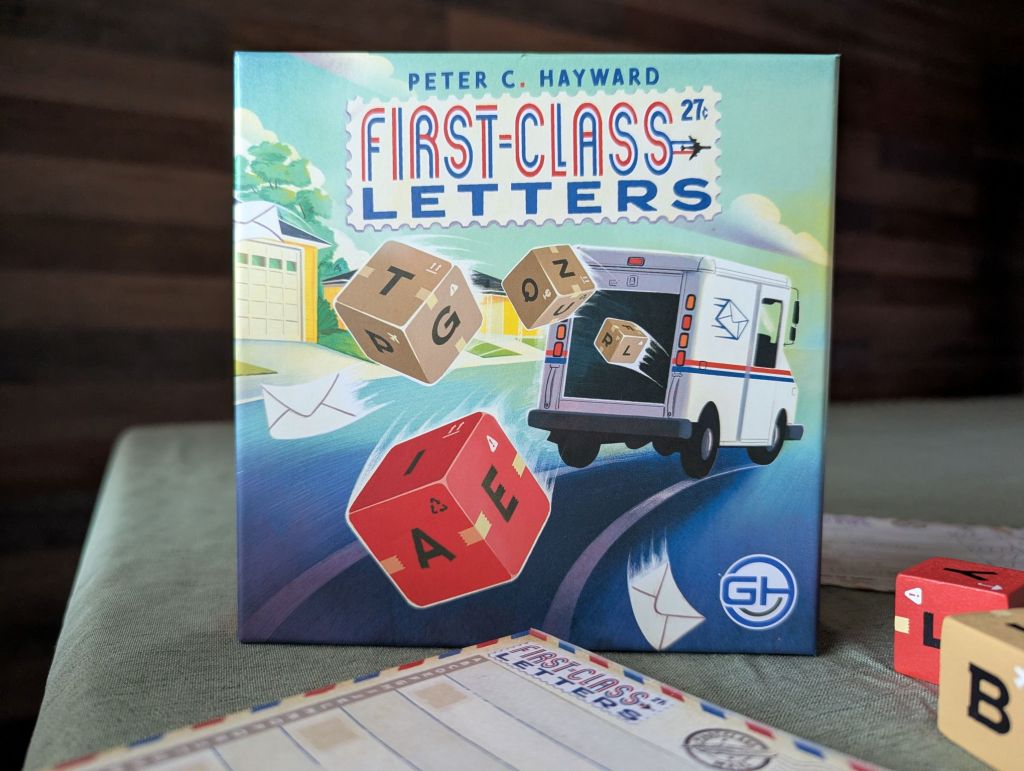
More word games should give you points for coming up with off-the-wall long words like First Class Letters does. Too often, word games incentivize knowing two-letter esoteric ones or words containing every single vowel drawn into your godforsaken hand. By my count, First Class Letters is about two things: words with lots of Js in them and knowing your alphabet. Surprisingly, the alphabet part is what trips people up.
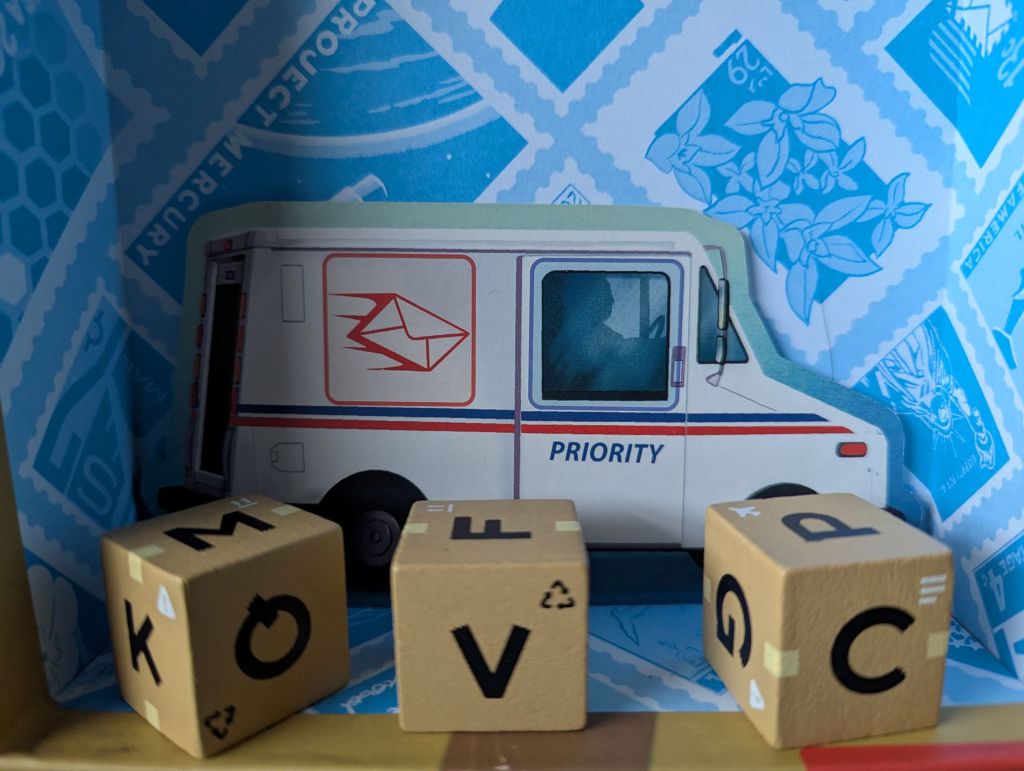
First Class Letters’ vibe can be divined by listing out its sparse components. A cardboard mail delivery truck; hell yeah, I love those things. Four oversized, wooden dice; as all games ought to have. A stylized pad of paper with blanks for words and checkmarks and an accompanying collection of pencils; we are rolling and writing. A tiny sand timer; menacing or perhaps even evil.
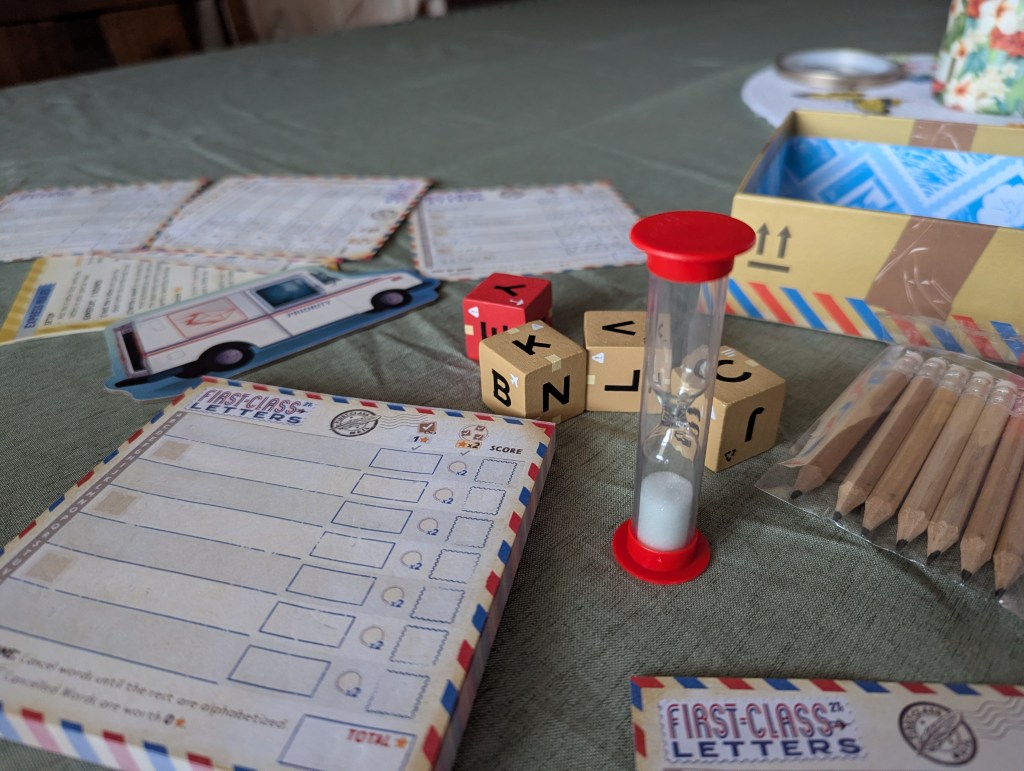
To play, roll the dice. Each di has unique letters on its six sides. Try to make a word using as many of the rolled letters as possible, while avoiding the letter rolled on the red di. Mark your word onto your sheet, which has seven blanks, making sure that you put your word in a blank where the words before and after it will be in alphabetical order. If you are the first to write your word, congrats, flip the sand timer and put everyone else on the world’s shortest clock to have their word written.
First Class Letters is a bumpy but charming ride. Because the game uses dice instead of any other tool to randomize its letter output, there’s never a good enough selection of letters out there. Q or J or some other irritating letter always finds its way into the mix, taunting you to get it involved or frustrating you into ignoring it. I like that you always have the option of trying to come up with a word that uses as many Ms and Os as possible rather than being forced to eventually utilize an X, for instance. You can wrack your brain looking for a double points bonus, but how many dead-end verbal cul-de-sacs are you willing to go down before cutting your losses?
I also like that, as the game goes on, your word choice is restricted by your previous offerings. It’s a classic boardgamey feeling, being hemmed in by your own past decisions, good and bad. Maybe it’s the final round, you need an absolute points bomb, but your word has to start with exactly G whilst your opponents can use any letter A-F. Usually, you are trying to maximize your points yield by coming up with a huge franken-word. Other rounds you have ten seconds to come up with any word whatsoever starting with an F and containing the letter U but not S.
The game’s pace is controlled by the fastest player at the table is. I enjoy a round of Letter Tycoon, but I don’t want to play it with someone who will sit there and puzzle out the perfect word for five minutes. Each round of First Class Letters begins with no timer active, but one person finishing puts everyone else in a mad dash to get something, anything, down. In this scramble, a player will scrawl a word down with three seconds left only to find, in utter dismay, that it was written out of alphabetical order or including the one letter they weren’t allowed to use. A cruel joke played by the ghost of first-grade’s past as their one or two pity points is reduced to zero. I wish there were more incentive to put your opponent’s into this time crunch, at least some of the time. Maybe if the sand timer was even less than forty seconds.
The dice force you to conjure words you haven’t actively summoned to memory in years. However, the dice can lead to frustration or repetitiveness if the same letters show up again and again. Everyone is dealing with the same set of inputs, so there’s comradery there. If you have once again been tasked to come up with a word using the two least common letters in the English alphabet, everyone else has, too. It is not uncommon for a collective groan to hit the table after those dice are rolled.
It is also not uncommon for players to come up with the same or similar words once the round is over. It’s generally seen as undesirable in roll-and-writes for multiple players to do the same things with the same inputs. Here, though, it’s a relief. Sure, my word kinda sucked– but it was good enough that my buddy put the exact same thing. Between rounds, my family and I would discuss the non-words that were buzzing around our brains, blocking us from progress towards a good answer. The game is just difficult enough, especially in the later rounds, to evince those shared struggles.
I think many party games fall into one of two camps: make you feel smart or make you feel dumb. Either the game tests you in a way that makes you feel like a genius doing incredible tasks; or it’s an uproarious affair of watching you and your friends fail at seemingly easy tasks. First Class Letters, like a few of my other favorites, rides the line. Sometimes you’ll come up with a word that scores ten points, catapulting ahead and being met with ooo’s and aah’s. Other times, you and everyone else wrote down, like, “gun” for two points and the last person didn’t even get a word down in time. There’s a laugh to be had, in the right company.
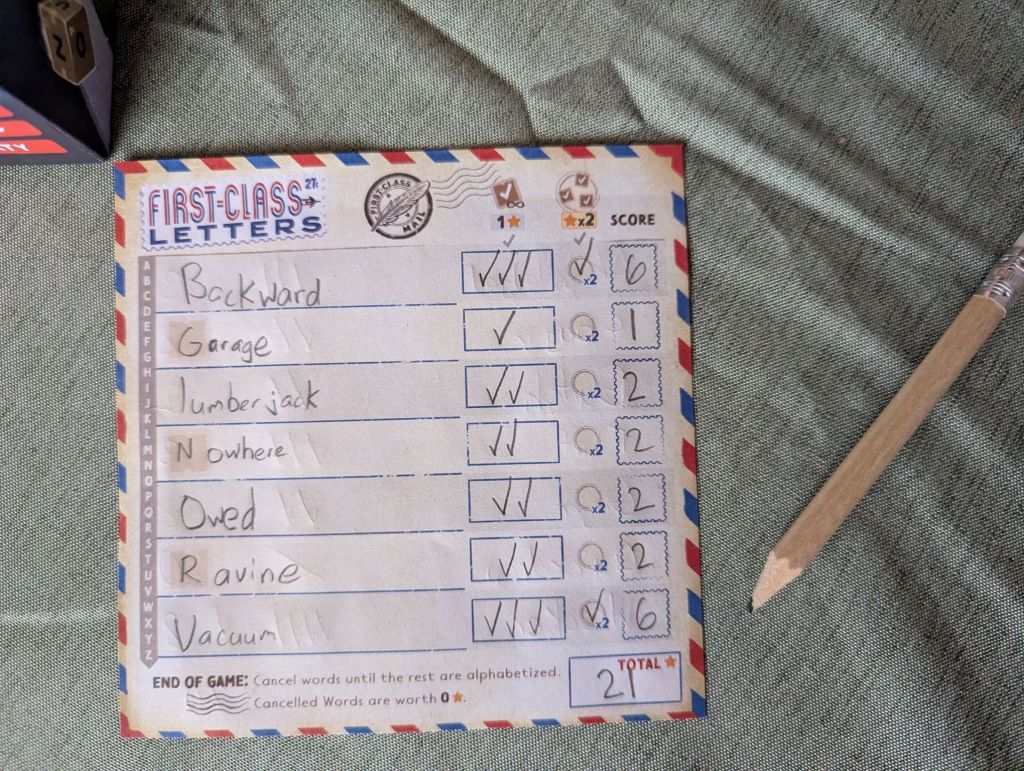
I previously reviewed another of Peter C. Hayward’s games, Things in Rings, which also lent itself to moments of excited revelation interspersed with many-a-moment of “uhhhh, I dunno.” But where Things in Rings explored a much more nebulous realm– how do we categorize the world?– First Class Letters is more grounded, almost to a fault. Here, any talent you might have in “knowing lots of words” will be rewarded, albeit in a less groundbreaking package. I think it has enough to win over a space on my shelf, though. Very little rules overhead, a funny moment here and there, and opportunities abound to flex one’s vocabulary muscles.

Leave a comment