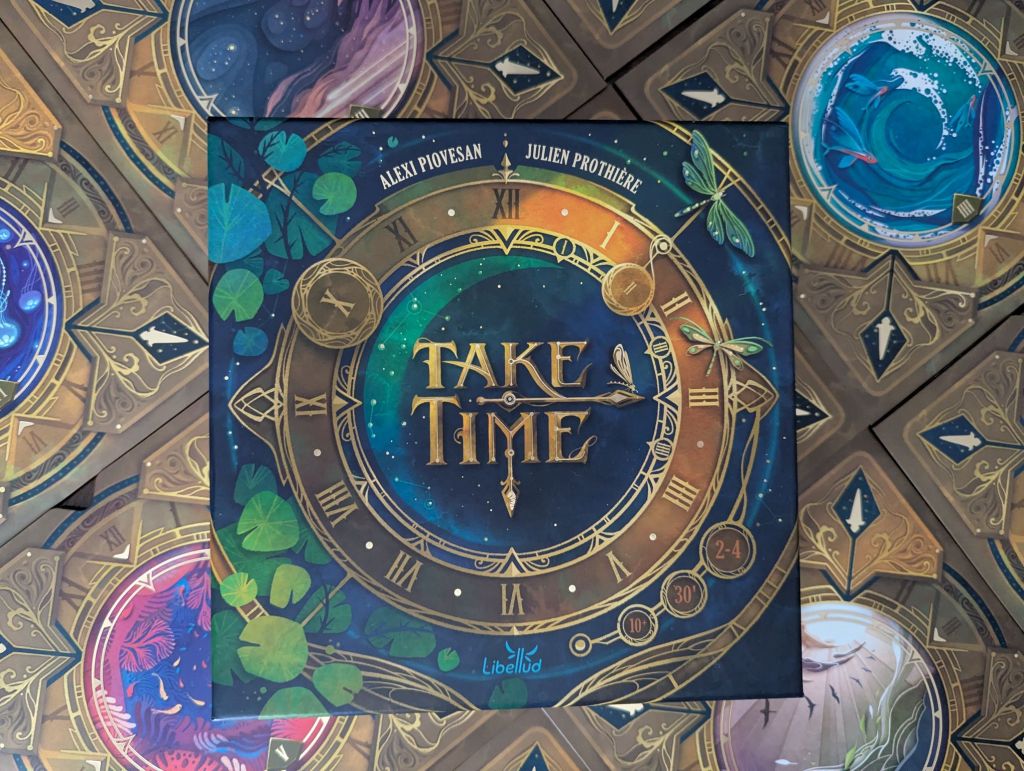

Take Time’s title and dramatic presentation led me to believe this would be a slow-moving game about sitting around silently and counting the ticks of a second hand. I envisioned a game about waiting–maybe a game about mindfulness, but not necessarily– and a game about deliberate caution.
Limited communication, alternate dimensions, putting stuff in order. Can’t you just imagine all the pregnant pauses and hesitations and dreaded glances you’ll give your partners? The dreamlike art and the foiling on the cards seemed to me to say: clear your mind and behold me. Do something magical and read each others’ minds.
I was a little worried, but Take Time assuaged my doubts by being much more than another mind-melder. Designers Alexi Piovesan and Julien Prothière let you encounter each challenge on your own terms: problem solving, coming up with your own heuristics, building up a whole suite of skills. Reading minds is part of the puzzle but not the whole game.
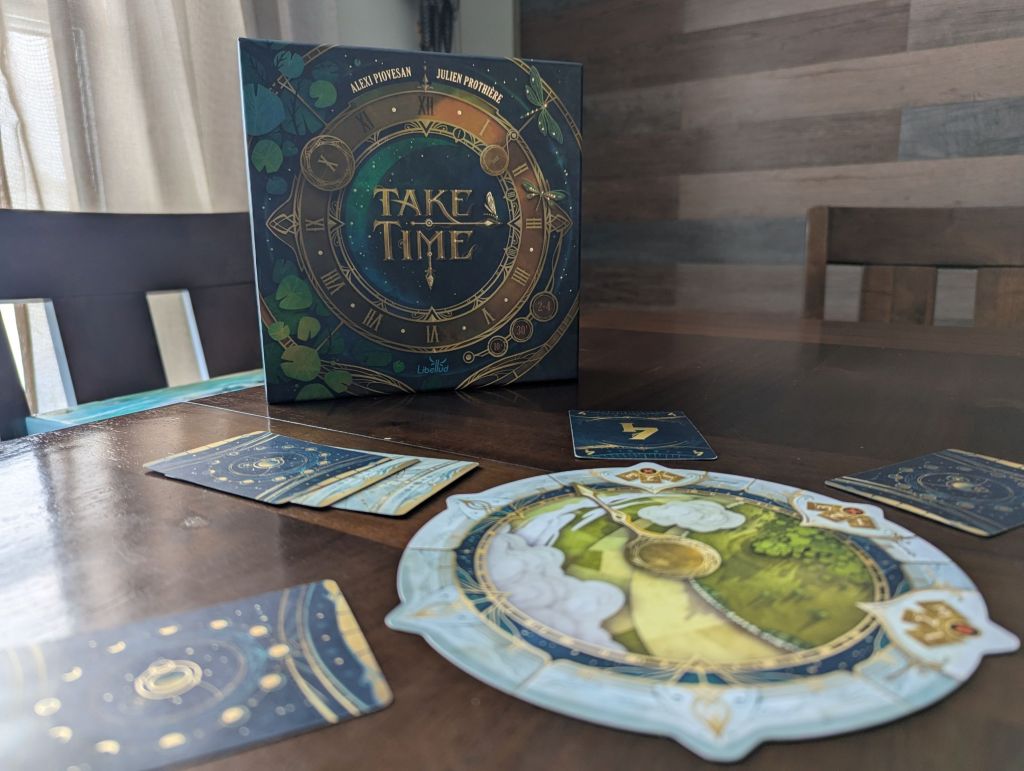
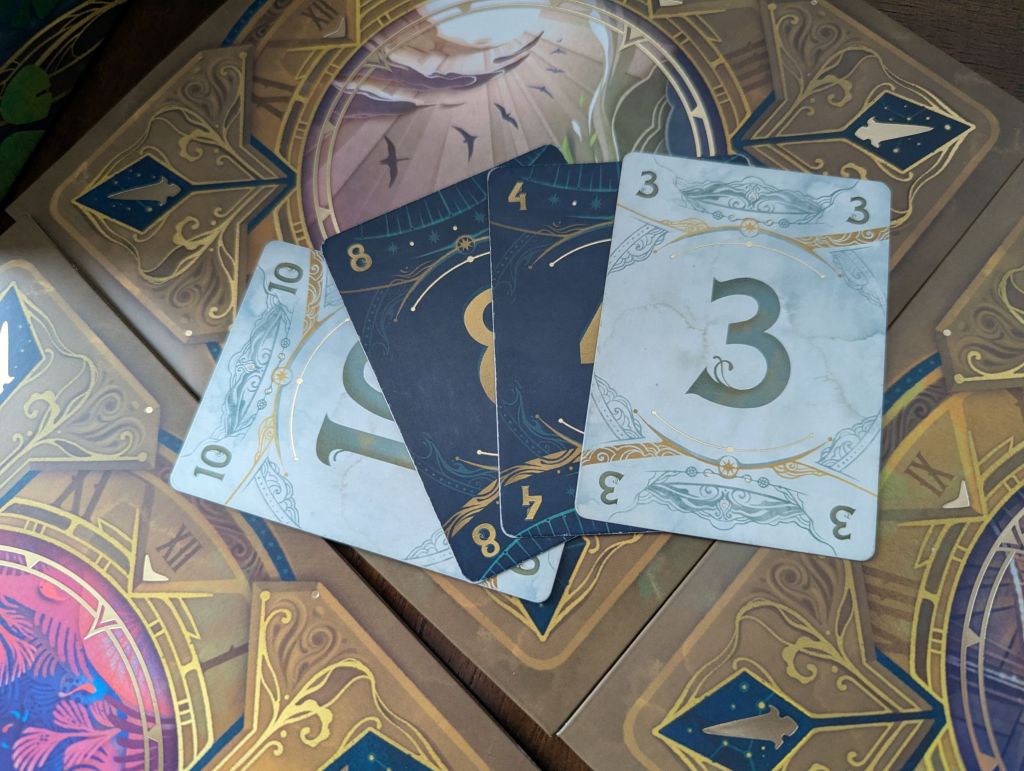
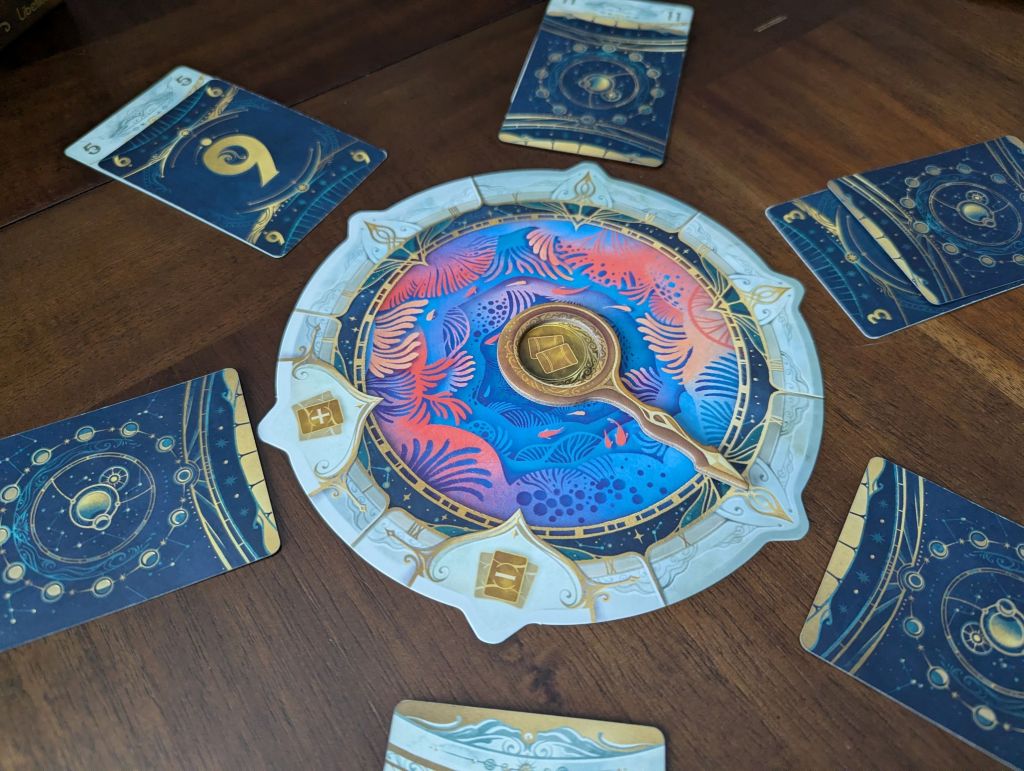
The rules are straightforward. There is a clock with six segments. There is a deck with twelve lunar and twelve solar cards each going from 1-12. Your team will be dealt twelve of these cards at random. Cards are played face-down into segments such that each segment in clockwise order sums to a number larger than the previous segment.
Each set of clocks adds new rules, mixes and matches old ones, and generally turns up the difficulty. This is, of course, a game with limited communication, so the foremost obstacle is always going to be not knowing what cards your teammates were dealt and how they are going to play them.
The gameplay is immediate and so is the tension. It only takes about a minute or two to onboard someone into the rules, but rarely is a card placement easy or risk-free, even early on. If you’ve planned what your first couple moves ought to be (which you will have to do, more on that later), there are still agonizing decisions to be made within seconds of being dealt your hand. Sometimes, it feels impossible.
The ace up your team’s sleeve is the ability to cheat. Permitted cheating. Before you’ve looked at your cards, you can hatch plans to tackle the scenario ahead. Talk about exactly what you intend to do or what you want your teammates to do. Discuss what numbers specifically ought to land where, if we can help it, and what placing there communicates. Not only is planning allowed, it is necessary. As you move from clock to clock, “just vibes” isn’t going to put numbers in order.
The first clock or two of each envelope teaches you a new skill, while the later ones remix the new mechanic and crank up the heat. The twists are more difficult than they are complex, though. I’ve played through eight of the ten levels, and no mechanism has taken more than ten seconds to comprehend from the added rules leaflet.
On one hand, I’m glad this game didn’t go the way of complexity for complexity’s sake to fill out forty unique missions. On the other hand, as I’ve gotten deeper, I find myself less “wow’d” by new challenges and rather nodding my head that, yeah, this one sure is harder than the last.
Levels seem deliberately designed to challenge you in new ways; the methods that solve this set of clocks won’t work on the next set. Just as you start coming up with heuristics on what order cards ought to be played, the next level is about playing your cards in the order you were dealt them. Smart. A little frustrating.
Later challenges require more forethought, more skilled play, and, unfortunately, more luck of the draw. For my group, we often found ourselves defeated on a razor’s edge by getting one too many high cards, no low cards, or some other head-scratching combination. Too many variables, the clock needs too much–we aren’t good enough to skate through with a bad draw. The early levels are breezy but the later ones are definitely not. Probably a relief for some, a minor headache for me.
The strength of Take Time lies in the same feelings that emerge from a well-played hand of The Gang or The Crew. When it’s all said and done and the clock is in order, it feels like you’ve performed a minor miracle.
Maybe a crazy plan came together, maybe you all perceived and executed a mid-round pivot, maybe something finally clicked and the impossible was suddenly trivial. Take Time is better than those games at accelerating straight into hard decisions. Each card in your hand is simultaneously a burden (it needs to fit somewhere) and a blessing (it can add to a segment that needs beefing up). It’s a smart source of tension. Sometimes, a white eleven is the exact card you need but, two turns later, becomes a malignant curse and a problem to be solved unto itself.
All this to say: I like Take Time. I recommend it especially if you want a game like this where you aren’t wedded to one specific play group. You can teach it in five minutes, start at level one or two, and everyone is up to speed. There’s no story to miss or meta to be clued into– just shuffle and put numbers in order. For every frustration I may have, there’s someone I’ve played with who thinks Take Time is one of (if not the) best cooperative game of its ilk. After spending quite a lot of time with it, I’m inclined to agree.

Leave a comment