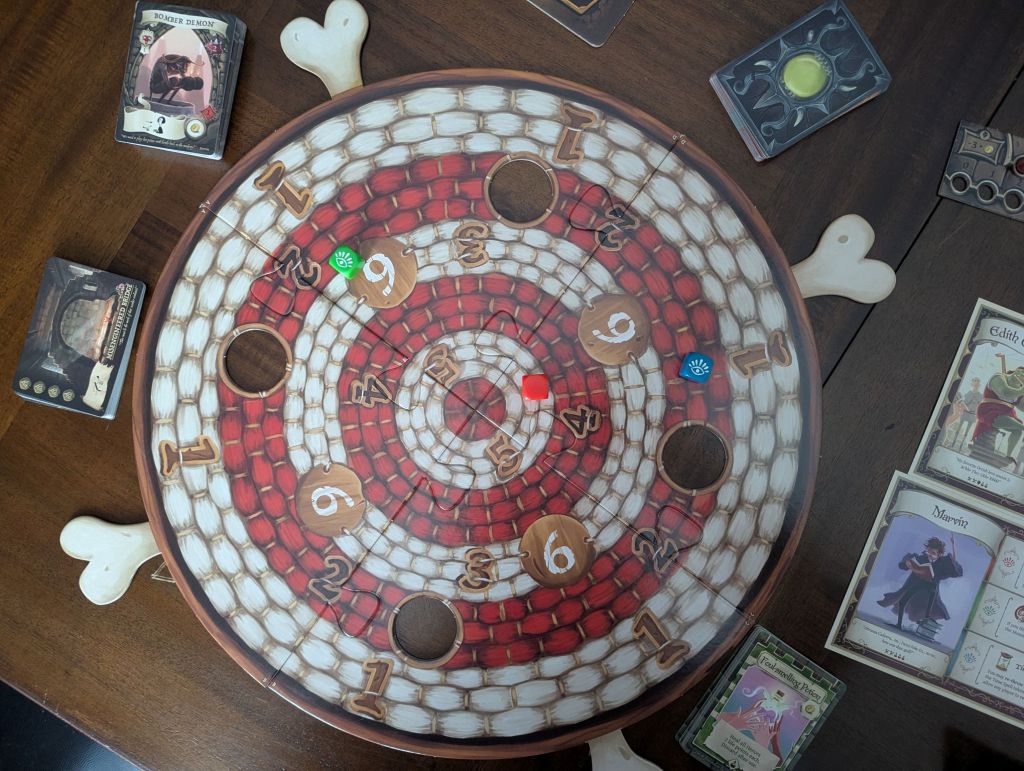

It took me an embarrassingly long time to make any progress in Dungeon Fighter. I somehow had it in my head that this was a dice throwing game rather than a dice rolling game. I was fruitlessly throwing cubes at an eighty degree angle into my dining room table and wondering how anyone could predict or influence how it might bounce. Eventually, I came to my senses and started rolling the dice like normal, which was all well and good until the second or third encounter asked me to roll the dice from my head down onto the board. That was tough.
I should explain what this game is to those who haven’t yet Fought a Dungeon. Dungeon Fighter Second Edition is a pseudo-dungeon crawling cooperative dexterity game. Players will be selecting heroes, finding and purchasing equipment, casting spells, healing each other, and all other manner of fantasy things that dwarves and goblins do in good company. Instead of hex-crawling or playing cards, though, players interact with enemies by rolling colored dice onto a cardboard dart board, dealing damage based on how close their di lands to the bullseye.
A couple things immediately complicate your dice chucking, though. For one, it must bounce at least once off the table before landing on the target. You’re gonna need velocity or at the very least some panache to get your di on there. If you miss the target completely, the monster hits you instead. It gets worse! You only have three free dice each encounter. If you do not defeat your enemy in three rolls, you will likely have to recall those three dice, proc’ing a counterattack.
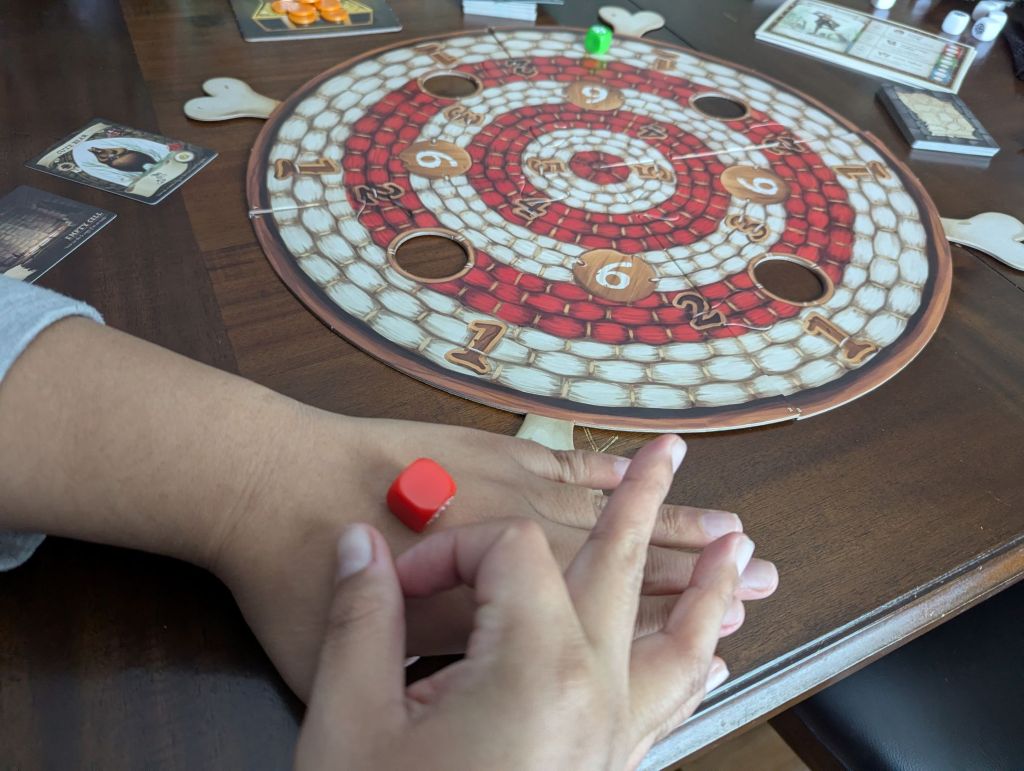
And, like I mentioned earlier, it gets worse! Nearly every enemy encounter is going to demand some extra sauce on your toss. Off the head. Behind the back. Eyes closed. Using your teammate’s hand instead of your own. Dungeon Fighter is less a dexterity game about getting good at accurately placing cubes and more a gauntlet of dice-themed humiliations from which you may, if you get on a hot streak, emerge victorious. You probably know if you’ll like this game based on that description alone.
There is a tension at the heart of Dungeon Fighter that many will find irreconcilable. I barely get over it. For as silly and random as it can be– certain monsters in certain rooms will come out asking you to roll dice in ways you’d need a PhD for– it also asks you to engage with money and spells and tactics.

In my plays, discussions about which dice to use were either obvious or slowed down the proceedings for minimal gain. Each dice color represents a different spell for each hero, but more often than not the choice between “do I use blue or green?” were not the most interesting. For one character, blue nearly always seemed like the best option, doubly so when the character next in turn order really likes to roll green. Is that a bummer or a relief that we don’t have to engage with the less-good mechanism as much?
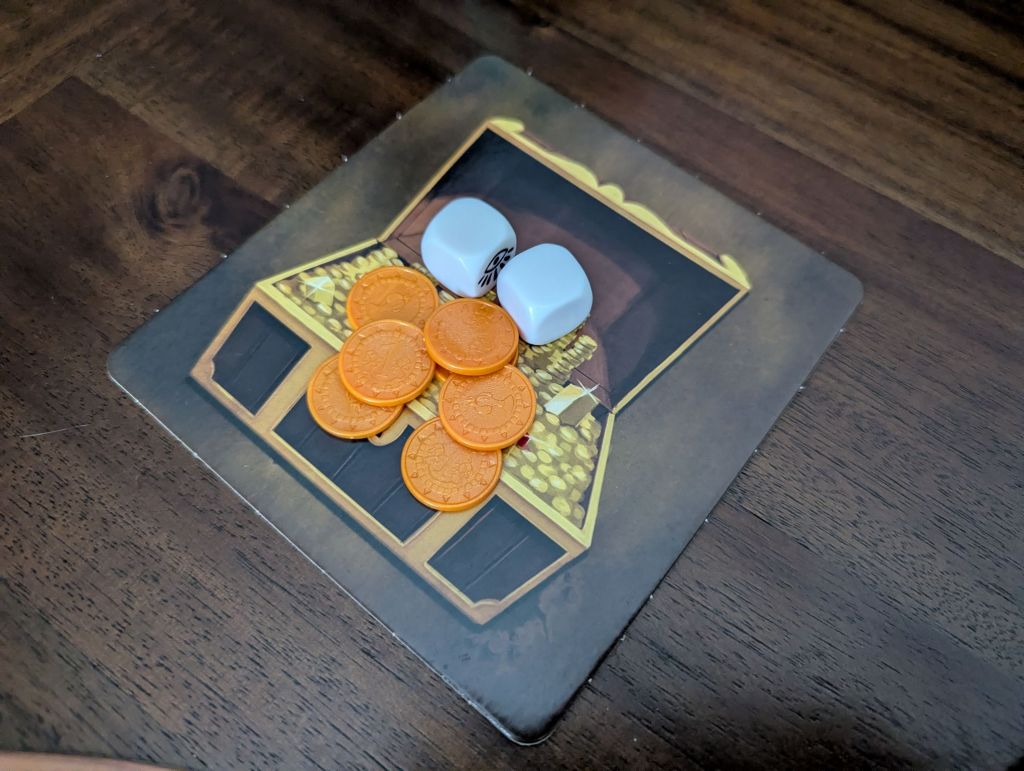
The shops embody this fickleness even more. You reach three shopping checkpoints over the course of your delve. This phase does provide some relief from the constant dice rolling, so I like the idea. But most of the time the options at my disposal (heal, buy one time use dice, get some equipment) feel insignificant in the face of the next enemy asking me to bounce the dice off my nose. I’ll heal and buy some stuff, sure. Maybe I’ll cruise through to the next shop unimpeded, or maybe we will all get chunked down to one health by the first guy. It’s unevenness that I expect in a party game– but then why is it simultaneously asking me to stress over and manipulate the details?
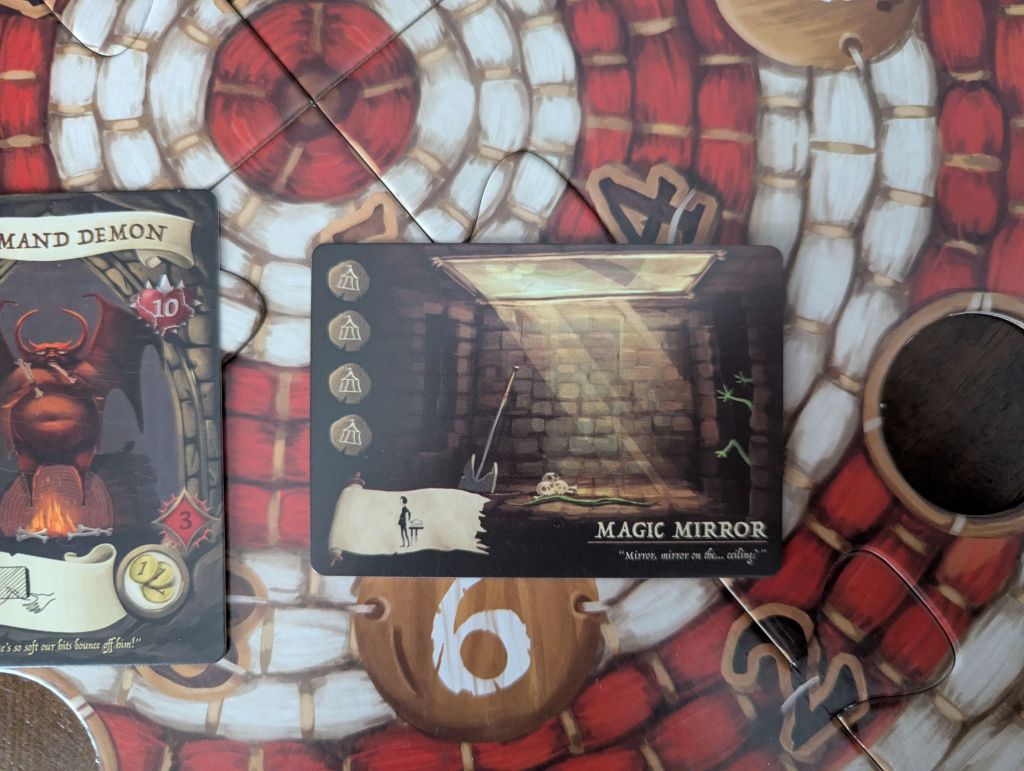
It doesn’t help that this sort of wacky fantasy world is a couple steps too irreverent for me– I’ll go about as far as World of Warcraft on that track before it gets grating. Obnoxiously nerdy wizards, tongue-in-cheek Dungeons and Dragons references in the form of dragons themselves, it’s all things you’ve probably seen too many times before.
When it’s all said and done, though, when the items are bought and the health is topped off and the coinage has been micromanaged, I do enjoy the game. I can’t help the feeling that it doesn’t quite “work” all the way– but at its core there is a game of darts as-played-with-dice that is strangely satisfying and just difficult enough to necessitate practice. When somebody’s been rolling a dice off a card all game (items you acquire give you bonus damage if you do stuff like that), they’ve mastered it by the end. They’ve forgotten how to roll dice without a flimsy piece of cardboard to launch from. They’re more card than human.
Getting dealt an unbelievably difficult encounter and toughing through it is satisfying, too. It is nice in a dexterity game when players get the opportunity to cheer each other on– how many cooperative dexterity games are there? Whether someone invents a technique to overcome a fight or simply lucks into a bullseye, there’s relief and joy around the table. You want to believe in their ability even more than you want to laugh at how silly they look doing a 360 prayer-hands dice throw. Most of the hero abilities are same-y and do some variation of heal/bonus damage/reroll, but when you need the bonus damage, it will get cheers when you roll the symbol to trigger it.
This is not a game I would want to play all the time, or maybe even very often, but it is unlike anything else I’ve played. I can’t attest to it being a “beer and pretzels” game, because I haven’t played it with either. I also don’t know for certain if it would go over well with kids, though my intuition is that it would be an absolute hit. I can attest to it being a “Late night and no games are really calling to me– oh wait this one is so weird you have to try it!” game.


Leave a comment