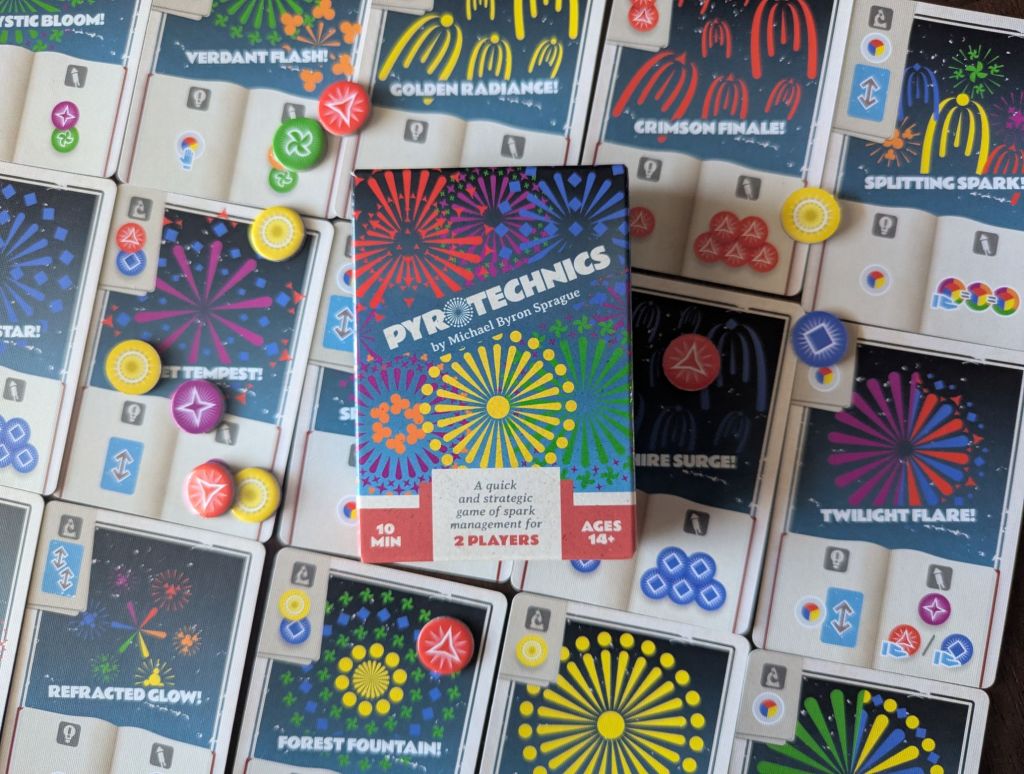

2025 was the year I got into small box micro-games. I’ve been introduced to everything from party games to solo games crammed into tuckboxes, tins, and wallets. For every limitation imposed by size, there is someone out there creative enough to accept the challenge and bound over them. Pyrotechnics by Michael Sprague does exactly that, albeit with more subtlety than explosions.
Pyrotechnics is a two player card game about rival firework technicians racing to develop and set off their payload of five firework cards. It is played with a mere eighteen cards (three of which are “burned” before each game– how’s that for variable setup in a game which is already working with so little) and a handful of little tokens.
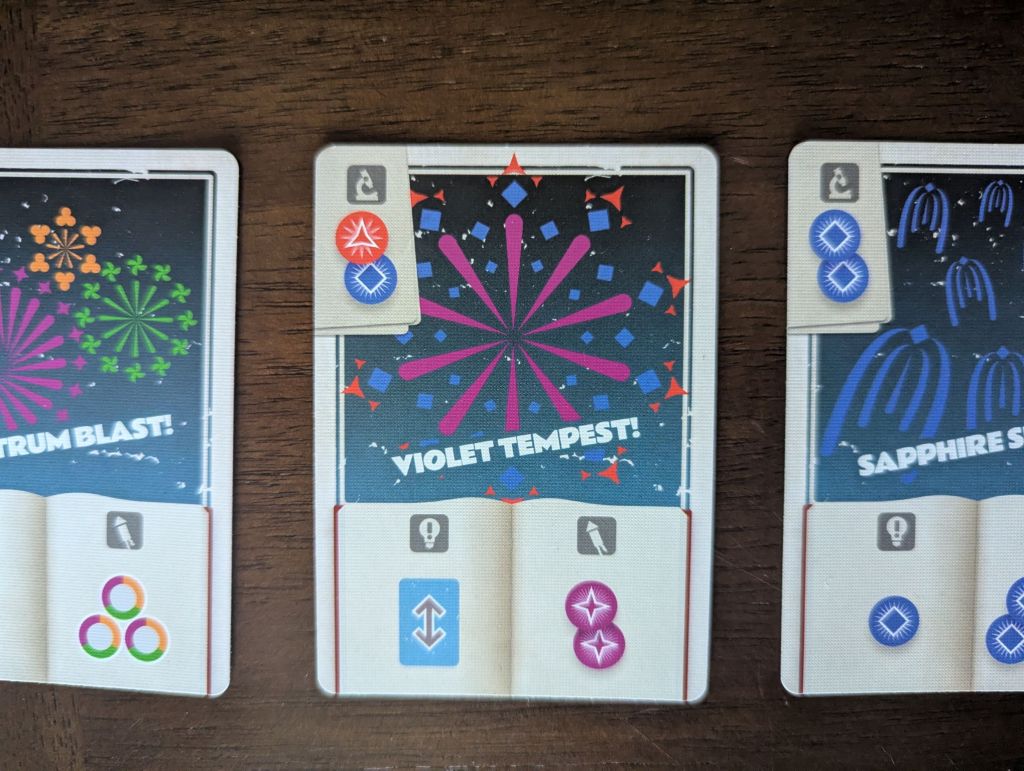
On a player’s turn, they will be playing one of their five cards into a central market, gaining or trading one of a few different sparks. Then, a choice. Either pick up a card from the display, doing some more gaining and trading. Or– and this is how to win– cashing in sparks to showcase the pictured firework, removing that card from the game and permanently lowering their hand size. When a player has no cards left, they can dust off their overalls (what do fireworks technicians wear?) and walk away victorious.
The incredibly straightforward action economy means it is easy to weigh the efficiency of each move. You can plainly calculate how many sparks of which colors you can acquire on any given turn. With that overhead simplified, Pyrotechnics isolates and embodies the part of euro games where one is carefully eying an opponent’s resources to figure out how to outmaneuver them.
Not only can you plainly see what they’re likely going for and how to stop it– that’s the whole game right there. You don’t have your own fiddly engine to wrench into order or a reservoir of people or farmland that needs constant cultivation. You have an opponent who is hoarding all the blue and, therefore, a prerogative to shelter any card that will let them cash in. Luckily, nobody can hoard forever, and nobody can completely outpace the other by picking the “best” cards. It is a series of denials, small edges, smarter-than-average decisions. It’s hard to tell who is really in the lead until the final stretch when someone is marginally better setup for successfully scoring the last card.
This is not a fireworks shows where someone inadvertently blows the entire payload at once. It is rare, maybe impossible, for someone to gain a multiple-firework lead or coast to an easy victory after efficient plays on turn two and three. The game seemingly always comes down to who has compounded a turns-worth of efficiency down the stretch. For a game that only lasts fifteen or twenty minutes, Pyrotechnics being so close for at least twelve before someone is in a checkmate scenario seems like a good ratio. And for those fifteen minutes, you have room to make neat decisions.
All sparks are a finite supply so you can theoretically monopolize the color yellow. Some cards are cheaper but require you to pay their showcase cost to the opponent– it always feels like a game of chicken on who is going to bite first. Your hand-size shrinks and all cards in the game became knowable as the conclusion draws nearer, so you feel like you can make better and better informed decisions without your brain getting overrun by info.
I’ll admit though: the theme doesn’t carry much weight for me. The colored sparks are a clever way to make the game intuitive, even if they are a less-than-exciting resource to collect. Primary colored sparks are given out frequently by picking up or putting down cards, but there’s only so much you can score with them. Most of the time, you need to combine two primary sparks into a secondary color, which is an action on several cards. These resources and the associated iconography are easy to understand. Yellow and red makes orange- you don’t need to consult a flowchart to remember how to make bronze or a wicker chair. Something is lost by abstracting the resources to colors, though. I don’t feel unique for collecting more purple than orange.

On one hand, Pyrotechnics feels cutthroat in a similar vein to any number of games with “duel” at the end. Simultaneously, it sometimes feels like a little resource fest about efficiently exchanging bits and eking out a win in yet another close game. It is an interesting mix. In practice, this game fizzled a couple times when I brought it out to play with friends who prefer lightweight experiences. They would either enjoy the puzzle but hate the meanness or revel in the meanness but dislike the tight efficiency. But when I introduced this to a friend who loves to get in the mud and euro some games, it was an instant hit. When it clicks, Pyrotechnics really is quite good.
Maybe this is a small game for people who like bigger games, is what I’m saying. It is not the best subtle strategic game I’ve ever played, but it is probably the only one I stand any chance of shoving into my pocket or getting played during a fifteen minute break. For that, it has a niche and a spot on my shelf.
A review copy was provided by The Seahorse & The Hummingbird, the game’s publisher. Go check them out.
I am back from my winter/holiday vacation and happy to be writing again; expect me to return to my normal 1 post/week cadence.

Leave a comment