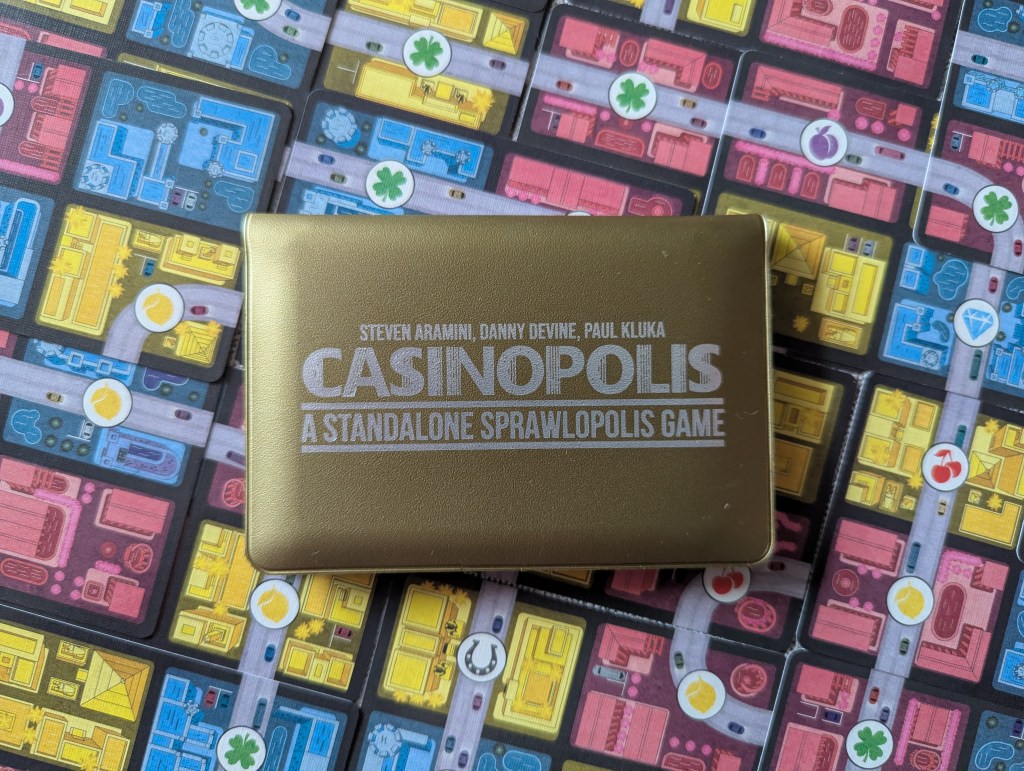

Casinopolis is a micro puzzle game in Button Shy’s successful Opolis line. The entire game fits on eighteen cards and is tucked neatly into a cute gold wallet. This is primarily discussed as a one-player series, but I have tackled Casinopolis now both solo and with a partner. I am impressed by how much “game” has been compressed to fit into such a thin and pocketable package, but I’m coming away with the impression that the Opolis series may not be entirely for me.
Let’s start with how to play.
One side of each card shows a 2×2 grid of your soon-to-be-casino, broken up into colored districts, roads, and slot symbols on those roads. The other side of these cards are unique scoring conditions, as well as target numbers. At the beginning of each game, three cards are flipped scoring-side up onto the table. Left to right, one card is worth one point each time you meet its condition, two points, and then three points. The other fifteen cards are shuffled up and will serve as the tiles you will be placing into a growing grid to craft your casino.

The main thrust of Casinopolis is the simple but robust scoring. You score points for having “jackpots” which are roads with runs of the same symbol. You lose one point per distinct road you create, so you are incentivized to have a few long roads. Further, you also score for the biggest districts of each color but only if those districts touch your longest road, called your strip. That already may seem like enough to chew on. There’s more.
Each card contains all three colors, so creating a single mass is an uphill battle. Frequently, pursuing “jackpots” means disrupting monocolored zones or creating loose roads (negative points) to nowhere. Although there are only eighteen cards, these basic rules pull you in many directions– it feels as though you can never make a “perfect” move without compromising somewhere. Analysis paralysis is at the door, it is up to you to let it in.
So many things give you points, you have to prioritize and figure out which you can reasonably do on any given turn. Problem is, the scoring cards you were dealt come pre-ranked for you. The third one that came out is worth triple what the first one was, after all. If you attempt to pursue your 1-chip objective, unless it can be done incidentally, you will likely fall woefully short. In theory, I appreciate the variability present in how the cards come out, but in practice I ignore one and a half of the scoring cards every round. Instead of choosing what to pursue, I’ve been prescribed a path and need to best walk it. For many, that’s probably exactly what they want.
For me, the idea of stitching together my own casino resort involves more, I suppose, creative liberties. Not that I particularly have imagined myself as the kind of person to design a casino, but you get the point. I want to make something strange, not because my 3-chip card is strange, but because I carved an unorthodox path to victory. The difficult 1-chip card is still there, tantalizing me, promising me that I ought to be factoring it in to some extent, or else it wouldn’t exist.
I also find it slightly headache-inducing to math out how many, exactly, points each play will net me. It is not prohibitively hard to do, so ironically I find myself doing it every play down the stretch. So-and-so placement creates two roads but makes my blue zone two bigger– so it nets me zero. This other play create an extra road to nowhere, doesn’t expand any zone, but satisfies my third scoring objective– that nets me two.
I find myself mindlessly pulled between these conditions, weighing the value of a play which gives me four points but terminates a potential jackpot or another play which gives me two and doesn’t. Again, some people will enjoy considering these tradeoffs and finding a third, secret option which rewards five points. For me, I’m unsure if I should settle for three points or if a fourth point hidden in between seedy cushions is worth digging out.
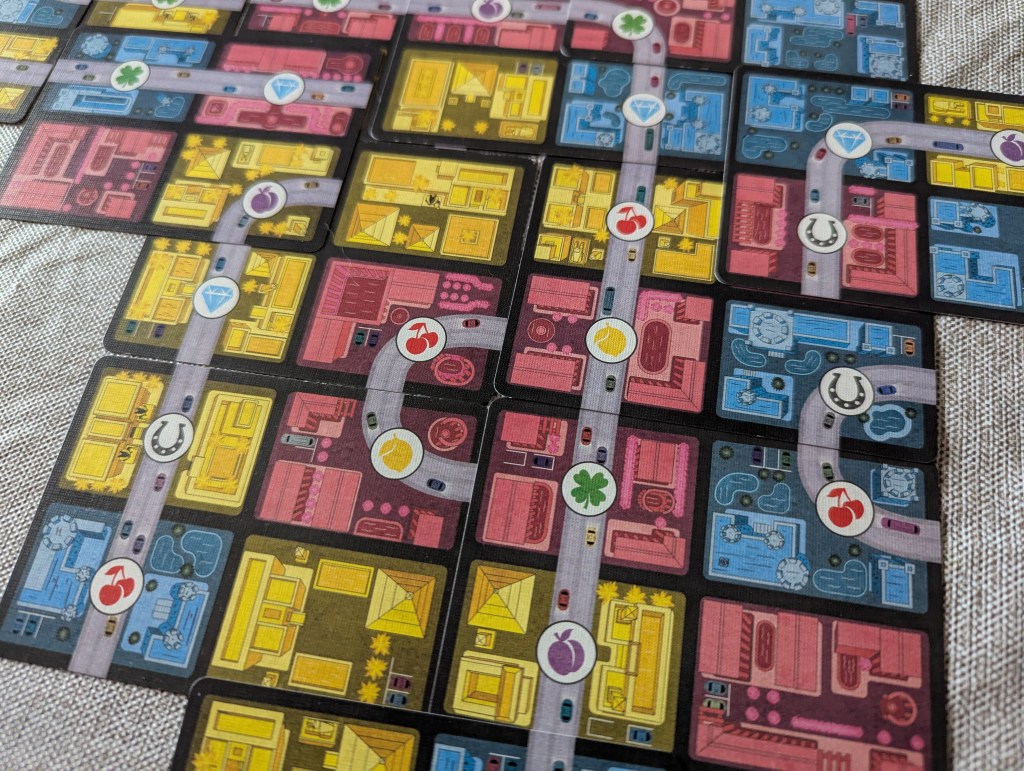
Still, I can’t help but be impressed by the breadth of what is offered in such a small game. Of the eighteen scoring cards, so many of them provide unique challenges that make me feel as though, with the correct set of bets, I could have an amazing time. One scoring card asked me to create roads starting from one color and terminating at another– okay, pretty tough. I wouldn’t even try if it weren’t my 3-chip card, but I had a good time going for it. Turning that part of my brain off that made me do point-calculus every turn made this game a lot more enjoyable. Do the objectives, make the colors big. I’ve heard Casinopolis is the easiest of the series, after all, so vibes-ing through it mostly worked.
Treating Casinopolis as a casual little puzzle to work against, with two players effectively playing one-handed, ended up being my favorite way to play. Going with my intuition or comparing my intuition to my partner’s first choice and living with the result. As the board-state gets harder and harder to digest a dozen cards in, having another mind to untangle your burgeoning Vegas goes a long way.
Maybe we should give up on making that cherry jackpot, one of us muses. It is not revelatory. But for a game that I can fit in my wallet, I do not regret getting it. It can travel with me for now, and I will enjoy showing people: hey, they make wallet games with only eighteen cards that feel like complete games. Isn’t this cool? I’ll have to try out a couple more to find out if any of them truly are my games.

Leave a comment