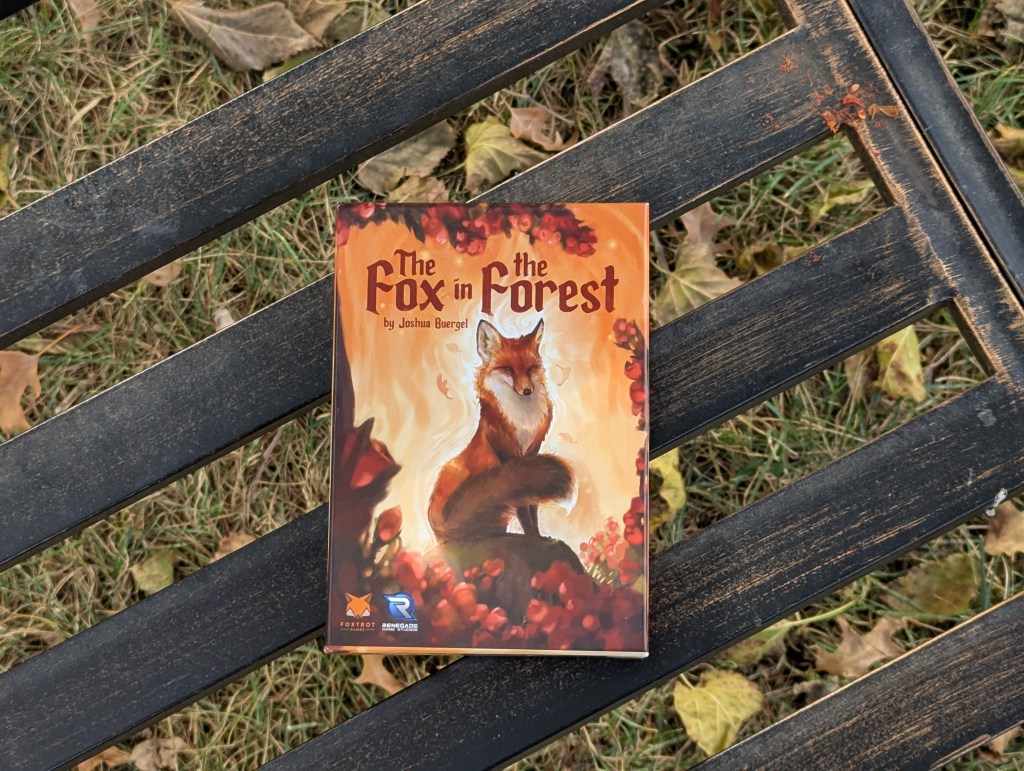

The Fox in the Forest was my first trick-taking game.
If my understanding of board game genealogy is correct, less trick-taking games were coming out in the year 2017. As a trick novice, I tend to find the most mind-bending corners of the genre to be off-putting. I can make it roughly 60% of the way through a rules explanation before the third wrinkle gets added in– I don’t have it in me. Nor have I played the hundreds of hours necessary to be pleasantly caught off guard by a unique subversion. I am still impressed by the mechanism at its simplest; I do not need the extra spice quite yet. I’ve played maybe two dozen hours of tricks and I’ve mostly been quite bad at it, though I’ve had a good time.
The Fox in the Forest has been the source of a quite a few of those hours. It is a two-player only must-follow trick-taker. There are three suits. There is a trump. Maybe in 2017 I would be required to explain these terms, but I don’t think that’s necessary today. Even the non-gamers have played Euchre or Hearts, I figure.
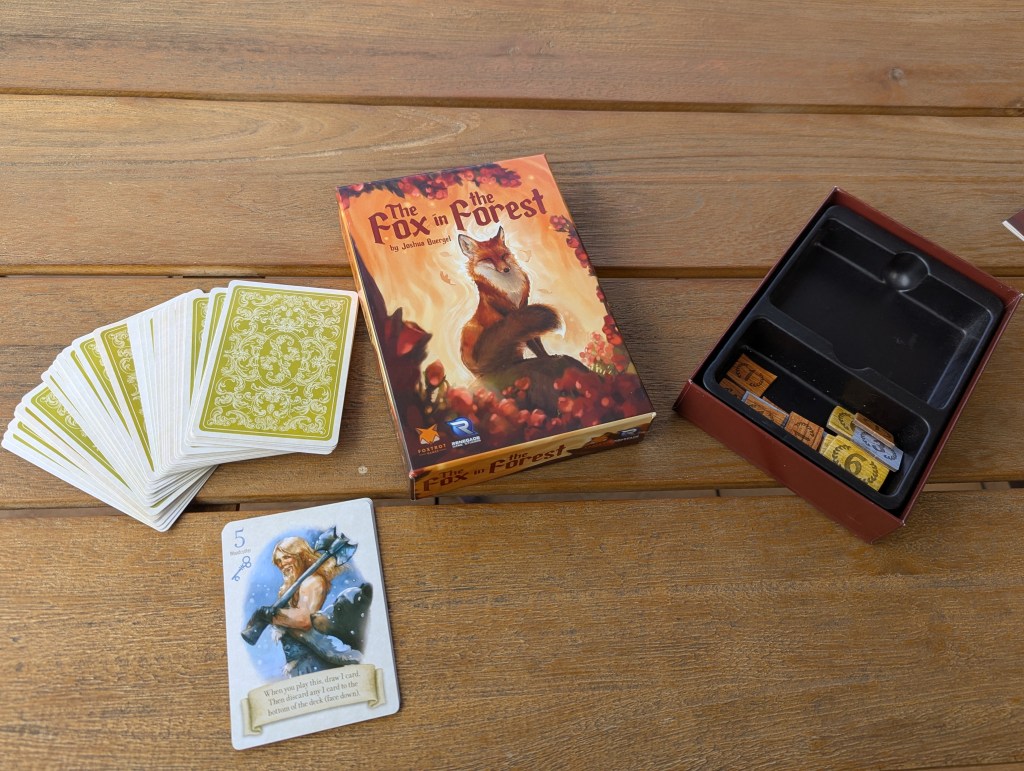
What makes trick-taking so good, to me, is how smoothly and quickly it resolves conflict. By leading a trick, casting out that first card, a challenge is made. When your opponent plays a card in response, that clash is immediately resolved without consulting dice, charts, or any further mechanism. I love that smoothness. In reviews of other card games, I’ve mentioned how much I enjoy the tactility and straightforwardness of cardplay– shuffling around my hand, playing a card here, drawing a card there. Classic. The Fox in the Forest gets out of its own way to make that magic happen.
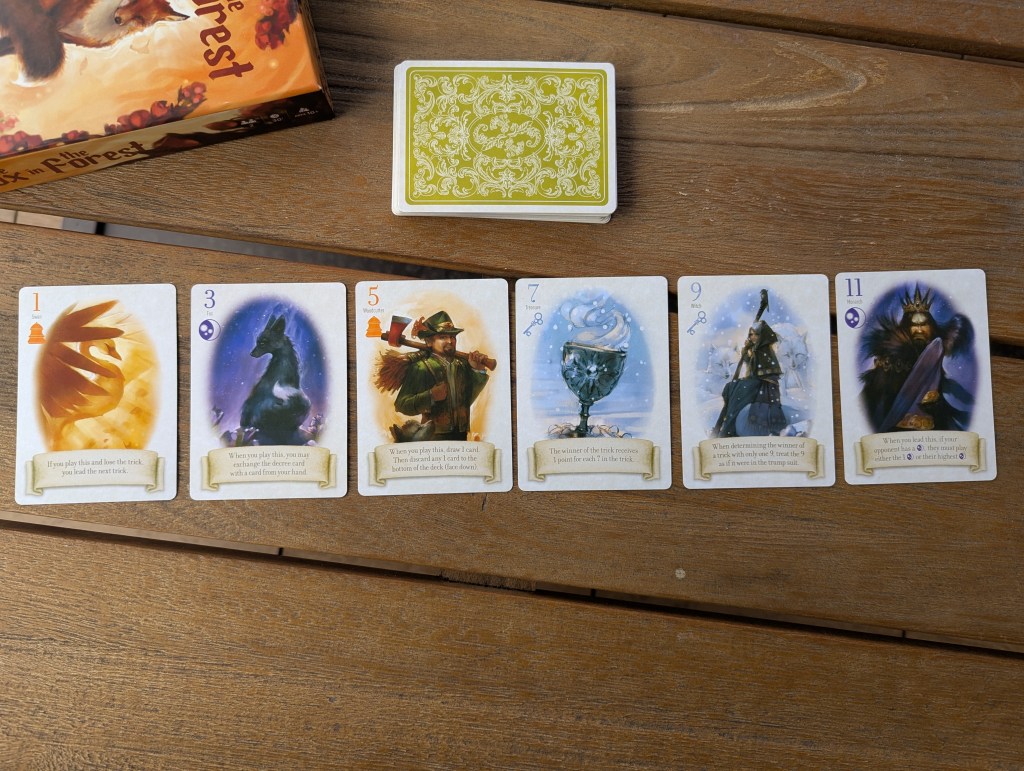
In The Fox in the Forest, there are other considerations to be made other than “play the higher card (of the same suit) into the current trick,” but they are subtly warping rather than explosive. Some cards (the 1, 3, 5, 7, 9, and 11 of each suit) have immediate effects. The 1 lets you lead the next trick even if you lose. The 7 is worth a victory point to whomever wins it. The 3 lets you exchange the current round’s trump with a card in your hand. Each of these cards are elegant, add a layer of strategy, but do not increase the game’s complexity.
The other consideration–the main one, I suppose– you make in a round of The Fox in the Forest is how many tricks you want to take home. The “sweet spots” where the most points are scored are at 0-3 and 7-9. In true fairy tale fashion humbleness beats greed, so scoring too many tricks (10-13) scores nothing. I like this a lot. In other trick-takers where a “bid” has to be placed, I am intimidated by the knowledge that a “perfect” bid could exist. Especially when playing with new players, making a start-of-game bid before they’ve even played a card seems like a guaranteed loss.
Meanwhile, in this game, I am adapting as the hand plays on. If I feel I have a mediocre hand but I pick up the first two tricks, maybe I feel confident about winning 7-9 while also feeling safe I won’t win 10+. Maybe I am missing a suit almost entirely, which means my opponent has a lot of it. If I could make that suit trump, I could make my opponent win 6 tricks in a row– and their “greed” will be punished. The woodcutter lets you see another card from the deck, and like any good card game, that one draw could drastically change your gameplan. What does my opponent not have? What do I know that they don’t?

I also appreciate that there are only 3 suits. Again, it seems like something that would at most be a subtle change. However, my ability to count cards and remember what has been played is fairly awful in 52-card deck games. Here, with 3 suits and 11 cards each, it is suddenly manageable. There are also only 6 “unknown” cards each hand, so I can predict at least some of the cards my opponent must have been dealt based on what I don’t have. Even if you aren’t someone who counts the cards or sets little fox-traps, there is still room for you in the forest. If your plans collapse, maybe you got to 4 wins on accident, all is not lost. Scrapping for an extra trick or two to get up to 5 or 6 is worth a couple points, too. As this was my entry point into the genre, I appreciate that little consolation prize. Without it, I would be getting blown out by my partner even more.
In all, this game stands out to me even after having played so many other games like it. Each trick matters. I can teach it in a minute. I was able to introduce it to people who play trick-takers without them rolling their eyes at how incomprehensibly different it is than the ones they like. It lets you feel the satisfaction of a five beating a four, but also the hubris of doing that calculus one too many times.

Leave a comment