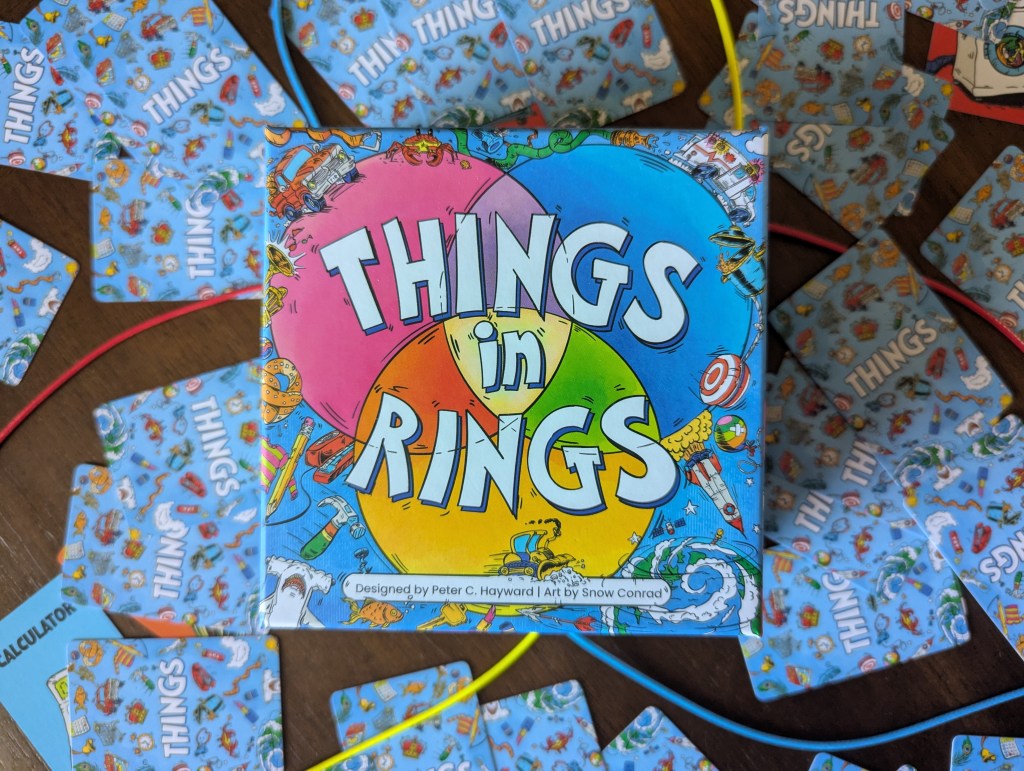

When a board gamer goes out of their way to describe a game as an “activity,” in my experience, they are saying the game is mostly bad. The points don’t matter or maybe the rules don’t really matter. When they say it’s an activity they mean it’s a distraction or an icebreaker, but it doesn’t feel like a game. I am guilty of this, too. I am someone who tries to win party games and is discouraged when “keeping score” isn’t really part of them. Today I am writing about a game which looks like an activity–often feels like one while you are playing it–but there’s a lot of good in it. It has a good heart. It’s funny.
In Things in Rings, players are taking on the role of what I can only assume are amateur semioticians, trying to suss out meaning from a couple of circles. One player is the “knower” (a properly Suessian term for a game with such Suess-inspired art) who has laid out a Venn diagram and knows what each circle of the Venn diagram represents. Maybe the red ring is “words that begin with two consonants” and the blue one is “things that fit in the palm of your hand”. The other players, armed with a hand of random object cards called Things, will try to place their Things in the correct ring(s).
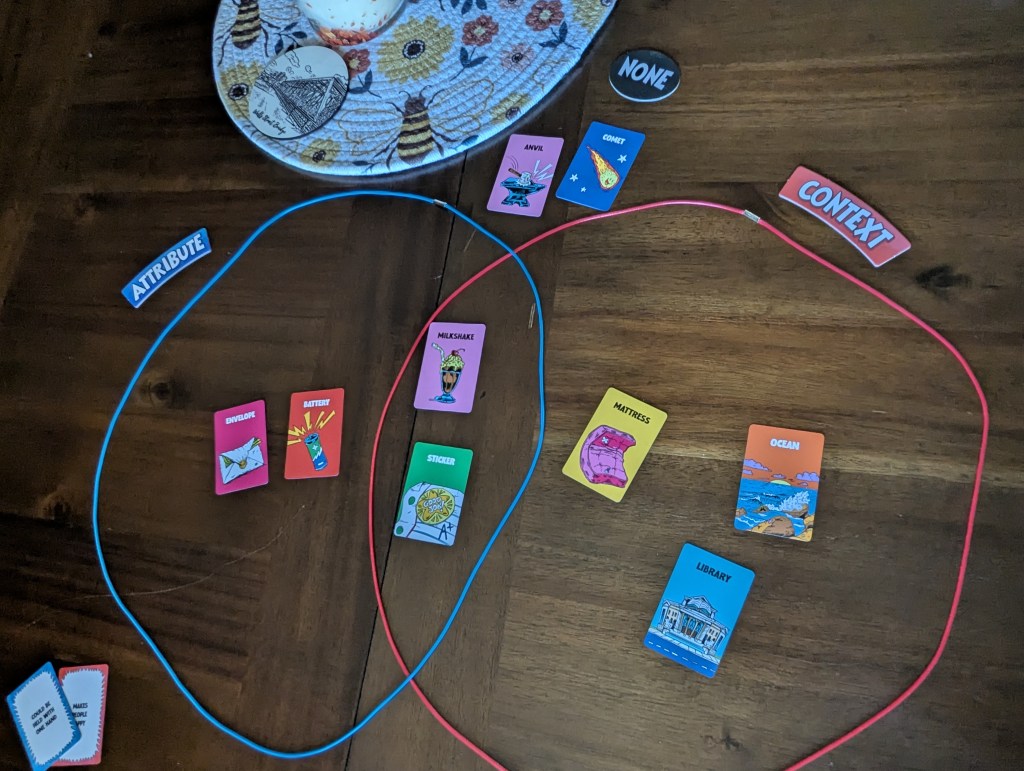
In the beginning, players have practically no information and so they slap a random Thing in a random Ring. The knower either accepts their placement or corrects their guess and puts it in the right place for them, giving them information for what quality each ring might be describing. Whoever deduces (or induces?) enough information about the categories to correctly place five things first wins.
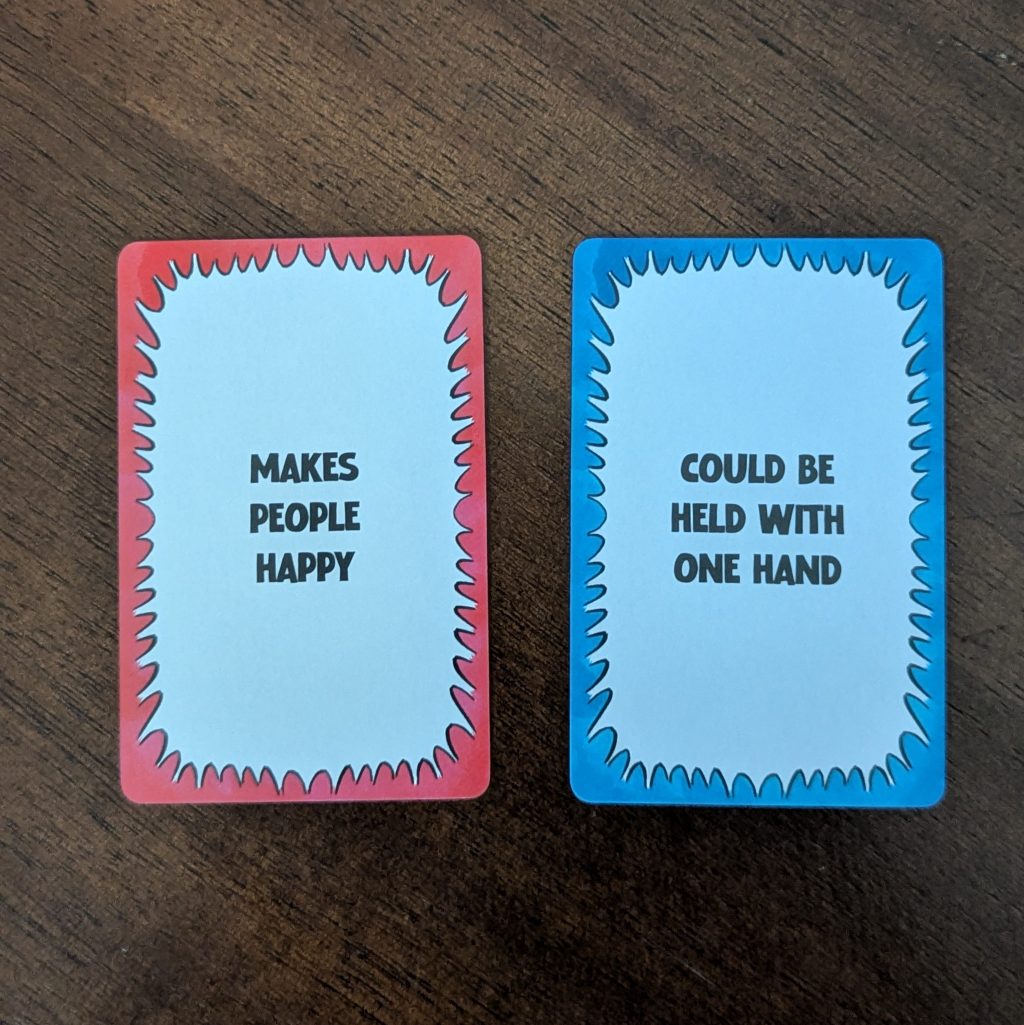
Placing an item in a ring correctly can feel like deciphering an impossible text– but in reality, you have okay odds of getting it right accidentally. And the ring, as indecipherable as it may seem, could be something as simple as “the first two letters are in alphabetic order” or “usually found in groups”– and those are on the higher end of difficulty. The knower’s job is often no easier. Are staplers usually found in groups? As the knower, it’s your job to definitely declare whether or not they do. Do these things fit in the palm of your hand? Again, make that determination right now and, I suppose, make all future determinations with that in mind. You have a hilariously difficult job for someone who is, in theory, only facilitating the game. Being the knower is as much “the game” as being a guesser.
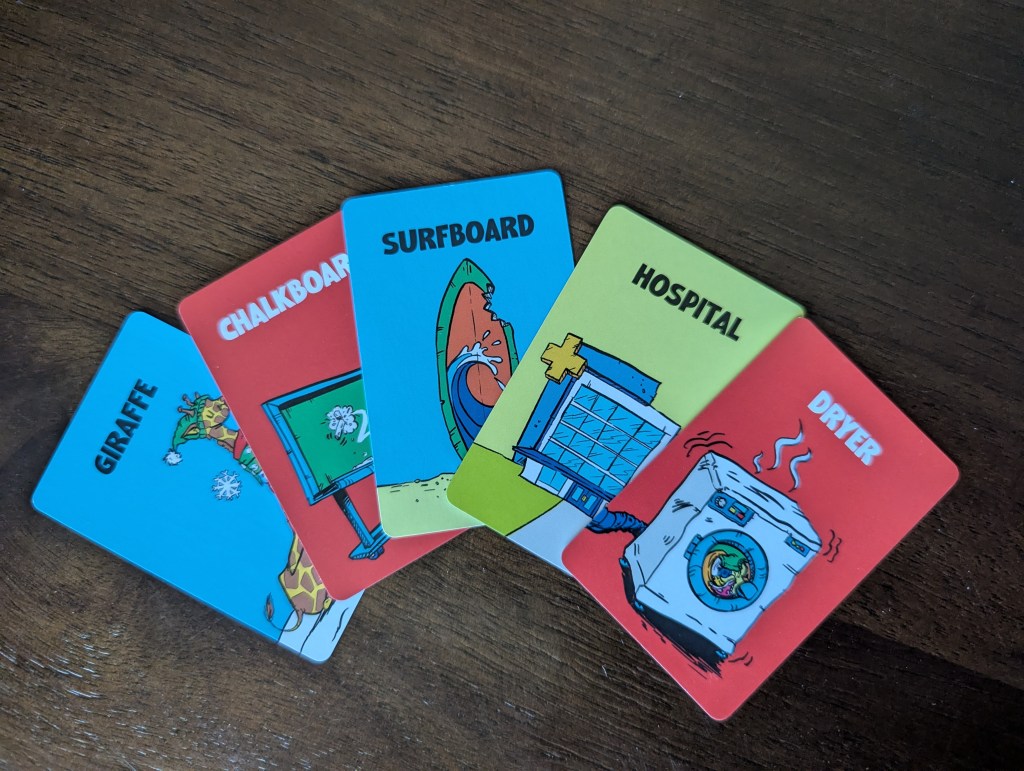
Things in Rings plays in the grey area of our understanding of the world and language, but it does not “make you feel dumb” as some party games are liable to do. I bounced hard off of That’s Not a Hat!, which gamified our failing memories. I don’t want to think about that! How hard it is to categorize the world, though, is a comparatively lighter topic I can roam around in. In Things in Rings, you are going to be asked to categorize things in ways you’ve never thought to, both as the knower and the placer. What do robots, hats, wardrobes, and oceans have in common? You’ll be racking your brain, as if there is some combination of labels that will fit perfectly. Uhhh things that you uh sometimes you put other things into… them? The difference is, the feeling isn’t “I should be able to do this easily, I’m so dumb!” Instead, it tends towards, “I’m missing something and it is going to click eventually.”
This is also not a game where you argue incessantly over who is right and who is wrong. It threads the needle right through all of these thorny problems. At the end of the game, when the grand reveal of what the categories were happens, there are quite a few “aha!” moments that any good “thinky party” game ought to have. Depending on the length of your play, sometimes this conversation after can be as long as the game itself.
The “Word” ring, which describes a property of how the word is spelled or constructed, is often the easiest category to logic out. It has potential to be the least interesting one, unfortunately. There is no room for interpretation from the knower– the word either has the quality or it doesn’t. But when you are playing with a kid for whom “compound word” includes items like “sandwich”, the game can evolve. The “word” ring being solvable does place a sort of cap on how hard the game can be, too, as with three rings the game can otherwise get fairly long. Things in Rings takes you on a little journey through understanding and does not overstay its welcome.
In the realm of games where a judge determines other players’ submissions, this game is thoughtful and uniquely funny. For a word game, it stands out for not being strictly spelling or word-association. If you are not interested in the competitive aspect, there is even a cooperative mode which I find equally good if your group wants to discuss and debate out loud the whole time rather than keeping deductions private. It may not be as infinitely replayable as some other party games–there are only so many category cards, there is only so much room for creative input– but I recommend it anyway. It creates its own niche, its own ring if you will, and slots neatly into that spot.

Leave a comment