

Until recently, I owned a single bookshelf that was host to my books, records, DVDs, and board games. I do not have a lot of space for big games with lots of components– so I don’t own any. I’ve never backed a game on Kickstarter (note to self: revisit this in a year and see how you’re doing). I’ve never devoted a shelf to one game and its myriad expansions; even my Keyforge had to share its shelf space with Netrunner. If you read any of my previous reviews on this site, you’ll note a proclivity for smaller box experiences that I can actually get to the table enough times to write 1000 relatively thoughtful words about them.
My single shelf solution wasn’t working. I had about forty or fifty-odd games, half of them very small boxes, but they found ways to spill out onto speakers, onto desks, onto chairs people would’ve liked to sit in. So I got a new shelf, just for my board games. My previous biggest game, a copy of Oath, went from hidden atop the shelf to having its own cubby, proudly displayed.
What they don’t tell you at the online furniture retailer is this: once you buy a big shelf and call it “the boardgame shelf”, you are going to want to fill that shelf with bigger and bigger games. Horrifying, really.

I heard a lot of good things about Death May Die, though I do not have any previous affection towards Lovecraft novels or cosmic horror broadly. I was convinced, though, having played co-designer Eric Lang’s Marvel United and enjoying it quite a bit despite also having no interest in the Marvel universe. I was also intrigued by the idea of a board game whose grandiose appearance belied a simple, streamlined core system underneath. I picked Fear of the Unknown, the second core box of Death May Die, because it was cheaper and I figured it made no difference to me whether I was thwarting Cthulhu or his third cousin. Since then, I have played a lot, some solo, some with a partner. I like it way more than I thought I would.
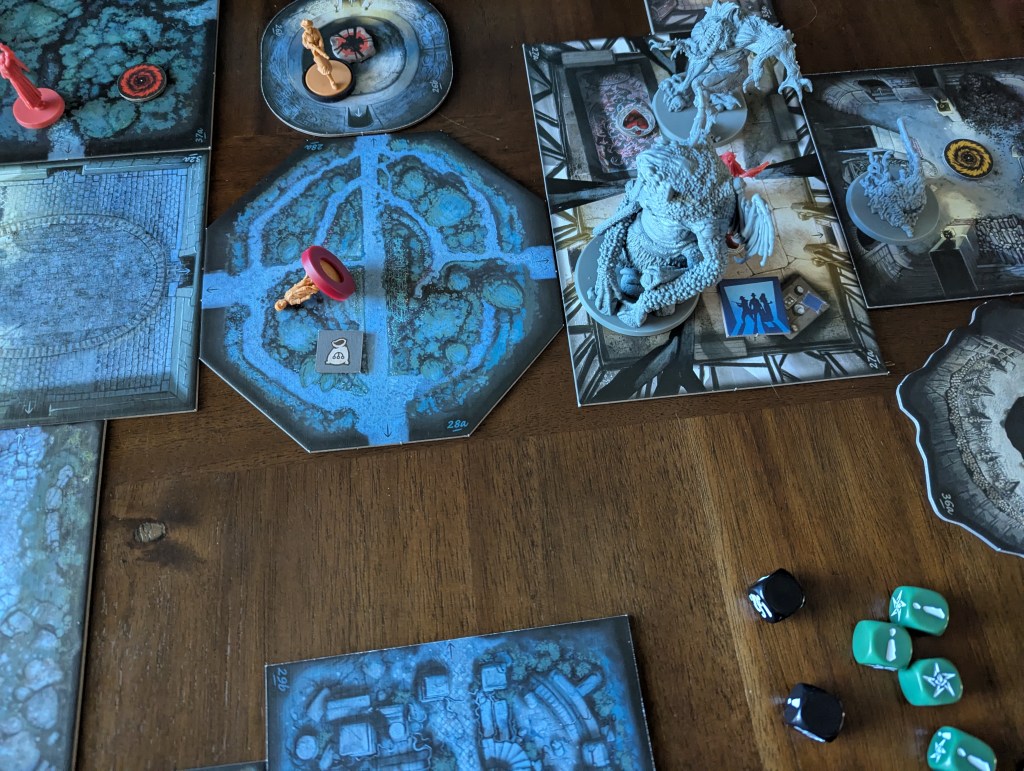
Fear of the Unknown is a cooperative game of throwing wild handfuls of dice to disrupt a cadre of cultists who are bringing an Elder One to the Earth. In each disconnected, one-off “episode” these cultists will be channeling the dead, holding ritual daggers, and walking around like they own the place. Players choose from a roster of 10 unique investigators and are given instructions on how to disrupt the ritual so that once the Elder One is brought down to the world, they will be vulnerable to punches.
The big twist of Death May Die is– well, actually, there’s two big twists. The first is that while you are trying to disrupt this ritual, the Elder One’s summoning is literally inevitable. You are going to get a climactic boss fight even if you trounce over those cultists. Most of the time, the puzzle of the ritual is more mechanically interesting than the boss fight that awaits on the other side of it. It feels like an attempt at appeasing both types of players– you always have the tactical ritual disruption to solve and the dice-chucking boss fight. If the Elder One is summoned, to not invalidate the puzzlers of the group, the ritual must still be disrupted. I don’t know what exactly we are disrupting if Cthulu always shows up at roughly the same time, but I understand the gameplay and narrative justifications. We wouldn’t want an anticlimax, so the bad guy shows up.
Each character starts with three abilities; two from the common pool of abilities and one unique ability only they have. These abilities can each be leveled up, and when they level up, your investigator will be able to do a litany of powerful things. A Brawler goes from getting a bonus di when attacking a nearby enemy to being able to wombo-combo every enemy in a room. Characters with Swiftness go from being able to move an extra space when they move to being able to run around the entire map without breaking a sweat, and bringing friends with them while they do it. You need to level up if you want a chance to win against the ever-escalating list of treacheries happening around you. The other big twist of Death May Die is how your characters do this leveling up.
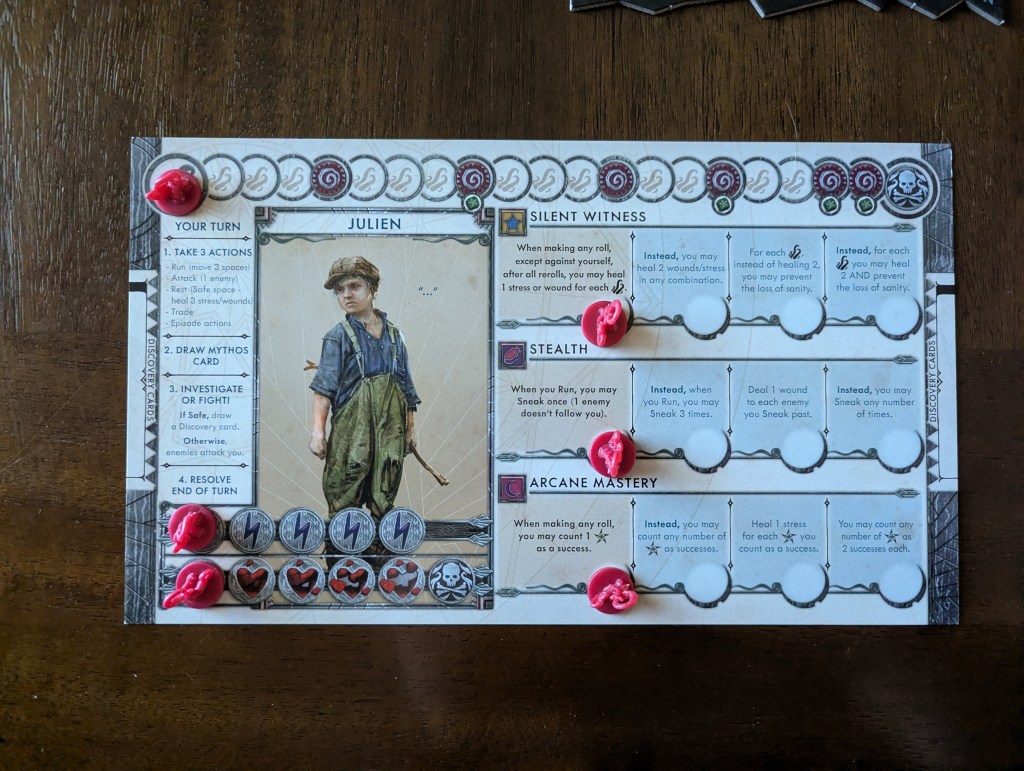
Whenever you roll the dice, whether that be shooting a Ghast, inciting a riot to distract the guards, or getting attacked by that same Ghast, you will likely lose sanity from a di result. Hitting a new sanity threshold causes your character to lash out in a way determined by their dealt “insanity” card. However, these thresholds are also where you level up and potentially get more bonus dice for all actions going forward. At the end of this track is death, but what are you going to do– not roll the dice? You don’t have much of a choice. Losing sanity is going to happen, it is just a matter of when and where, and whether you will be able to capitalize on the gains before your character is lost. Towards the end of this track, you will be rolling boatloads of dice– which is convenient, because “boatloads of dice” is about how much dice you need to work through the several health bars of each Elder One.
This system creates enough drama to keep each of the six episodes in Fear of the Unknown tense and surprising. I also enjoy the spectrum of success present in this game. For a brief moment before going insane, you’ll get to rolling 5, 6, 7 dice at a time and steamrolling just about everything you attempt. But at the beginning of the game, you only have 3 dice. All of those starter dice have the “lose some sanity” symbol on them. There will be tradeoffs.
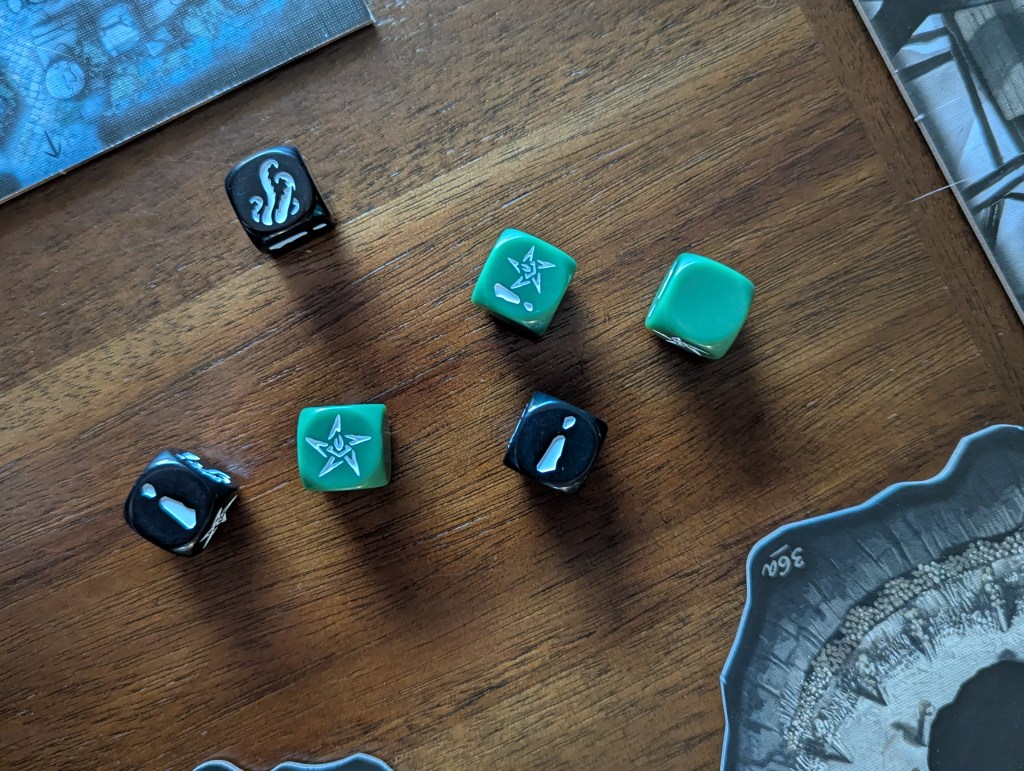
Rarely do you end a turn or even an action without any change in game state. There is almost a TTRPG-esque “fail forward” system in this game. Everything is interconnected, with penalties and rewards feeding into each other. To oversimplify the challenges players face: enemies need to be killed, wounds and stress need to be healed, sanity is a fail-state that you need to climb towards regardless, and the advancement track is a hard-timer. If you fail to kill an enemy (1), you may end up taking some wounds (2), but you could trigger a sanity threshold (3) which makes something interesting happen immediately. Even if you do the most “boring” possible thing– hide in a corner and lick your wounds, the game brings the excitement to you through Discoveries.
If there is one singular mechanism I wish more games would crib from Death May Die, it would be the discovery cards. Each episode is an entirely standalone experience; maybe you’re at the site of an old witch trial trying to prove the innocence of a long-dead ghost, maybe you’re deep in the Paris catacombs where cultists are building a ritual. Whenever your character ends their turn “safe”, they search through ancient tomes, get spooked, and otherwise get into whatever trouble they can. You read the middle portion of the discovery card aloud: a friendly ghost wants to chat you up, you find a gun, you find a map, etc. Then, you take stress to gain one of the two options on the card.
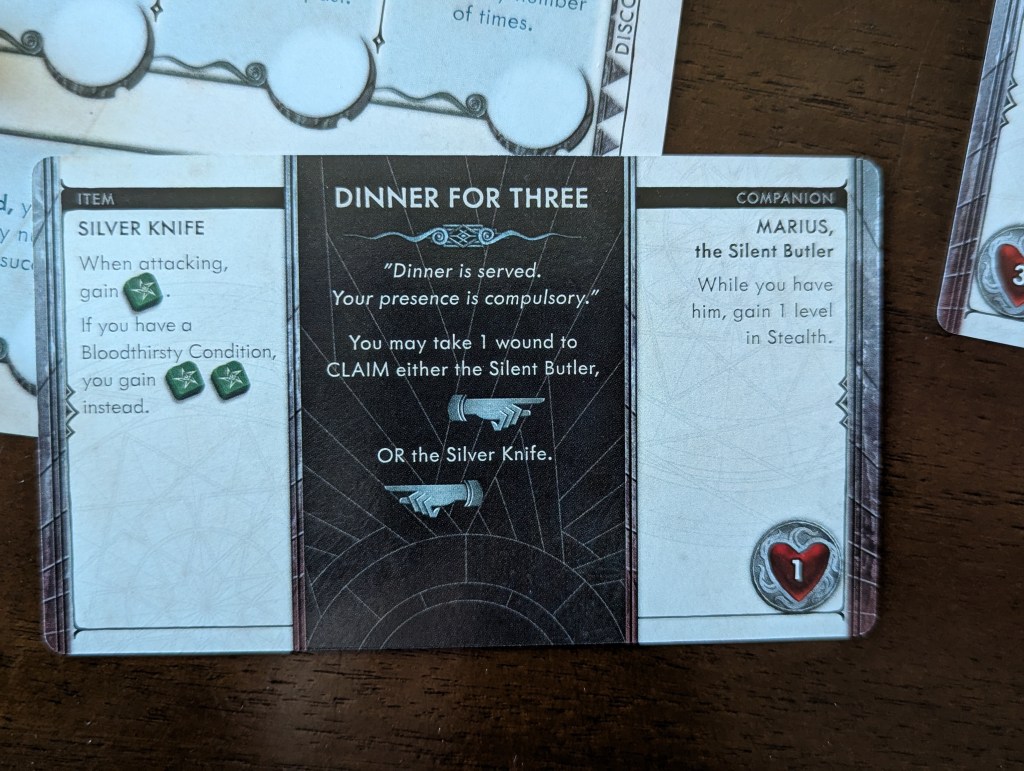
The flavor and narrative of the episode is revealed through these discoveries. Sure, each episode has its set of episode actions and special rules to tell you what you and the cultists will be doing today. Ultimately, though, it is through these discovery cards that the game’s wit comes into focus.
Items you pick up are tailor-made to warp the rules of the encounter ahead, often completely changing what strategies are available to you. Even when an item is fairly generic– the equivalent of finding a healing potion or a blunt weapon– it paints the world as large and the corridors as heavy with secrets. Conditions you take (the bad sort of discoveries) are also specific to the episode, hitting you where it hurts for exactly what you are trying to do. Companions you find may be a bit of a nuisance, or in search of someone else, or capable of offering you a devil’s bargain right then and there.
Instead of a collection of tiles and miniatures, I feel there is something bigger and more cinematic happening. The one-ish paragraph on a discovery card often tells me more about the episode than all the sculpted detail on the episode’s gruesome little baddies. I can imagine a more modular discovery system, with more randomness and variability, but that version of Fear of the Unknown is much worse.
This is, in my experience, a fairly challenging and extremely swingy game. Somehow, I don’t feel at the mercy of the dice. Sure, a couple of early bad rolls can put you behind the curve in a meaningful way. However, most of the time my failure in Death May Die feels like my own. I was too cowardly, or I didn’t leverage an incredibly powerful companion I had, or I leveled up the wrong abilities and so was unbelievably powerful at the wrong subset of things. I can’t say it enough, swingy is the name of the game.
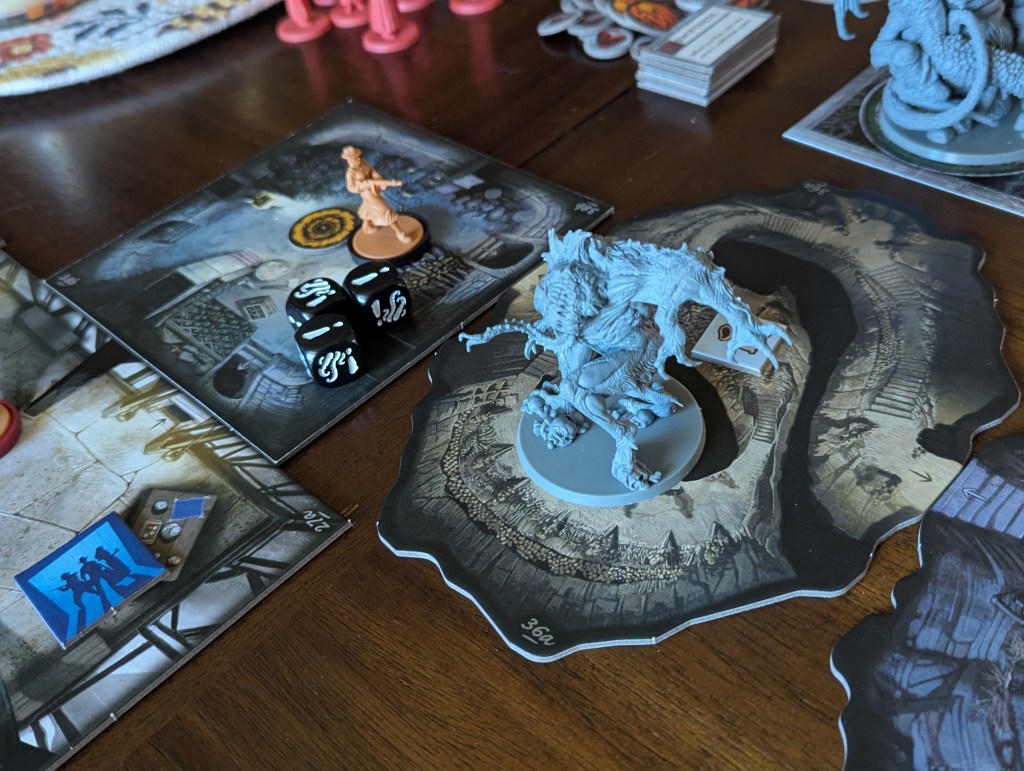
An untimely Mythos pull (the card which determines what the bad guys do on their turn, so to speak) can be the difference between disrupting the ritual next turn and instead having one Investigator abducted and dragged across the map. Compare that to any other card in the Mythos deck, which can sometimes for all intents and purposes read “This card does nothing.” As someone who wishes some cards in Final Girl read like that, I appreciate the variance in difficulty turn by turn.
Maybe you’re the type of person to feel cheated when cards like that come up. Or maybe you will be bothered when two backbreaking Mythos cards in a row put you three steps back. I want things to ratchet up and then, unexpectedly, have a moment of respite. In games like this one (maybe all games?), I want to have easy turns and I want to have difficult turns. I want to tee things up and then knock them down, or just have a turn where I can relax and rest my character. If everything was always cranked to 11–if every turn was a mind-bending puzzle through which true genius could ascertain the only winning sequence of plays– I would probably grow tired of it.
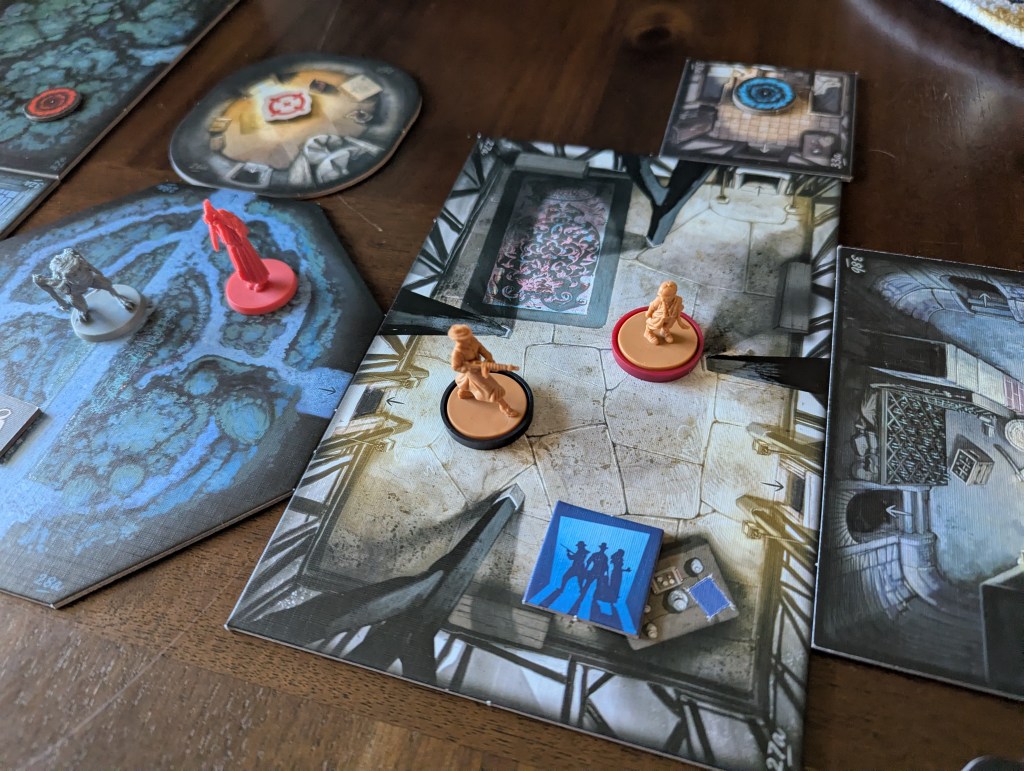
Sometimes, it is incredibly simple: I’m very close to death, I am going to run away and heal. Or: I am going to shoot this giant frog with all of my actions as a reward for all the tactics and planning I did earlier. In proper Ameri-trash fashion, we are fist-fighting ancient, incomprehensible gods by throwing swelling handfuls of dice at them. You get to feel powerful in the face of the inevitable. It figures that’s the most straightforward part, right? How hard can it be, it’s just an unintelligible mass of tentacles that drives you insane to even behold. Just kick it or hit it with a hack saw.
This game is not the most fun to take out and setup. Nor is it the most fun to box up and put away. There is a lot of plastic to handle, things to punch out, tokens that could potentially be lost. I question if more boxes of Death May Die, with the ability to mix and match investigators and Elder Ones, would be worth it. Do I need more boxes to take out and put away each time I want to play? I think I will cave and get more eventually– apologies to my shelf. The payoff has been that good.


Leave a comment