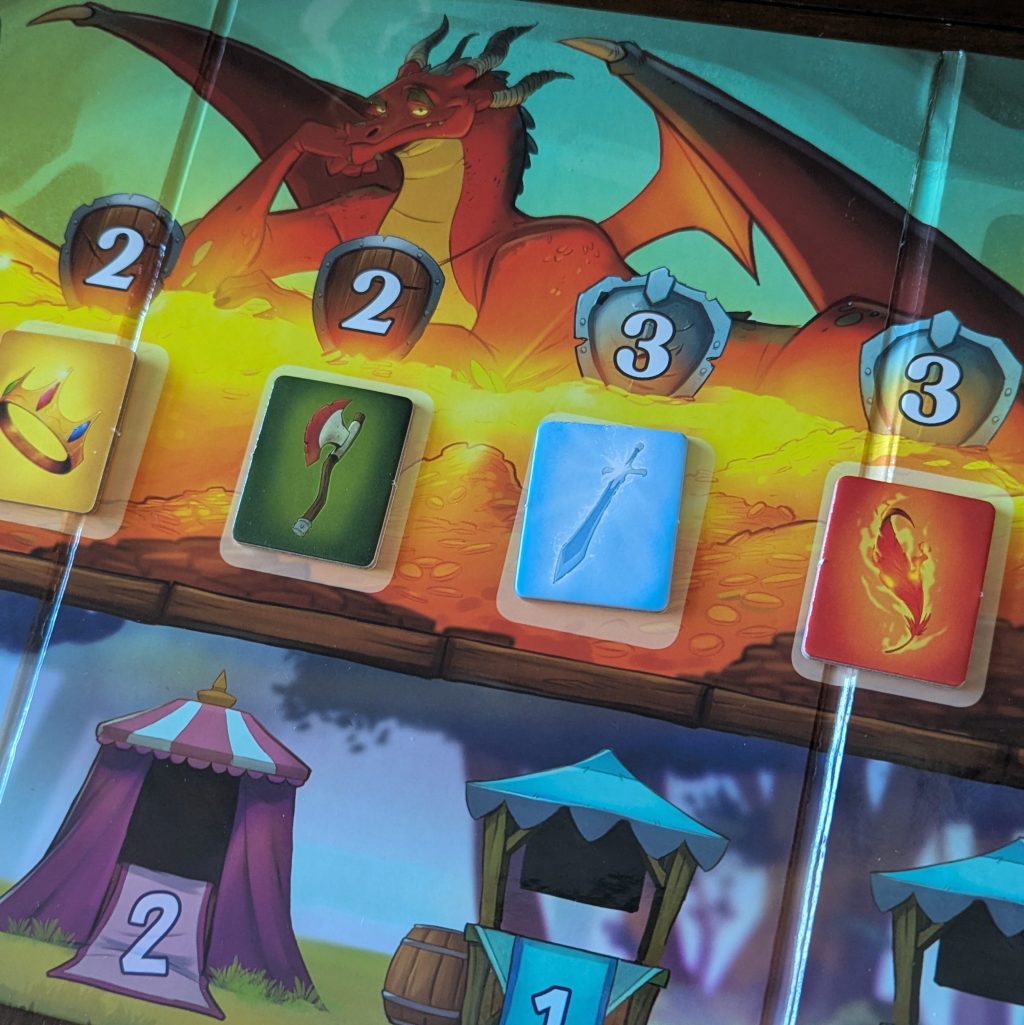

Oddly enough, I am reviewing a second game in the month of October whose name contains an exclamation point. I was, to this point, aware of less than five games whose names were even worthy of being shouted. The name is not the weirdest part. Somehow more surprising, Please Don’t Burn My Village! has a smoldering dragon on its cover– suggestively raising an eyebrow at any would-be players and expectantly awaiting its bribe. Strange stuff going on here.

I don’t know how to feel about the presentation here. Nor do I fully understand the mechanics of these bribes, these curses, or the relationship I may or may not have with the aforementioned dragon. And yet…
Breaking through all of that–or perhaps burning through it all– is a worthwhile, quick-playing push-your-luck stock manipulation game. Published by Fireside Games, Please Don’t Burn My Village! is a game where players are competing to put together the best tableau of offerings to pacify a dragon. On your turn, you’ll do one of two things with the cards in your hand. You may play cards to one of your bribes, which is effectively your scoring area. Placing these bribes causes cards to cascade out into the market stalls. Your other available action is discarding cards to take a stack of cards from one of those market stalls. Sounds simple, yeah?
The rub is in what I call the self-fulfilling prophecy mechanic in Please Don’t Burn my Village! By investing in a good– offering five king’s crowns or a trio of glittery swords to our beloved dragon– that good immediately becomes much more valuable for everyone. This is an extremely temperamental dragon, who seems to value objects in order of what was most recently plopped down in a pile at its feet.
Oppositely, whenever you choose to divest in an object by discarding it from hand, the dragon’s valuation of that good plummets. The things you like are worth bunches of points, the trash is worth far less. You are well on your way to a unscathed village.
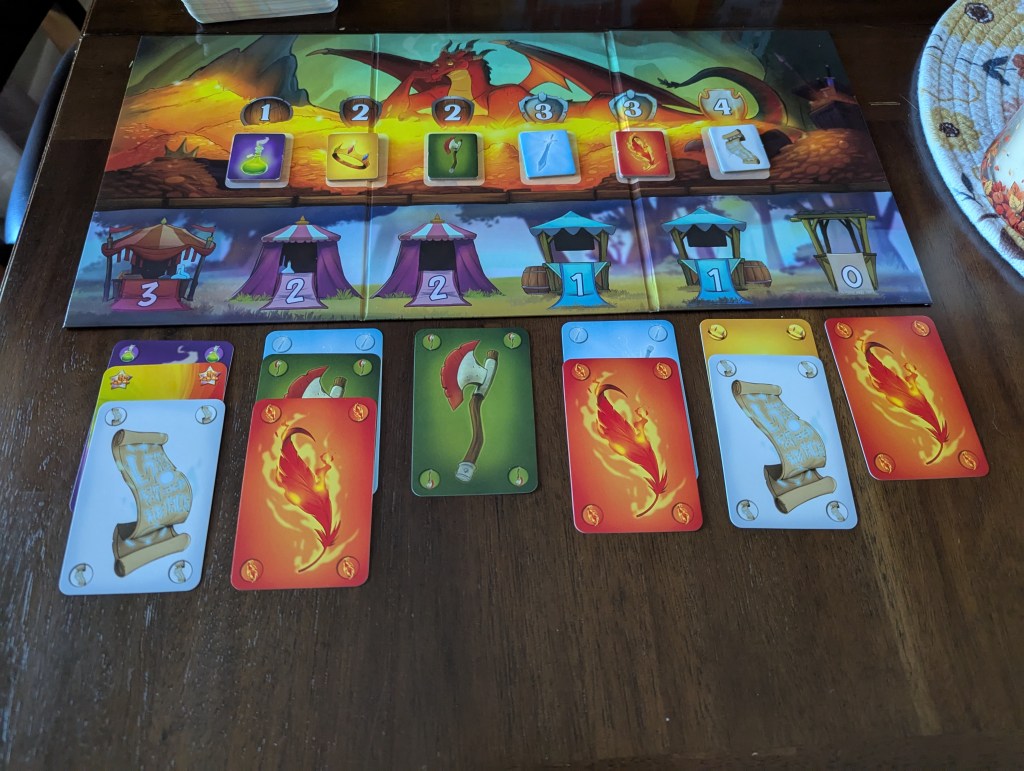
The problem lies, like most things, in other people. If you’ve resolved to discard every last potion you ever happen upon, potions will tank. If you bribe with a bunch of barbarian axes, axes will rise. If someone else, or two other people, see your stockpile of axes and decide to keep themselves out of that market– well, their prophecies will self-fulfill, too. Every time they reach for a market stall you bet they’ll leave an ax on top of the discard, disintegrating your value.
Like many a stock market game, timing is everything. Even if you conspire to keep potions worth 1 victory point, a timely all-in on potions from someone else can maximize their value on the game’s last turn. “When is the last turn?” you may be asking. “Can I do all my investments on that one?” would be a good follow-up question. However, this is a push-your-luck game where reaching and predicting the end involves, well, gambling and a whole lot of not-knowing.
The game ends when the draw pile runs out, but how many cards get pulled from the draw pile each turn is something you’ll be wagering on in the waning moments. Whenever a bribe is placed, cards spill from the draw pile into the market. The first card goes into the 3-discard shop, then the 2-discard shop, and so on. This will continue, looping even, until a Wild or the bribed card shows up. If there’s 9 cards left and someone bribes the dragon with a couple of those holy-looking scrolls, we might be right onto scoring then and there.
Stockpiling up a single good and planning to send it “to the pale draconic moon” (as it were) is often complicated by these market stalls, too. Cards tend to accumulate around the top of this market, desirable or otherwise. If you want a bunch of cards– which you do, if you are in the market for a bunch of points– you probably want to take from one of these overflowing market stalls. This means you have to find opportunities to pitch some unwanted cards into the bin or, perhaps, reconsider your investments. Worse, if those opportunities never come, cards in your hand are worth negative points at the end of the game.
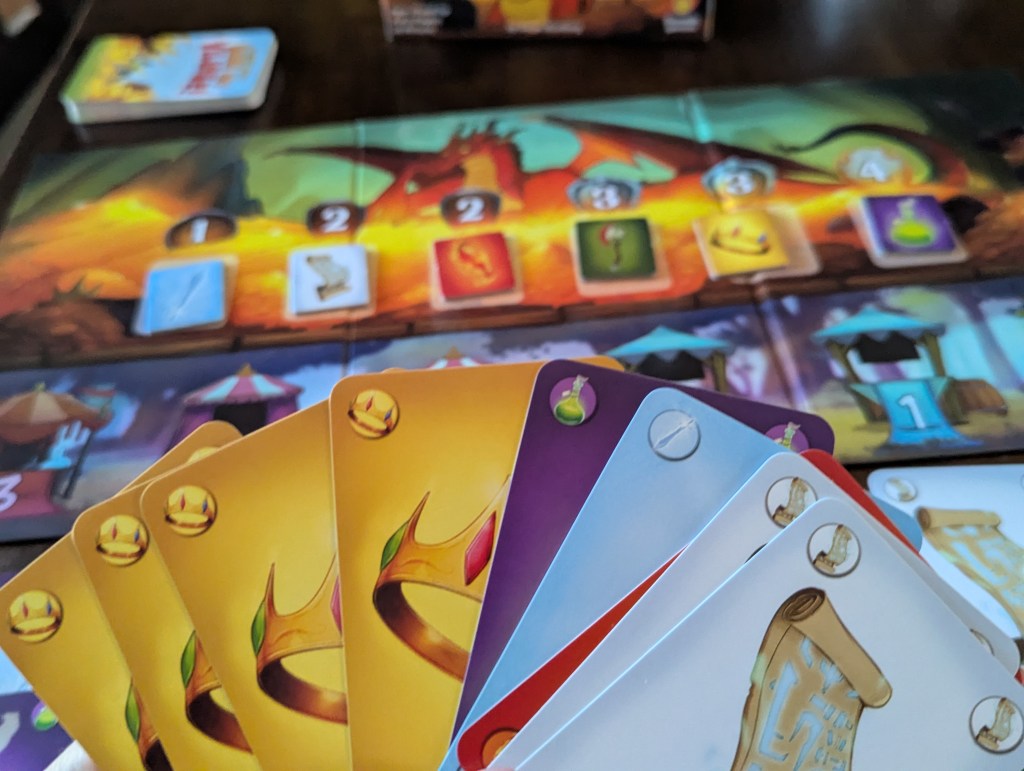
Hilariously, rounds of Please Don’t Burn My Village! often hinge on whoever picked up the unwieldy mess of cards last. Were they able to do something with those cards before someone else burned the rest of the dragon’s patience? Were the rest of us all too cowardly? Is it funny either way, seeing someone fumble around with 20-something cards while the rest of us have 3? I’d say so, yeah.
Unfortunately, I do have a ding against the dragon’s token board. The little divots in the board snag the tokens a bit as you try to slide them around, so you’ll often have to pick up and place them which adds a micro-second of delay. In a game that’s so quick and snappy, the half-second delay every other turn starts to add up, especially when it impedes an otherwise tactile experience. My brain wants me to slide the tokens around instead of pick them up; I’m not sorry. That’s such a small thing, though. When someone else is captaining the dragon’s board, I don’t notice it and nobody else has complained.
Please Don’t Burn My Village! belongs to a family of card games where players are allowed excessive cards-y actions– draw a bunch of cards, play a bunch of cards. I mentioned this in my Nanatoridori review, another game where scooping up a big stack of cards made others sweat about what exactly you were planning– and how big your next played stack of cards was going to be. Please Don’t Burn my Village! is in the same vein. If you like adding an eighth card to an already massive set of seven, this is for you.
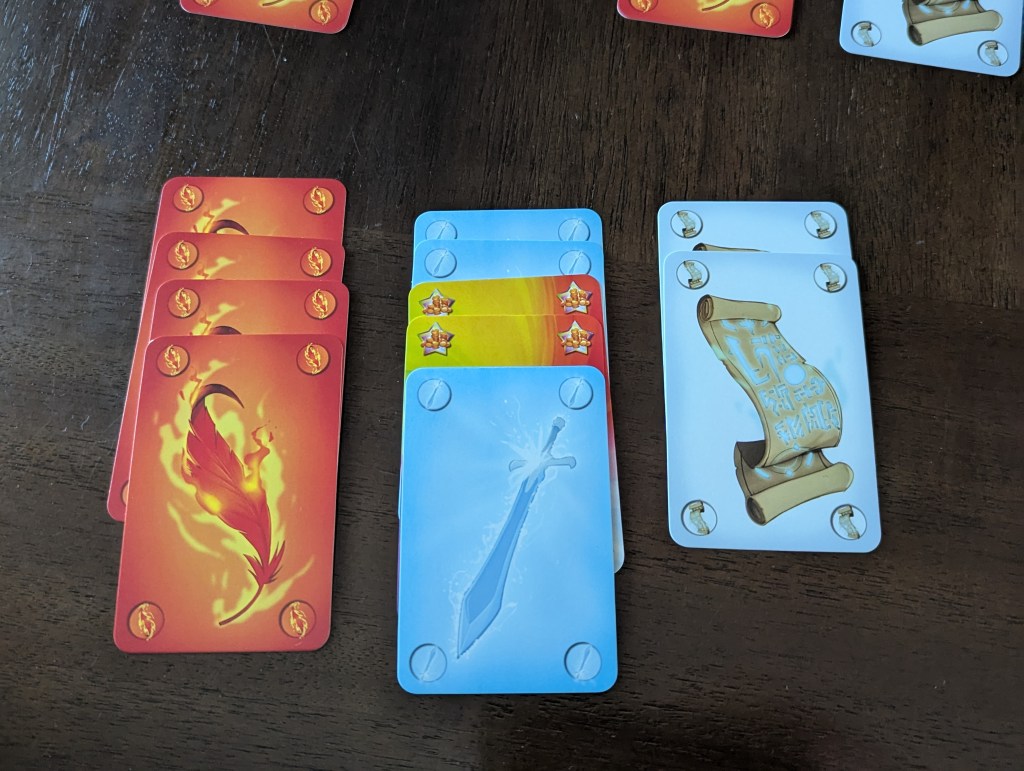
The dragon’s extreme volatility plays into making every turn meaningful, too. Making a decently sized bid can completely reverse the market, which feels satisfying if a little swingy for some players. I want that in a 20 minute game though– items should be able to go from 1 victory point to 4 and vice versa in one turn. It’s one of the best parts of Vegetable Stock and it’s great here, too. I would just advise not to get too attached to your best laid plans, whether they were made by mice and/or men. Someone else is going to devastate the value of your precious potions more than once. Maybe you should wait until the last minute to get invested, or hop on someone else’s bandwagon. Either way, this probably won’t be your jam if you are discouraged by massive disparities in final scores.
I find Please Don’t Burn my Village! a smooth experience to breeze through, even with thorny scoring. Refilling the market one card at a time, for instance, is a tiny bite of bliss for anyone who enjoys the act of dealing cards.
Even if my gamble is foiled a turn or two down the line, the immediate market shifts from my bid are satisfying. I’m a sucker for speculating on a market, and this lets me do it in twenty minutes. Don’t expect tense negotiations or the strategic building up of a long-term stock position. If you’re looking for an opportunity to put an economics degree to good use, this is not it. There are simply not that many beans to count.
I don’t miss the beans. I’m going all in on potions. Maybe I’ll diversify my portfolio-majig with a holy text or two. Maybe I’ll score 50 points– or maybe you’ll ruin me forever and I’ll score 10. I’ll have a good time either way.


Leave a comment