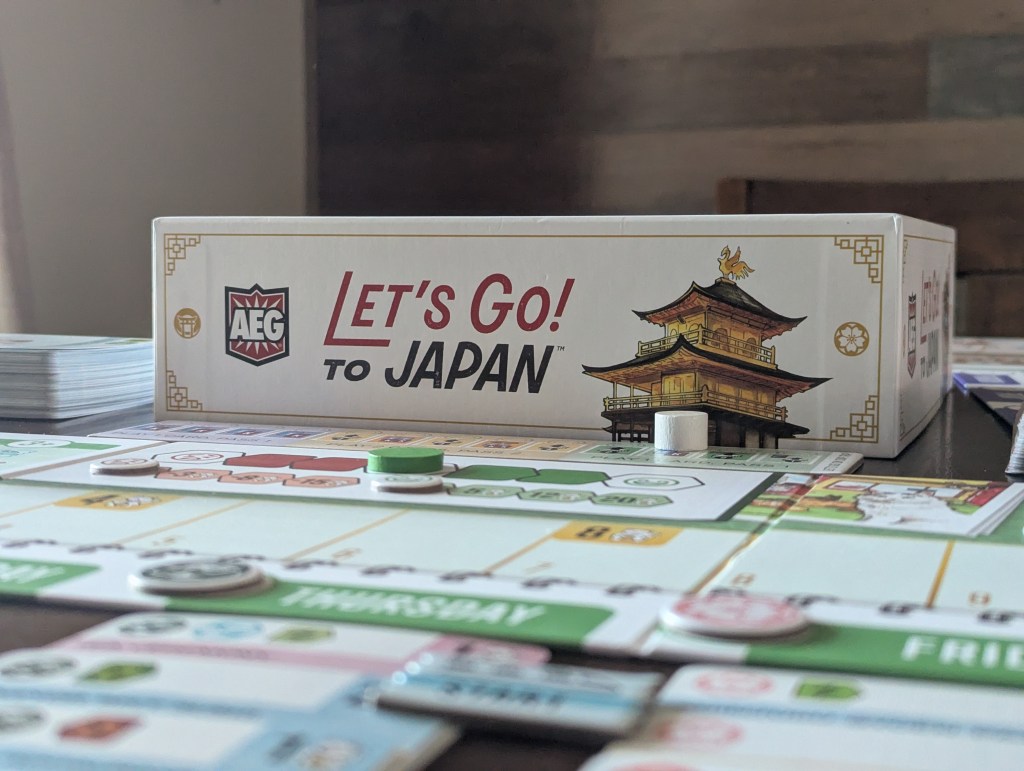

Before I go someplace new, I revel in the opportunity to do some research. Reading blog posts from locals, restaurant reviews (and their menus), Wikipedia articles, rosters of local sports teams and which stadiums they play in. When I book a hotel, which I do so sparingly I don’t know what “good” things to look for, I compare hotels side by side through Google Streetview of the front doors. There is so much excitement that even this act is joyous. Let’s Go! To Japan is a microcosm of this experience, encapsulating the anticipation of planning a trip, all wrapped up in a neat bundle of game mechanics. It’s enough to make you feel warm and cozy inside.
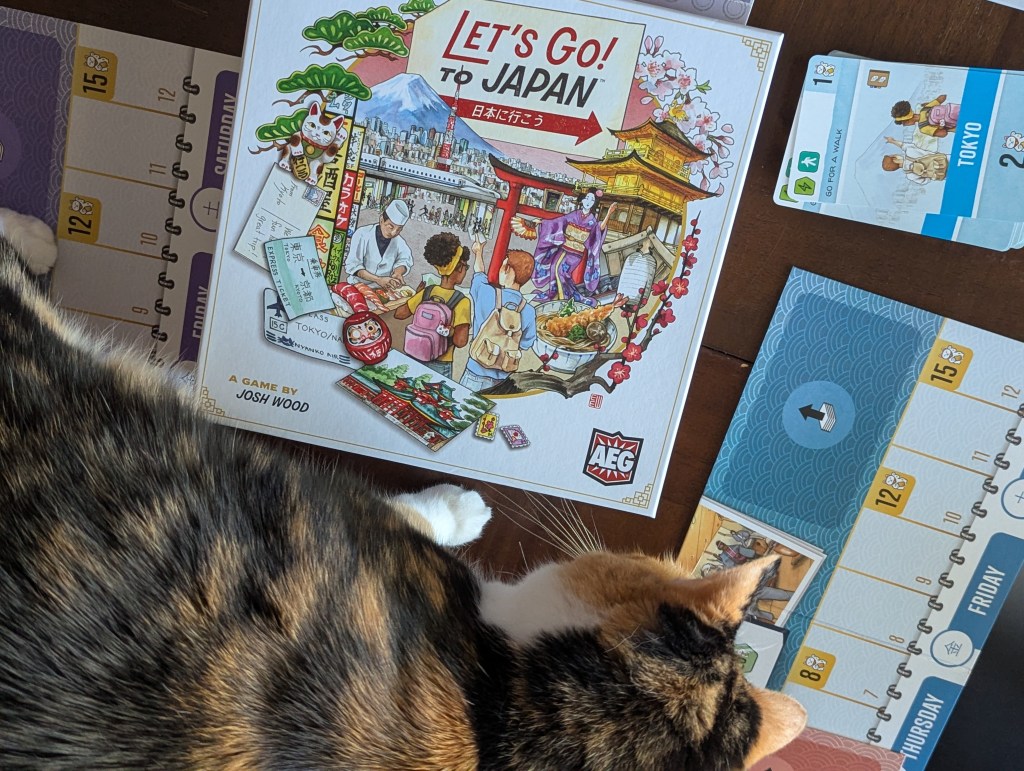
In Let’s Go! To Japan, 1-4 players are building out an itinerary over the course of a one week trip to Tokyo and Kyoto. Players draw a couple cards at a time, place 1-2 into their schedule, and pass the rest to the next player. Activities you place are scored through a number of simple mechanisms: collecting sets, raw victory points, moving up and down a happiness track, and bonus objectives on the cards themselves. There’s quite a few interesting considerations to make.
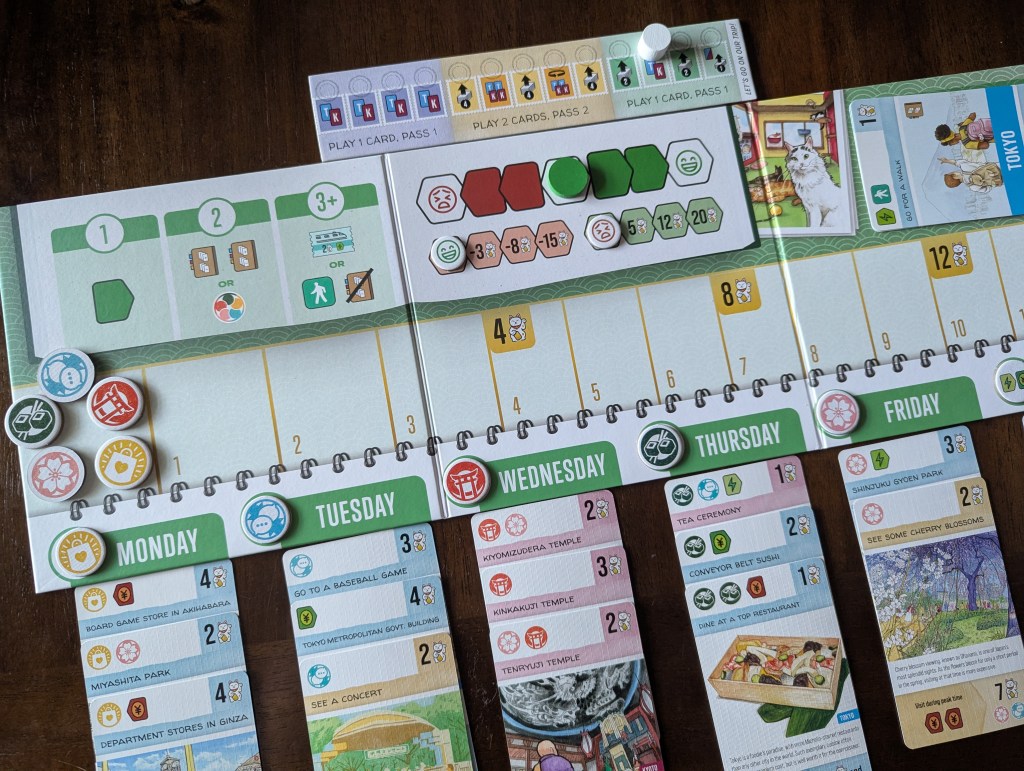
Planning a trip isn’t so easy, turns out.
When you place your third activity in a day, you have locked in a couple different things. For one, each day of the week has been randomized to be the “ideal conditions” for a particular activity. Maybe Thursday is a good temple day, and Friday is a good day for socialization. Depending on how many times you did that activity in the day, you get bonuses like wild tokens or a luxury train ticket.
The last activity you do in a day, though, also provides a new objective. Maybe your visit to the museum will be more enlightening if you’ve visited 4 temples beforehand– so you’re tempted to put that museum visit on Friday or Saturday. It’s satisfying being able to check off 7 distinct mini-quests along your itinerary.
There is one last twist, though, which makes Let’s Go! To Japan such a brain teaser. Some activities take place in Tokyo while others are in Kyoto. You can travel between the two locations, but unless you’ve amassed a bounty of luxury train tickets, you lose points whenever you spend valuable vacation time shuttling around. Maybe placing a suboptimal activity in Tokyo is better than taking a midday trip to Kyoto just to have to come back to Tokyo in the morning. This is never too punishing in my experience. I have to make a handful of little compromises, maybe I won’t be able to get done everything I want, but the stakes are never too high.
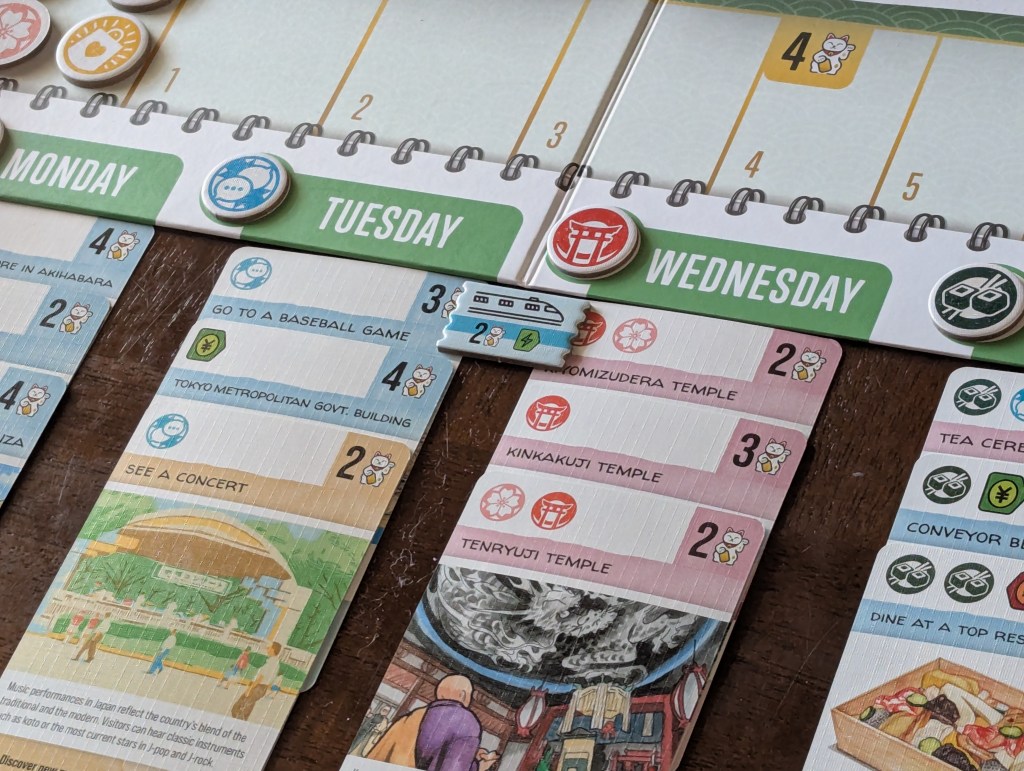
I would go so far as to say the game feels generous. If the offerings you drew (or were passed to you) simply don’t fit into your plans, you can always take a walk instead. As an avid pedestrian, this is probably my favorite mechanic. Taking a walk is worth some points by itself– as it should. I would feel robbed if I couldn’t go on a little aimless walk on my trip to Japan. However, at the end of the game, as you go through and score each individual day, you may peak at the flip sides of your walks. Your aimless walk around Kyoto could turn into an impromptu visit to a ramen shop you otherwise wouldn’t have seen, or a small shrine, or any other activity in the game.
Choosing to take a walk also gives you a research token, which can be used to essentially refresh your hand on a later turn. Later in the game, as players draw less and pick up what’s passed to them more, some less-desirable activities inevitably filter to the top. Having a research token in these scenarios, generously given to you for taking a nice walk, is the marinated egg on top. I think that’s what goes on those noodles. American cheese, also, maybe.
Anyways, Let’s Go! To Japan plays out so smoothly and there’s very little conflict. Drafting has long been one of my favorite mechanics, but it’s usually cutthroat. Here, drafting has been sufficiently “cozy-fied” to fit the vibe. Hate drafting is an extreme rarity. In a two player game, the draft does carve out some interesting play space, though. Every time I choose to stay in Tokyo, I am passing you an opportunity in Kyoto, and vice versa. If I push my opponent into hanging out in Kyoto and passing me back some Tokyo, a symbiotic little relationship grows where I’m happy with a blue tableau and they with a pink one. This, too, has its wrinkles– but suffice it to say you could easily play this game without even reading other players’ cards. Ironically, the solo mode inverts this, and everything you “pass” becomes almost more important than what you keep.
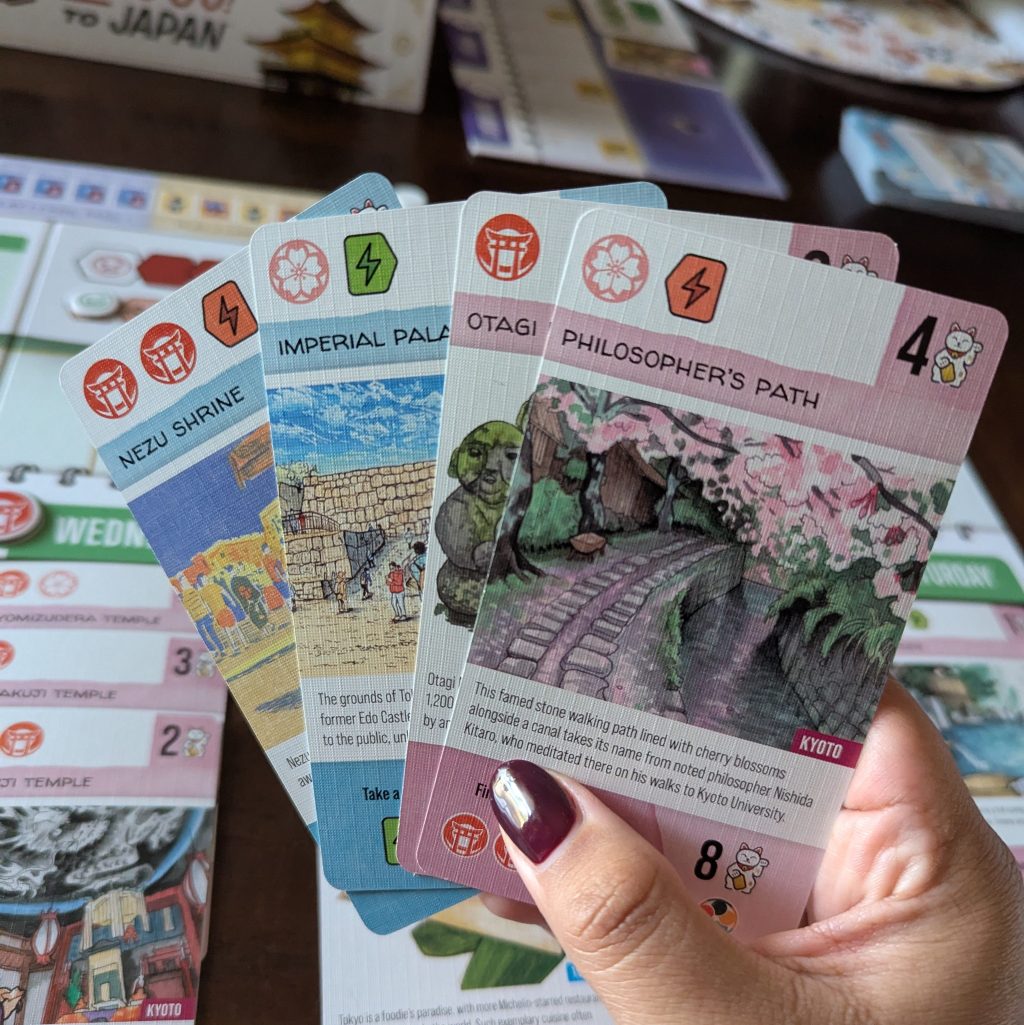
I enjoy the flow of this game, too. In the beginning, you are non-committal about what you’ll do. At most, you’re committing to what cities you might be in for a day or two. In the mid-game, you are now placing two cards per turn and the week really starts to shape up with bonus objectives. You have an idea of where you’ll be and what you’ll be doing on most days. The last few rounds go back to one card per turn, which makes sense as you are often plugging holes or rounding out a day. Then, you score.
Scoring is an interesting phase itself. Players go day by day, making decisions like when to use their luxury trains, whether to flip walks, and how to spend their wild tokens. The chronological scoring reminds me of Mana Worm favorite Faraway. Scoring is a part of the game rather than a chore to be done at the end.
My one gripe with the scoring is that it can feel a little more mathy compared to how cozy everything else in Let’s Go! To Japan is. The game’s many little thresholds are the culprit. You could lose out on 8 points by being one happiness point short. Problem is, before the scoring phase, doing the math to recognize you will be one happiness short is a chore.
My compromise is, usually, to not do the counting. But it can be disappointing seeing you left 10 points on the table by simply getting a bunch of symbols instead of the 1 or 2 that would’ve gotten you to a new threshold.
Pardon the cliche, but Josh Wood and AEG have written a playable love letter to their trips to Japan. There is so little downtime– and what downtime there is can be filled with adoring these illustrations or reading the tidbits about Japan. It is cozy but not inconsequential. Repeat plays have remained fresh and what I’ve valued has changed so much, but it’s entirely possible to grasp and be good at it on your first play. In the world of light-to-midweight games with minimal conflict (a genre my partner would live in given the opportunity), Let’s Go! To Japan is a gem.


Leave a comment