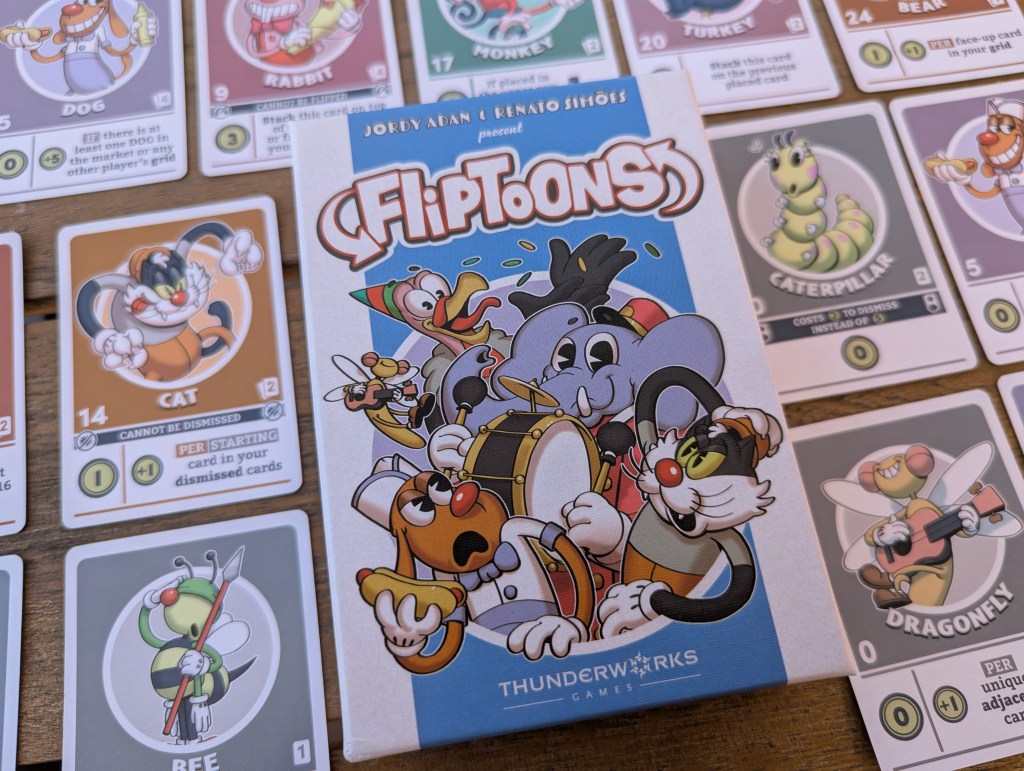

Like designers Jordy Adan and Renato Simões Silva, I was very intrigued by the video game Luck Be a Landlord. In that game, the player builds up a tiny slot machine to pay off the titular landlord. Round by round, you desperately add new symbols to your slots, hoping to create Balatro-like big number explosions as the score target scales faster and faster. When I saw FlipToons being advertised first in some creator’s video and then in a Board Game Arena adaptation, I did not immediately see the resemblance.
That is, until I read the designer diary posted over on BoardGameGeek. Learning of the game’s entrenchment in Brazilian culture, how quickly and naturally FlipToons came together in a whirlwind of inspiration, and yes, how the game was originally framed as a tiny little slot machine– I wanted to play it. Something about that designer diary was really inspiring to me. It made design seem like it could be spontaneous and maybe even obvious, if you were lucky. It’s as though there’s a magnetism which pulls good ideas together into good games if they just happen to be in proximity for a second. Maybe that’s not true. If there is any truth to it, FlipToons is a living testament.
FlipToons is a deck-builder for 1-4 players. In it, players take on the role of casting directors (or some such role) recruiting toon animals to perform in their company. Each turn, players flip out 6 cards from their deck into a 3×2 grid and score the Fame from the cards flipped. Using that Fame, they will either hire new talent or Dismiss the habitual underperformers– the caterpillars and other bugs and the like– to make room for the superstars of the toon world. Your deck can swell to any size, but only a random selection of 6 will ever come out on any given turn. Once a player’s grid produces 30 points, the game enters into a Final Flip where one last flip will determine the winner.
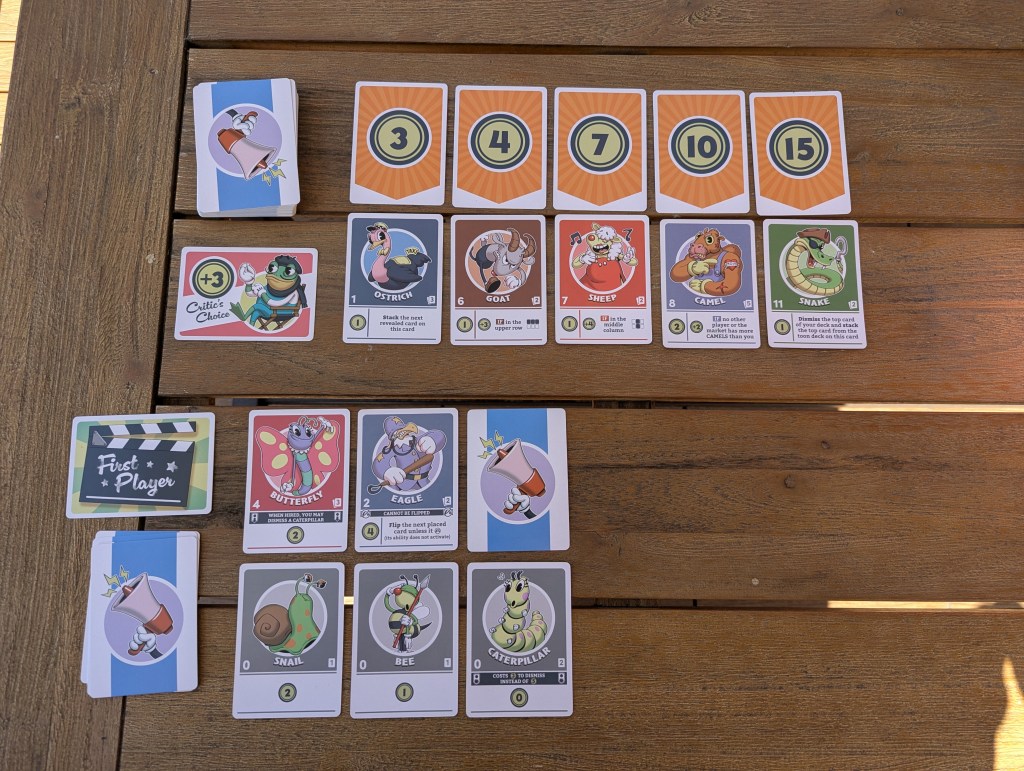
There are a number of little details I adore about FlipToons. The decision space tends to be relatively small, which makes sense for a very lightweight game with so much luck at its core. On any given turn, you may only make two market actions and you make no decisions during the flip phase. However, care has been taken to make sure no turn is ever too easy. On your very first flip, when you will have the least Fame to spend, you still have exactly enough decisions to chew on. Your starting flip always contains caterpillars, whose special ability (despite giving 0 dollars) makes them cheap enough that you can always afford to get rid one of them on turn 1. Additionally, no matter how many good, powerful cards get drawn into the market, the relative prices are always set– you’ll always be able to afford the first two cards available for sale, regardless of how your opening hand flips itself out.
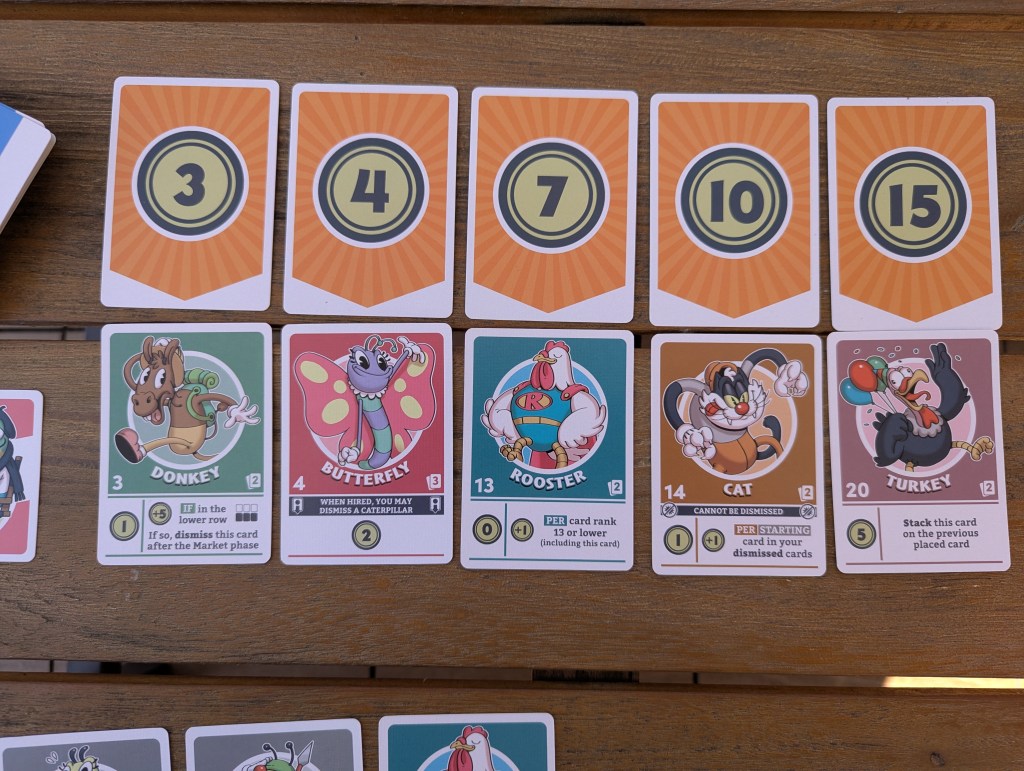
The ranking system of cards is an incredibly tidy solution to so many of the game’s would-be problems, too. Ranks decide where a card falls in the market, which removes the need to give cards individual prices, so getting “priced out” by a high-value market is impossible. The ranks also give a easy to understand mechanic for cards to key off of. The Rooster and the Lion, for instance, want you to fill your grid with low ranking cards. Simple. It also gives you as a new player (or someone who maybe doesn’t play games so hasn’t built the intuition to figure what cards might be good and which ones bad) an easy guide– higher ranking cards tend to be better.
This is also a game, speaking of players potentially new to the hobby, which does a great job teaching some of the basics of deck building. It reminds me of Abandon All Artichokes in this way. The game is a slot machine and so you immediately pick up on which of your animals are giving you a bunch of money and which ones aren’t. There’s no weird “cards you buy for points versus cards you buy for money versus tech cards you need one or two of” or other mechanisms to obfuscate what is going on. If your deck had some good Toons but it was clogged with all 6 of your starter cards, that’s a lesson you will learn after one 20 minute play. I like that.
I also enjoy how FlipToons ends. Getting to 30 points feels like the perfect goal score (oh my how many times I’ve seen people land at exactly 29 points– is there some math wizardry going on to assure that happens often?). Once someone hits 30, though, there is still one more market phase before the Final Flip determines who truly wins. Maybe that person got 32 so they have the Critic’s Choice +3 bonus, but their deck has more than 6 cards or relies on one card coming after another to get that many points.
There is so much room for these cool comebacks or just fun flips in general. Imagine playing a snake which dismisses the top card of your deck (maybe your worst one) and then gives you a completely random card from the market deck (maybe… another snake). So many cards have amazingly powerful upsides or game-losing downsides if they come out in particular spots on the grid. One game, I was relying on an animal which has been flipped over (nulled) by my Eagle, only for that same animal to get flipped back over by my Elephant whose “downside” is flipping the previously played card. Did I deserve to win that game? With that sort of luck, of course I did.
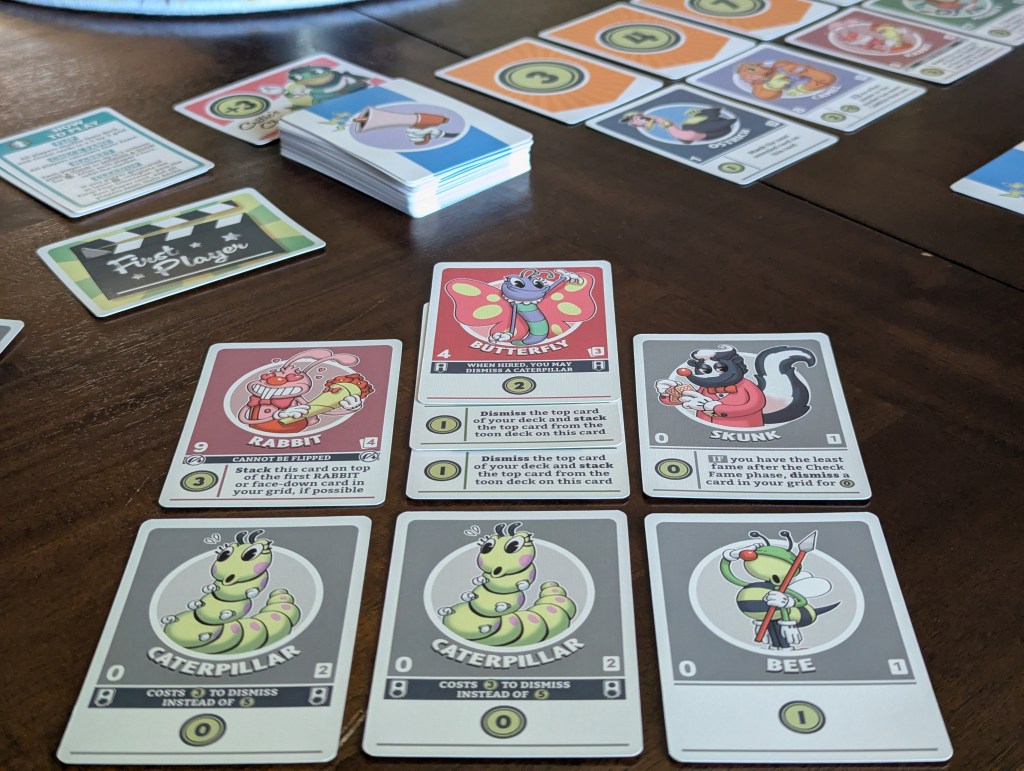
The solo mode isn’t bad, either. It feels like the aforementioned Luck Be a Landlord, though where that game stretches out into increasingly difficult goals, FlipToons solo mode gives you a timer to hit 30 points. This is not a solo mode I see myself playing a dozen times– it’s not that in depth– but it’s good for a handful of plays for sure. It does have a very cozy almost classic solitaire vibe of flipping out cards and trying to see how quickly you can accomplish a goal.
One gripe with the solo mode, and this is also a gripe with the two-player mode, is how the first and last card of the market are wiped every turn in these modes. I understand why it has to happen (the deck is the timer in single player, in two player it happens to keep the market fresh) but I found it to be a slightly annoying piece of admin which made setting up the market less snappy. The shop half-resetting every turn also means much of the higher rank cards will come and go from the shop before you even have the money to afford any of them.
I would also recommend double-checking the FAQ at the back of the rulebook if you run into any edge cases. There are a couple strange interactions, and with so few cards in the deck you are bound to run into at least one of them every game or so. There were at least two interactions which worked the exact opposite of how I expected them to act when I read the FAQ afterward.
I have yet to address the art, which is another strong suit of FlipToons, even if it’s not my favorite style. Sometimes the depictions of the animals is a little obvious– a very Tom and Jerry-esque cat, for one. Other times you get a gang of camels with MOM tattoos who are stronger together. The theme feels more like the dressing on a pinball machine rather than a narrative explaining why it is you are doing what you are doing. Considering the game is inspired by an illegal slots game where the symbols just happened to be animals, that checks out, too.
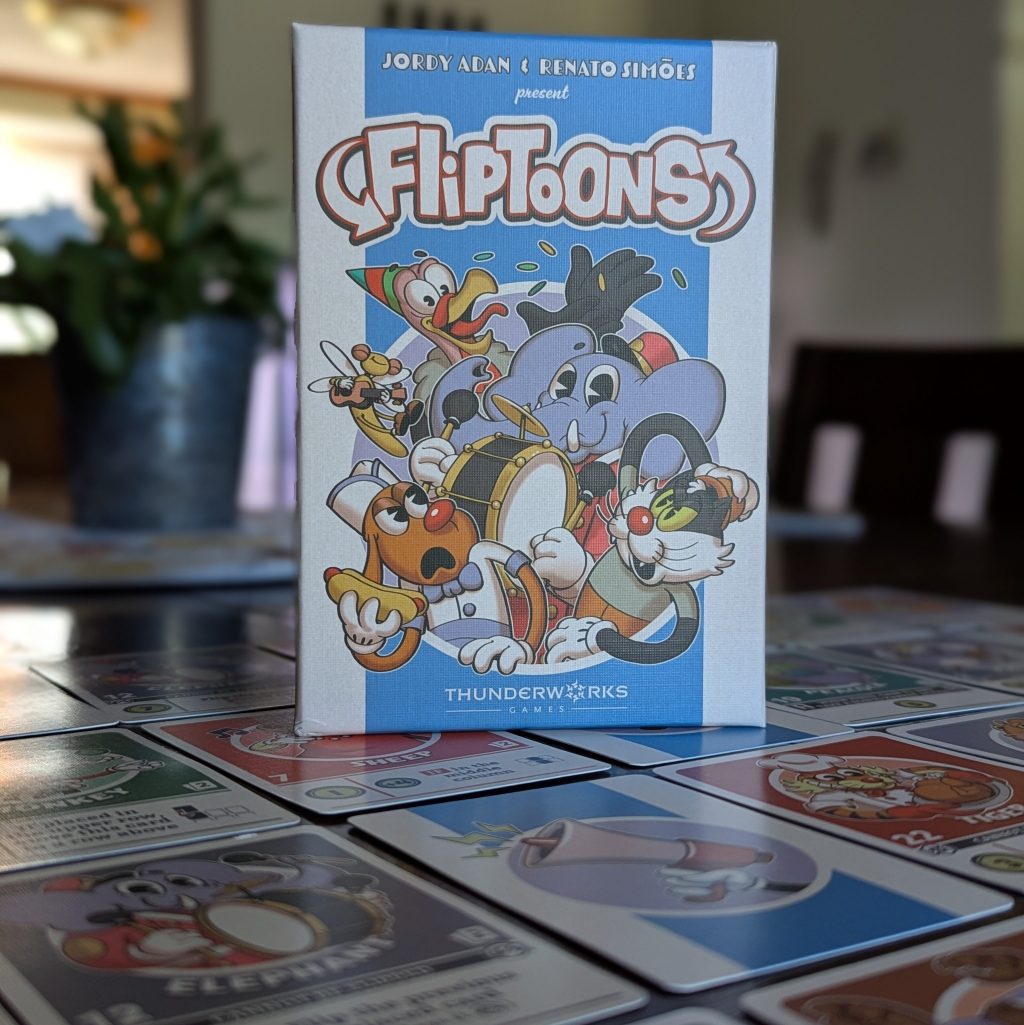
When I sit down with my friends or family to decompress with a 20 minute card game in the evening, I want something like FlipToons. I want to make some decisions without feeling like whoever made the best ones is going to win 100% of the time. I want to see someone get incredibly unlucky and completely nosedive like the best rounds of Quacks or Flip 7. In those situations, FlipToons has been great for me, and I look forward to keeping it around in my collection.


Leave a comment