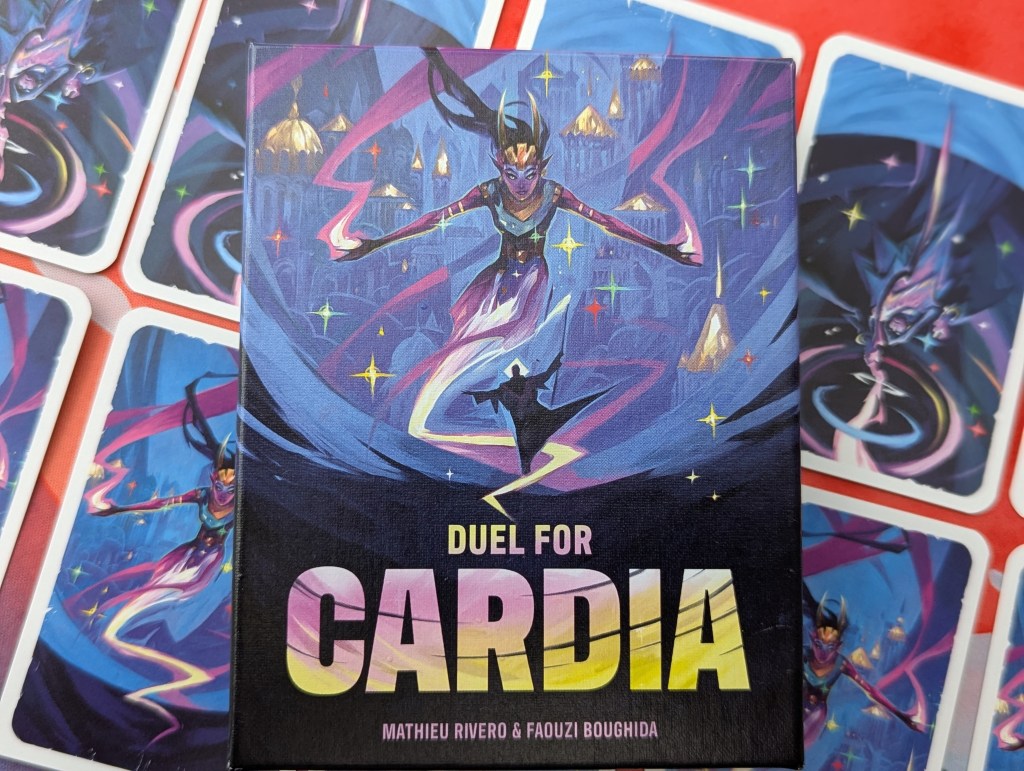

The name “Duel for Cardia” did not instill confidence in me. Worse yet was my little brother, for whom the invocation of “Cardia” was less a tongue-in-cheek reference to, you know, It’s a card game and more a death sentence for the name to ever be remembered. Every time I brought it out he would guess it’s name to be something along the lines of Battle for Boardlandia. I don’t think he ever caught on or committed to memory that there was no alliteration in its title. I don’t fully blame him. Inside this box, there is some flair and bombast, but the fantasy world of Cardia did not enrapture me.
Luckily, the gameplay — the core of this tiny box– holds strong against the wave of forgetfulness. More or less.
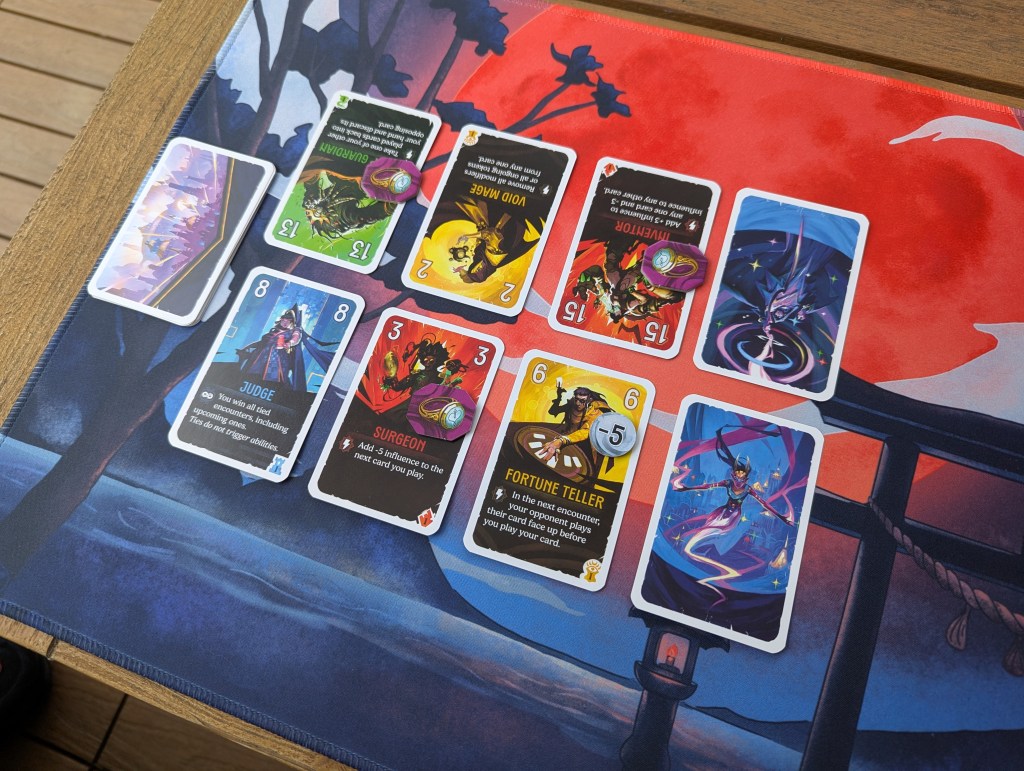
In Duel for Cardia (or Cardia for short), players are trying to win five signets over the course of a series of encounters. Each player has an identical deck of 16 characters cards, each numbered from 1-16. On your turn, you secretly choose one card from your hand of five to send into the current encounter. Then, both parties reveal, and a signet is awarded to whoever brought the higher number to the tango. However, and this is the dash of spice, whoever brought the smaller number gets to activate the ability of their card. Some of these abilities are static ongoing abilities which last the rest of the match, potentially swaying later encounters. Others are instant effects which can sway the next (or past) encounters, make your opponent discard cards, or otherwise do something cool to make your losing worthwhile.
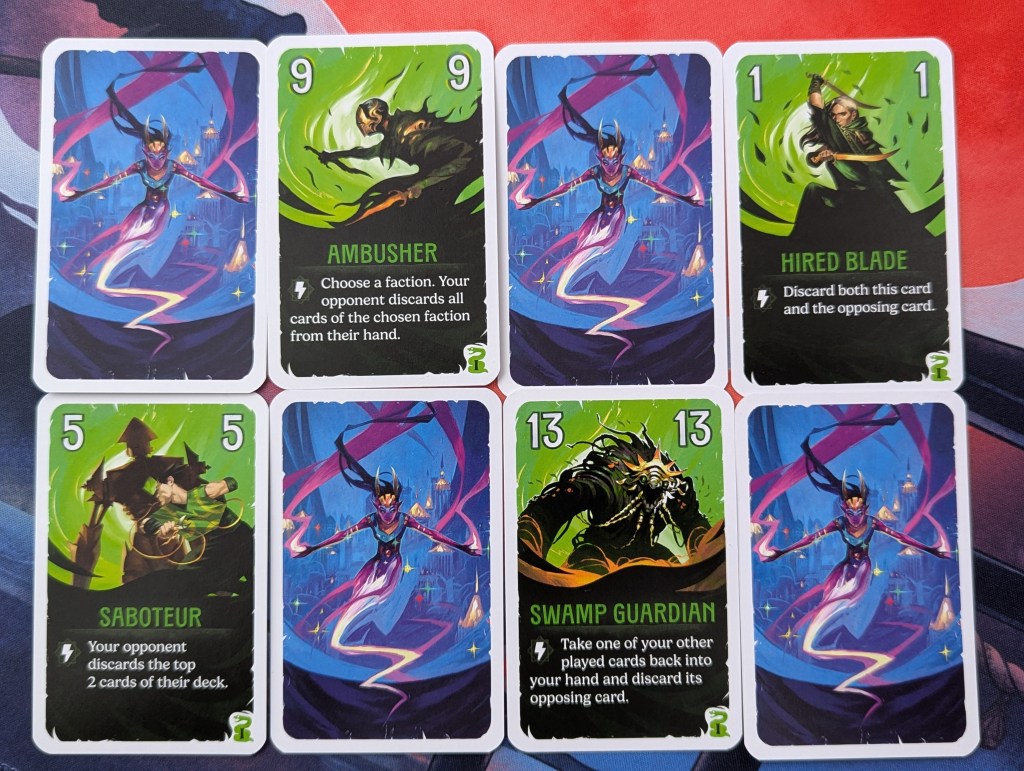
Maybe you are okay giving your opponent a signet now, but your card triggers making the previous encounter (which you hopefully won) worth an additional signet. Maybe you are willfully giving them a couple signets while you make towards a different win condition. Sometimes, lower number cards have much more powerful abilities– they’ll never win any battles so they need to make it up with powers, that’s typical card game stuff. However, the most powerful abilities tend to be on the highest numbers, which forces you to try and concoct scenarios where you can intentionally lose with 14s, 15s, or even the highest number, 16.
The abilities of these higher number cards are so game warping and fun to read and cackle over the first couple times you play. I don’t want to spoil how absurdly “broken” some of these cards are; that’s how fun they are to discover. Sometimes, you will slam a 16 because you really want to win a signet and nothing beats a 16. But say some other combo wanders its way into your hand, an opportunity to do something ridiculous and maybe win off the back of it. Can you resist? I know I can’t.
That’s the ebb and flow of the game: finding and deploying combos and otherwise taking wins when and where you can get them. Over the course of about 15 minutes, signets will trade hands, ties will form and be broken, and someone will come out on top.
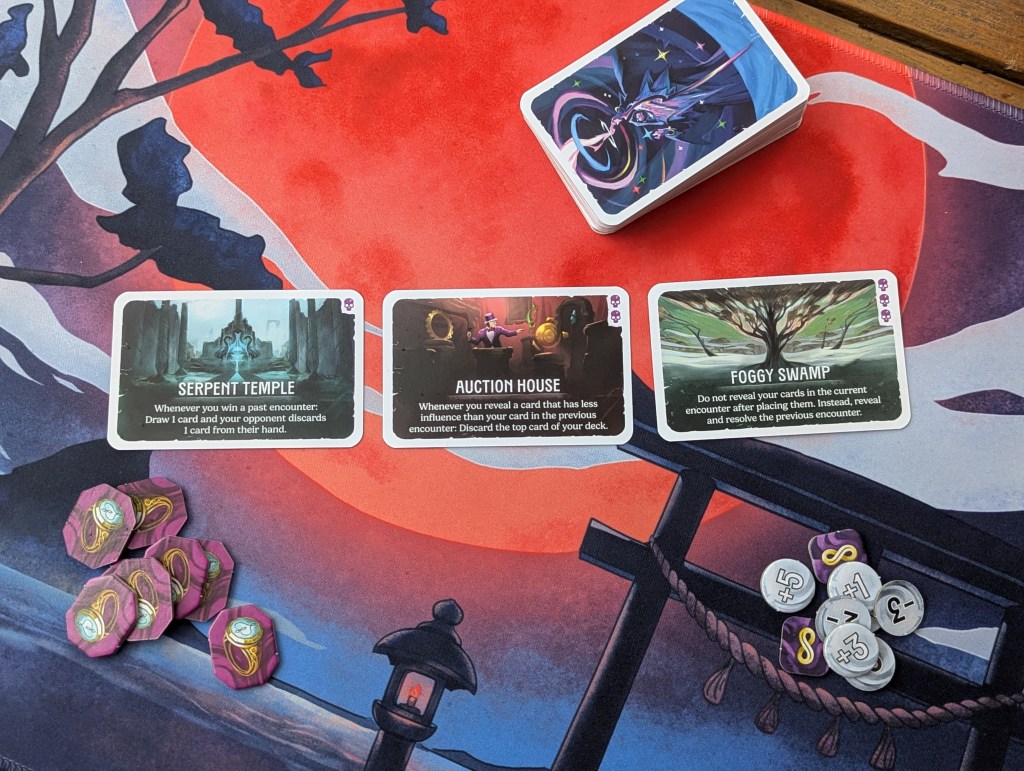
There are two pairs of identical 16 card decks in this small box, and both present opportunities to outplay, stall, and read your opponent. If that’s not enough, your duel can take place in a location. These locations, chosen before the duel begins, add persistent modifiers such as ever-growing hand sizes or sudden-death mechanics. Some feel like interesting little tweaks while others, the ones I prefer, turn Cardia into a different game entirely. I appreciate how much depth these locations add with, usually, a line or two of new rules.
A lot of its strengths come from the novelty of feeling like you’re discovering an overpowered card or card combo, but that does wear off, especially with Deck 1. I can definitely see the appeal of mixing and matching the two included decks to create more “woah that’s a novel interaction!” moments.
However, like other tiny very-knowable card games, there is also fun to be had once both players know every card in each other’s decks. It’s fun getting a read on what your opponent will likely play next and, because of the higher-lower system, deciding what you want to do with that information. Often locations force or dissuade particular play patterns, and I have been read like The Very Hungry Caterpillar predictably playing into a location’s demands.
I would argue, though, the game states created in Cardia don’t reach the highs hit by other small-box duels. Too often in my experience both players have 4 Signets and the previous encounters/interactions melt away as whoever has the bigger card in the last encounter wins. In that last encounter or two, what to play can be too obvious. Those conclusions can feel earned if you’ve played around all their biggest cards, winning through a tactical war of attrition. But are those moments as rewarding as a slam-dunk bluff or a smart retreat in Air Land & Sea? Cardia has some stiff competition, that’s all I’m saying.

At its best, you get moments of outplaying your opponent or timing things up perfectly. At its lowest, it feels a bit luck-of-the-draw, winning because your opponent played mostly middling numbers with middling effects and you slammed big numbers five times.
Cardia is a clever little game and one that will also delight you especially for the first couple plays as you discover crazy combos. For me, it’s a classic 7/10 type game– one I’m happy to keep around and play, but not one that I expect to be in the rotation a few years down the line.

Leave a comment