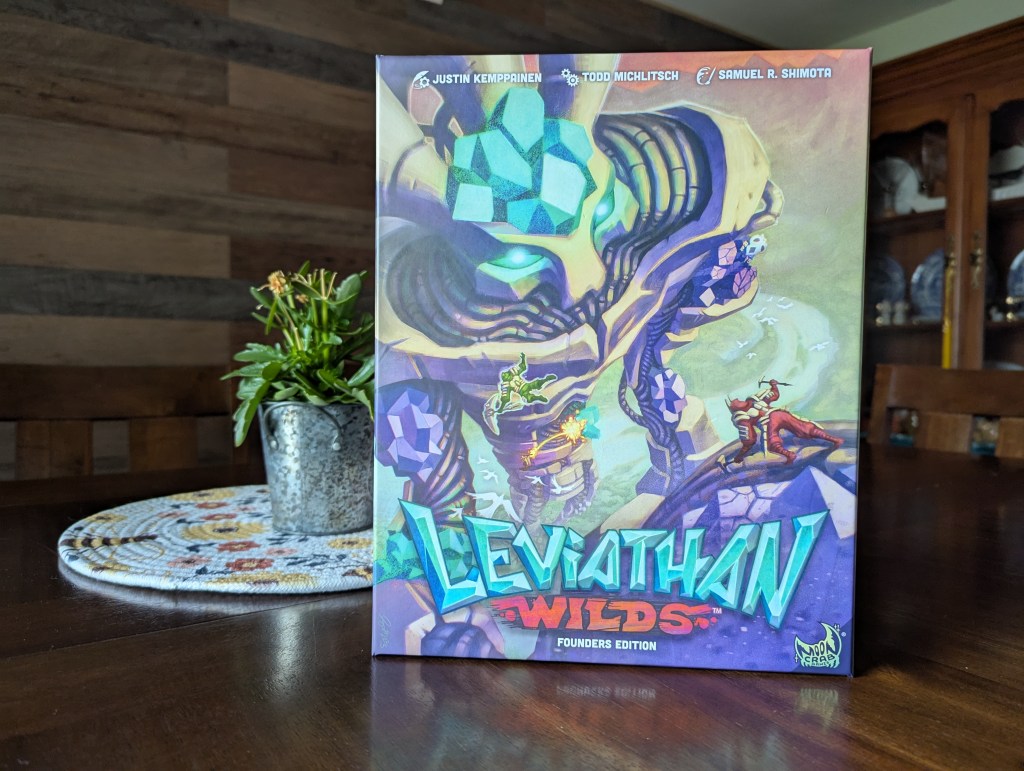

You can’t deny the inherent drama of The Climb.
Starting low, looking up at the insurmountable; lodging an ice pick here, leaping there; finally reaching the precipice of what was always seemingly impossible and yet somehow wasn’t. Mountains are, I would argue, the platonic ideal of an obstacle. A giant uncaring thing that nature itself has put in front of you you have to–just simply have to— get over. Celeste, Getting Over It with Bennett Foddy, all the hits. I figure “get to the top of a giant thing” has been enough juice for… I don’t know, 100 board games and a couple thousand video games. This one is no different.
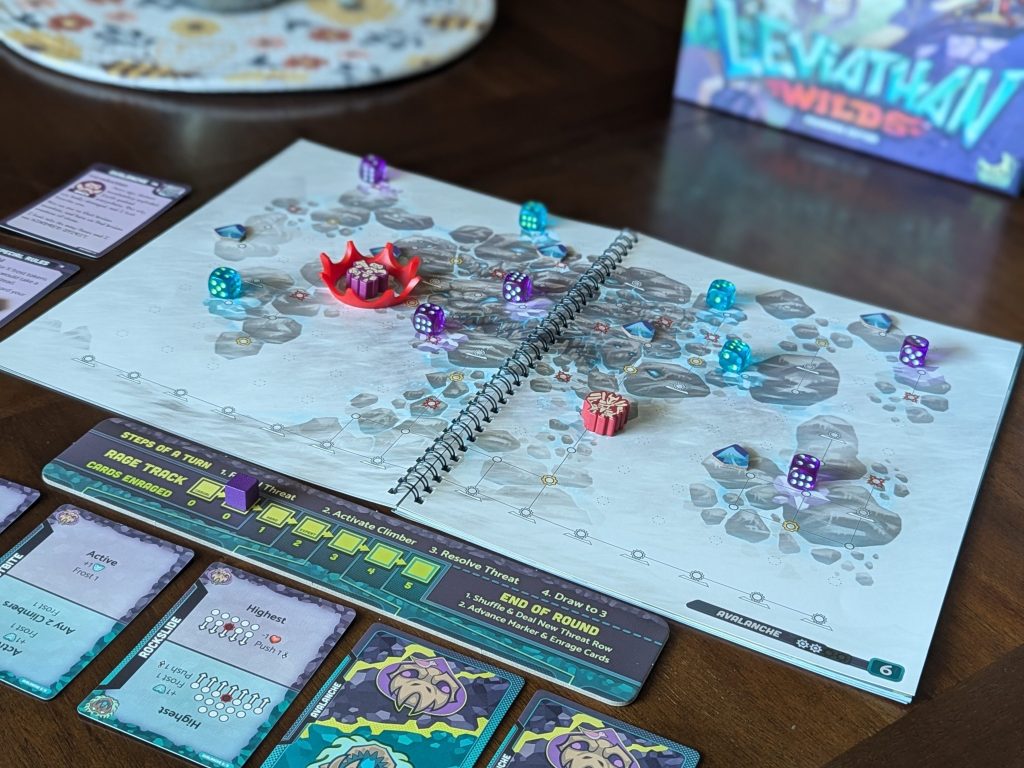
Leviathan Wilds looks like a boss battler but I contend it’s even more welcome in my newly-minted “climb this!” genre. You are a climber with a unique set of abilities but a non-negotiable penchant for swinging a pickaxe and foraging for mushrooms. There are 17 completely unique giant, eminently climbable creatures in need of… slaying? Well, no. These mountainous creatures, the way they buck and enflame and twist and blast at you, have been corrupted and it is your duty to heal them. You are not here to outmaneuver foes or clamor around a dungeon looking for bits of gruel. (What do you do in those games exactly?) You are here to climb, and you will need to do so as efficiently as possible. Being so close to this raging behemoth gets you knocked around, corrupted, and strains your puny fingertips as you grip the side of a giant cow for dear life.
Before you begin playing, the act of flipping through the spiral-bound book picking out a leviathan is a delight already. Each of these creatures is menacing, yes, and like any good mountain it’s hard to imagine being able to beat any of them. They’re so tall, so intimidating, so full of corrupting gems that are going to take ages to chisel off. But they also prod at your imagination, enticing you to give it a try just to check out what’s under the hood. What does this giant spider do? Or how about this ice elemental looking thing? Is this a creature or abstract art of a hurricane? After you’ve played one or two scenarios (which you can play in any order), you will be assured that regardless of which one you pick the gimmicks will be interesting and no climb will be the same.

And that’s only half the variability. After you select your Leviathan, you also select both a climber and a class. The climber you choose is your meeple, and they bring a card or two as well as a permanent anytime ability. Your class brings the bulk of your (extremely lithe) 9 or 10 card deck, and thus defines most of what you’ll be doing from turn to turn. By shuffling these two up, you have your character ready to go. You can do basic stuff, combining the fast character with the fast class to ascend at heretofore unseen speeds. There’s room for experimentation, too, and you can theorycraft or shuffle together random combinations to see what happens. Maybe try a hard-hitting medic or a mushroom-foraging tank. What you pick does end up deciding your play style (at least partially), but no combinations have felt unplayable or useless to me.
The cleverness of Leviathan Wilds does not stop at its shuffle-building character select, though. Your deck represents your character’s grip, a count of how long (a few turns) they’ll be able to hold on before they need to let go. There is no fall damage, but the same hazards you either avoided or toughed through on the way up are going to spike you on the way down.
Worse yet, the time loss from plummeting down a behemoth can spell failure. Each Leviathan ramps up over the course of your mission, represented by it’s 5 attack cards slowly flipping over to their Enraged half which are often tremendously more hazardous. If you need an extra turn or three to scrabble back up the side of one of these beasts, things are only going to go from bad to worse.
But lest you think falling is always bad, on the contrary, it can often be the absolute best way to get around. If you fall onto a ledge, you stop and can even give yourself a moment to rest, regaining all your lost grip. Better yet, maybe you can fall 7 or 8 spaces, going from one crystal all the way to another. As one subhead in Leviathan Wilds’ rulebook reads: Gravity is your friend.
The cardplay in Leviathan Wilds is simple, satisfying, and leans heavily towards empowering the player. On your turn, one of your cards is used for it’s AP value, fueling your turn with a simple “One AP = Do One Thing” formula. One climb, one strike, one healing, one diagonal glide if you’ve got gravity on your side– it all costs a single AP, but you can always choose to expend more. The other two cards in your hand (you will draw back up to three at the end of your turn) can be used with practically no restrictions, which is where the empowerment happens. Drop down from height and swing at a rock as you fall with a boosted strike card, play a card to block a Swift source of damage, or give yourself a refill of a couple Grip in response to suddenly losing some.
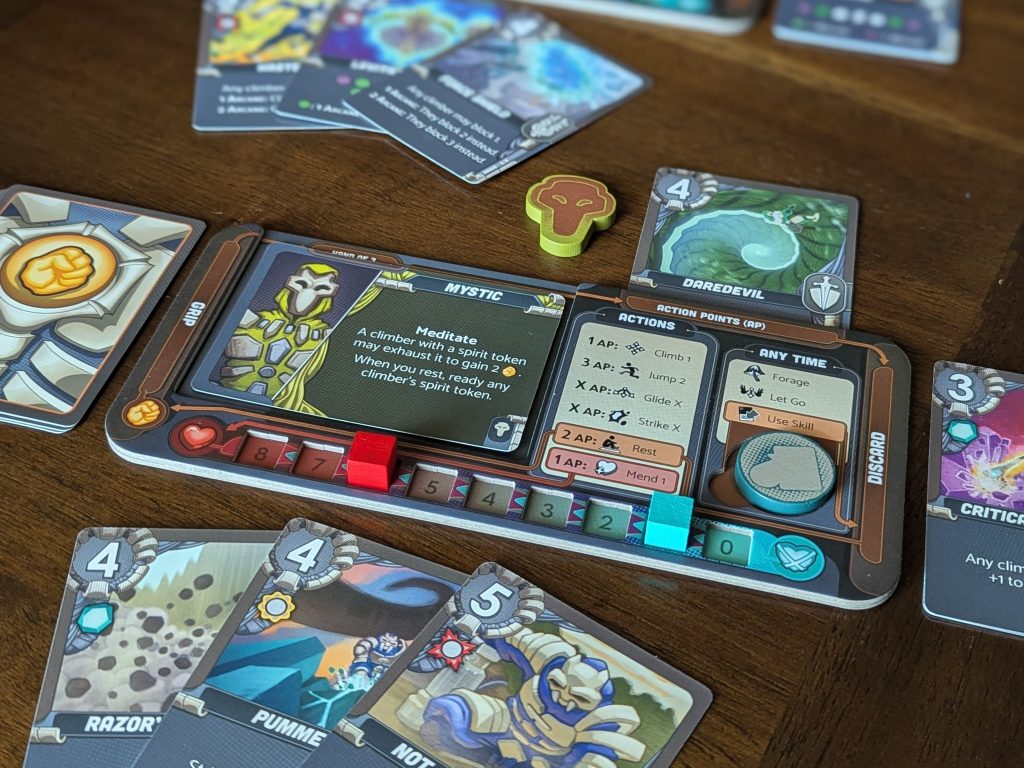
A lot of these cards can even be used on your friends. If you ever find yourself in a bind or impossible situation, there’s probably some combination of player powers, someone else’s cards, or bit of genius that can get you out. For all this choice and empowerment, the average turn involves you taking two maybe three straightforward actions. Leviathan Wilds nails it’s complexity-for-depth return on investment.
This game, despite how big it may appear on the surface, knows how to get out of its own way. No need to give climbing twenty different rules and ten types of terrain, it’s good enough with just a couple. No need to give cards a dozen different timings or subtypes to be considered, there’s only so many cards and they’re all balanced to be played with no restriction. No need to stuff the box with a hundred scenarios and unlockables, there’s more than enough here and you can grab the Deepvale Expansion once you’ve done it all. This is a game which has faith in its simple core; a game that honors its centerpiece Leviathans by making them the object of conservation and light-heartedness rather than violence and brooding. It’s welcoming and easy to hop into, even if it’s promising (and delivering) those white-knuckle moments.
The peak of Leviathan Wilds, for me, is in the design of those Leviathans. With only a paragraph (at most) of special rules text, five attack cards, and a unique geometry to navigate, each of the 17 Leviathans feels like something worth saving. There’s an enraged bull covered in wounds which, when mended, lessen the severity of its aggressive explosions. There’s an eye-ball monster with so much corruption pent up in its big eye that someone is going to be stuck squeegeeing it clean the entire combat, keeping the Leviathan sedated.
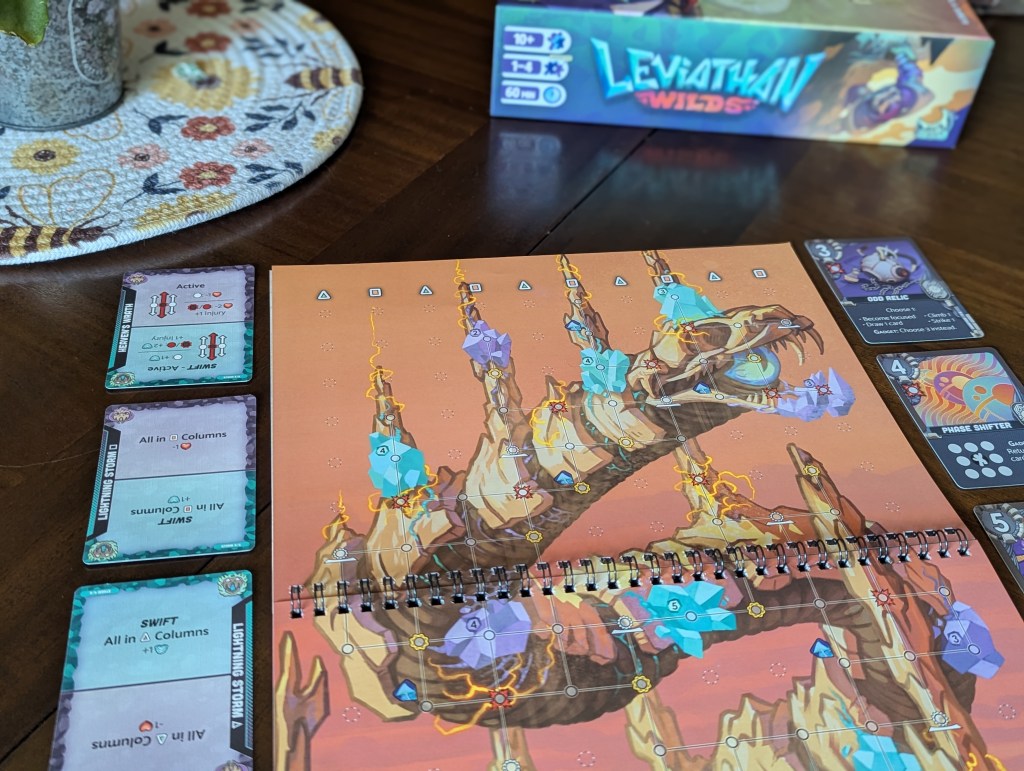
Each Leviathan only has five attacks, so after a couple of rounds, you feel like you’re already mastering what was moments ago an unpredictable wild animal. Because of this, it’s rare to feel screwed over by an unlucky flip. There’s so few attacks, they’re all memorable, and you have a full turn to react once you know what’s coming down the pipe.
The gimmicks are great, too, often telegraphing the kind of danger in store for you or providing a way to mitigate the strongest of the Leviathan’s attacks. There have been cases where the sparse writing on the special rules cards (and the equally small narrative before and after each encounter) has left me consulting BGG forums, though.
I do not have many criticisms to level at Leviathan Wilds at all. It takes a normally complex and tense genre, boss battling, and removes half the complexity while retaining all the close calls with its own natural ebb and flow. Moments of respite are broken up with spurts of action, health bars rapidly narrowing, crystals evaporated by the chaining of entire hands of cards, and a victory coming into view.
Time and time again, I have a great time getting knocked off my pitons and barely surviving a lethal blow. Difficulty is an entirely subjective thing, but Leviathan Wilds has found the sweet spot for me. I never feel completely blown out of the water by a hard encounter, but I’ve never been underwhelmed by a Leviathan, either. Some games I win by the absolute skin of my teeth while others are a satisfying cascade of efficiency towards a still-hard-fought victory. Maybe some people will find this game too hard, or others too easy, but there are levers to be adjusted until you find a difficulty you personally enjoy.
I’ve played both solo (two-handed) and with a friend, and both ways I have found something worth returning for. Solo let’s you lean into mathing our your turns, getting maximum efficiency out each activation, pausing and puzzling after the turn’s attack card is revealed.

In cooperative plays, I find that the spirit of helping each other often prevails over absolute mechanical efficiency. You’re both in this together, so when a Leviathan’s attack threatens a random injury to a player of your choice, maybe you’ll volunteer yourself knowing your partner will have your back next turn. It’s satisfying to think out loud, “I can’t quite make it to the ledge, I’m 1 AP short” just for your partner to respond, “no problem let me play this card to get you there.” You do feel like a team, and every character/class in the game is going to be directly helping the other players at some point, not just independently working towards the same goal.
I could continue heaping praise on Leviathan Wilds, but there’s only so many claims I can make that all point back to, “great game mechanically and impeccable vibes.” This is a mountain worth climbing and a world worth saving. You and your friends will feel incredible putting your little meeples in harm’s way to protect each other, and your boldness will very likely be rewarded.


Leave a comment