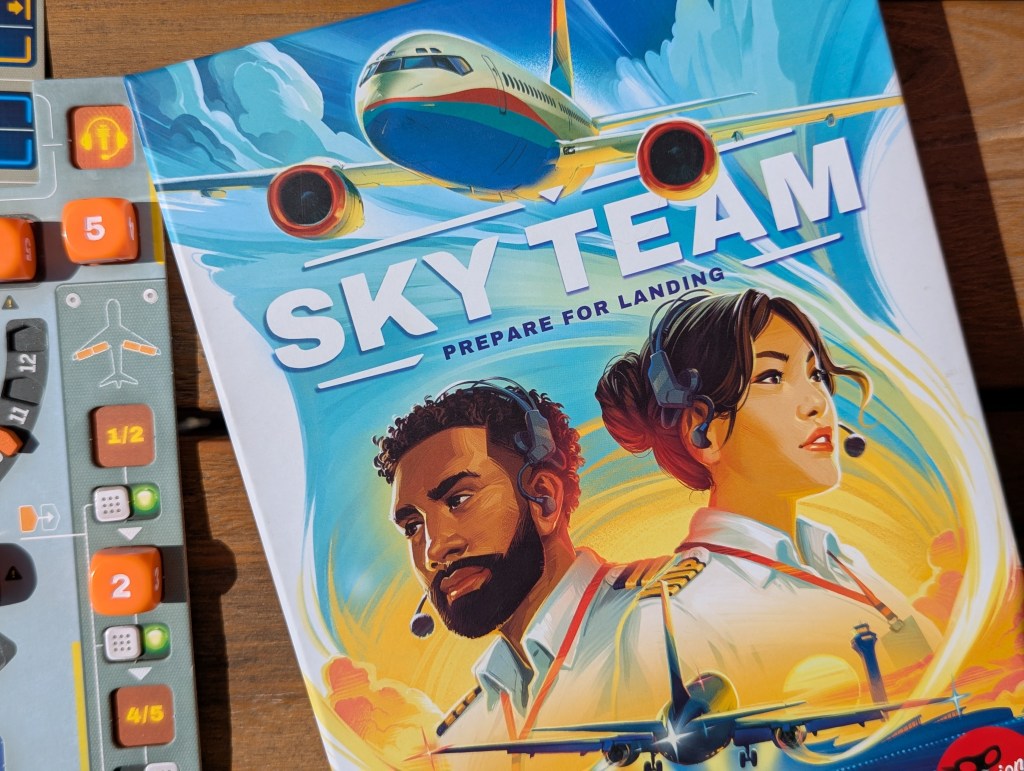

Much has been written about the precarity of Sky Team‘s airplane. This is a plane that, if the intern-on-board hasn’t done sufficient grunt work, will disintegrate upon touching the tarmac. This is an airplane where the pilots can’t speak to one another, though they can make coffee to encourage the other to, hopefully, do their job. At any given time, you may face frozen brakes, a leaky kerosene tank, or a dozen planes of traffic in need of shooting down– er, told to get out of the way, please and thank you, as we won’t be waiting our turn to descend. “Funhouse mirror version of a plane that might explode at any moment” might sound like a horror movie. But, in the context of Sky Team, it is instead a lightweight cooperative game full of tense moments and excruciating dice placement.
Two players will be piloting this plane. One blue and one orange. One pilot and one co-pilot, I mean. On a turn, both players can talk about the sorts of things that probably need to get done; maybe you need to slow the plane down so you don’t overshoot the runway, or maybe let’s adjust our angle to take a smooth left turn. Then, both players roll their dice. From then on, they sit in silence as, one after the other, they place their dice on the different instruments at their disposal. The co-pilot might eliminate some nearby traffic with a 1 and deploy the flaps with a 5. The pilot might brew some coffee and put down the landing gear. Either way, both of them must spend two of their four dice balancing the plane out and deciding (as much as one can decide with a randomly rolled d6) how much juice to give the engine. This continues, usually on the razor’s edge of failure, until either the plane crashes or you successfully land in one of the game’s real-life airports. Did I mention this game takes place in the real world?
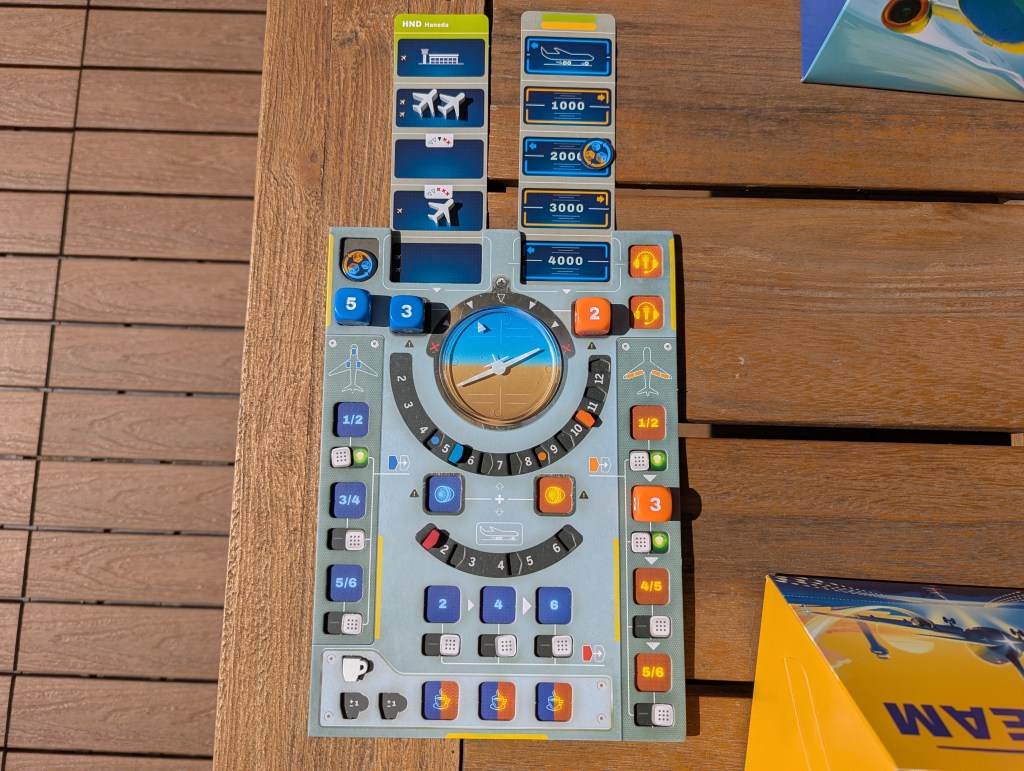
Sky Team definitely creates a dissonance between its realism– you are interacting with real-sounding pieces of the plane’s console and traveling to a real locale– and the absurdity of its stakes. You are sometimes extremely inept pilots (who can never talk) trying to remember to press all the right buttons and successfully complete what should be a routine landing. Other times, you are those same questionable pilots taking hairpin turns and trying to well-and-truly defy death to land this hunk of metal. The line between these two things, the action movie impossible task and the banal busywork, is blurry. Maybe we were able to unstick the frozen brakes or navigate hurricane-force winds, but we forgot to radio the guy ahead of us “excuse me,” and that was our undoing. That’s pretty funny.
This incongruity may be bothersome for some, but I would argue the emergent comedy here seems purposeful. Is there not an inherent corporate comedy to the aforementioned “the intern who must be trained during this five minute window lest the plane will self-destruct”?
Maybe I would be less willing to forgive Sky Team‘s difficulty and strange treatment of theme if it weren’t so easy to set up and play. If spiraling out or control only takes 10 minutes instead of an hour, then yeah, I don’t mind a couple failures. I can get a game of this up and running for me and one other person, including an adequate enough teach, in as little as 5 minutes. Dump out the airplane’s console, make sure the dials are set to “off,” fold the player screens and you’re all set for an easy scenario. You don’t even have to shuffle a deck. But the game has considerable variability in its setup, if you do want to look through the included Flight Log and select a more dangerous airport to land in. These additional optional modules add a huge manner of things to take up your valuable dice, force you into turning the plane, or make typically easy actions much more difficult.
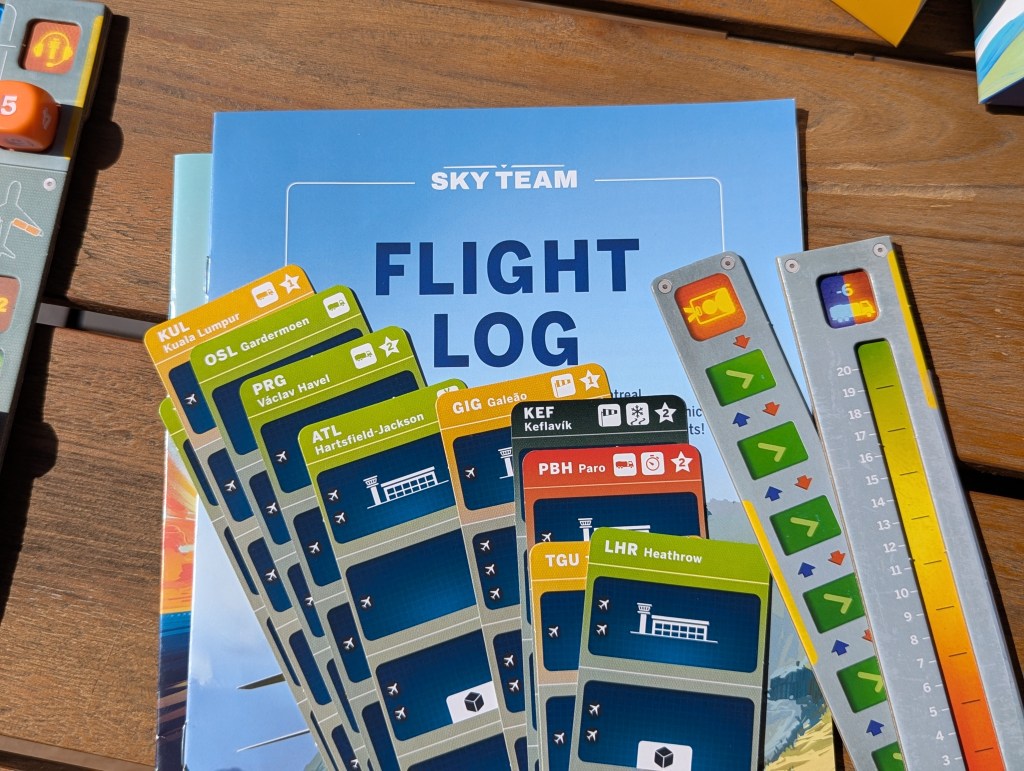
Some of these modules will force your hand a lot, and the “obvious” thing to do every round can become the only thing to do. If worse comes to worst, all I can do is hope for the exact dice results I need to perform the exact four tasks I need to do–meaning I’ve fallen woefully behind in the game’s tight action economy. In these cases, Sky Team sending me home packing instead of stringing me along to an inevitable failure down the line is preferable.
As much as the plane blowing up if someone sneezes might seem intimidating, the consequences being so rigid and obvious keeps me from wasting my time. Still, I always felt I had at least a modicum of control, regardless of the scenario. Most disasters could be avoided by better prioritization or more efficient use of the sparse reroll tokens. If I had planned better and spent an extra di on deploying brakes, we wouldn’t both need exactly a 1 in order to go slow enough to land the plane.
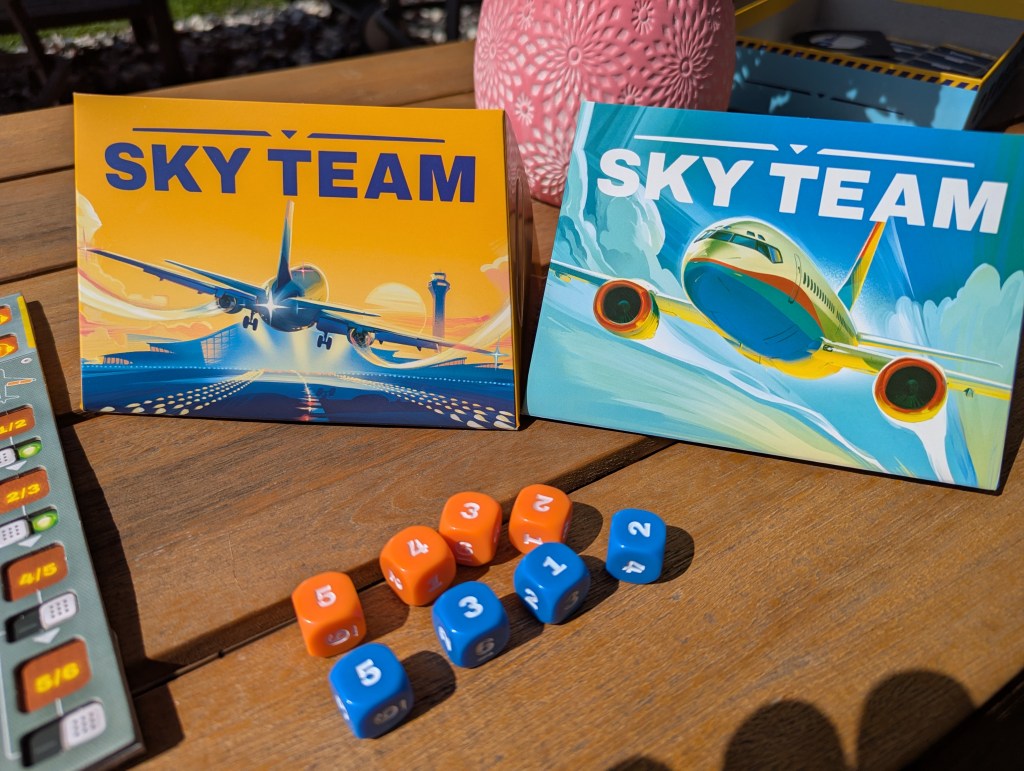
The components, especially the chunky dice and the little plasticky airplane axis marker, are all great, too. The spots where you will be deploying your dice are inset, so nothing is going to slide out and get confusing, which is nice in a game where players can’t communicate. There are neat little plastic dials are both very practical and incredibly satisfying to slide into place. The player aides double as havens to hide your dice from your partner, and the console between you two is perfectly legible and easy to parse at all times.
I’ve played the game twenty times, beaten maybe a third of the scenarios, and I still bring it out and play the starter scenario with someone new fairly frequently. I haven’t even touched the print-and-play bonus scenarios, or the expansion that adds penguins. There’s a lot here.
If you (or someone you know) are new to the world of cooperative games and often have only two players, this is an incredibly easy recommend. Your partner’s rudimentary understanding of planes will have them knowing the importance of “staying level” and “deploying the landing gear.” Once you fall into a rhythm, you will start understanding what your partner is saying about the dice in their hand when they play a high number in the plane’s axis, for instance. You get to feel professionally synced up when you avoid the half-dozen fail conditions and get your first win.
Maybe you’ll get good enough to beat a real-time scenario in which you have 60 seconds to cooperatively, frenetically deploy all 8 dice. If you do beat those real time ones, tell me your secret.

Leave a comment