
All good cooperative games should strive to be a heist movie. Not that they should be about stealing from some vault– though at least a couple are– I mean the opportunities for people to ooze with cleverness and synchronicity. You and your friends acting in concert because of some extreme forethought, planning, or the good fortune of tuning to the same wavelength. Some games achieve this effect by showing you a superpower you didn’t know you had. Wilmot’s Warehouse elucidates that you and your buddies are story-crafting memorization supercomputers; The Mind invents personalized telepathy round by round; The Gang, not to be outdone, makes you feel like you could win a hand (or two) of poker.
Bomb Busters did not reveal to me a previously-unknown superpower. But it also didn’t make me feel dumb. Sort of right in the middle. I felt like I was MacGyver’ing solutions out of duct tape and subtle ingenuity, but also mixing up my lefts from my rights.
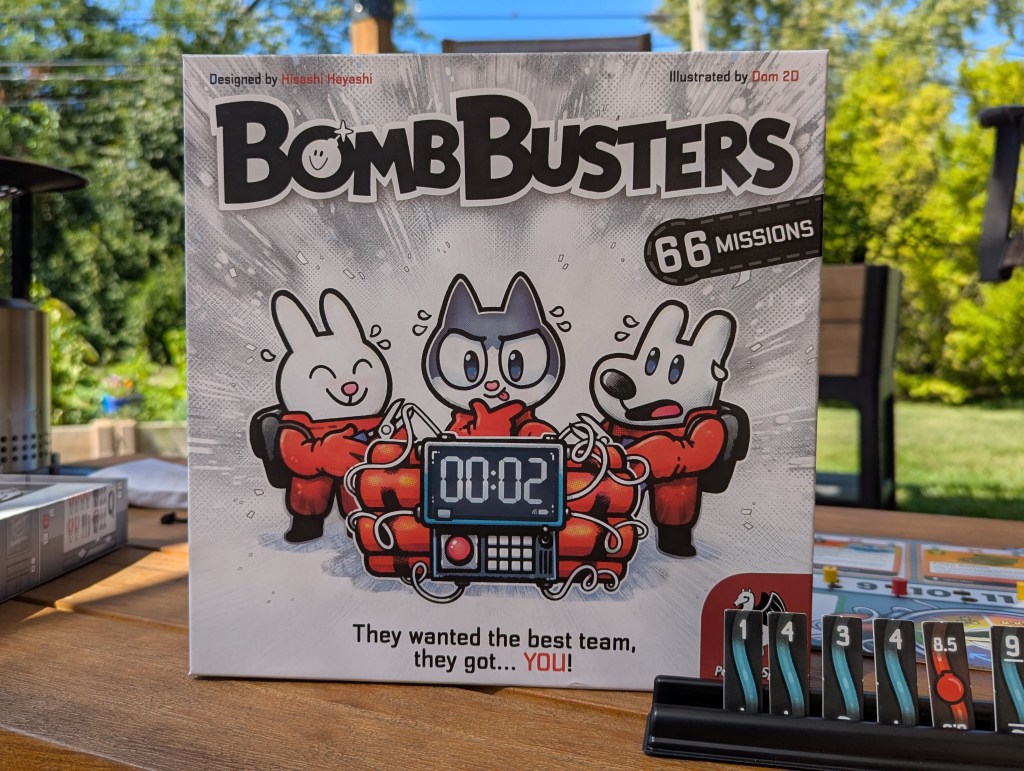
In this world, artist Dom2D’s cartoonish and cute animals are dressed in cool little outfits, operating pliers and other crude mechanisms to defuse bombs just outside their pay grade. Their reward for defusing those bombs? Harder bombs. And what better way to defuse a bomb than to work together with your friends to touch some wires– without communicating, of course.
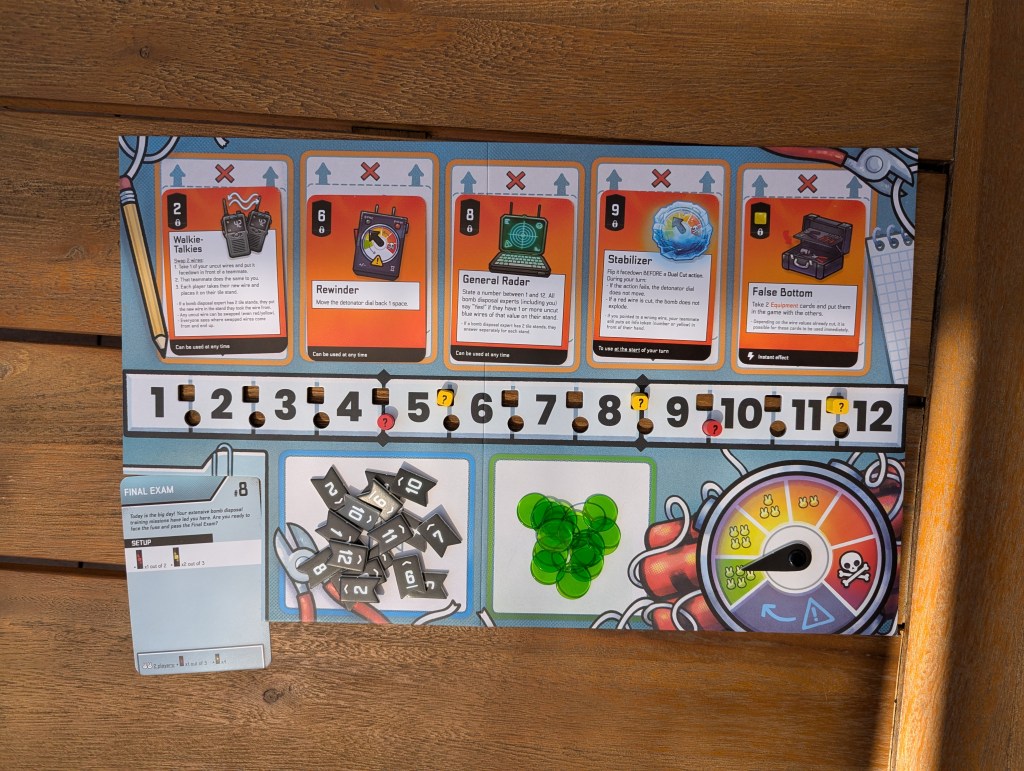
Bomb Busters is a cooperative deduction game for 2-5 players with a cache of bells and whistles at its disposal, but designer Hisashi Hayashi plays it relatively straight. Sitting down to play a mission or two, you will be doing some deduction. Gimmicks come and go, deducing a couple of numbers remains.
In the game, players will be dealt a rack full of wires labeled 1-12. Most of these are blue wires, perfectly safe to cut by touching another player’s wire if you A. can deduce what number their wire is (knowing their wires are sorted in ascending order) and B. have the same number somewhere on your rack. Because of allotted pre-game communication, the first few cuts are straightforward enough to instill confidence. “Well I have a 12 and they signaled their 3rd highest number is an 11, surely the last wire is a 12,” you’ll stroke your chin. And it will be a 12! And the bomb is being defused, slowly but surely! Except there are 4 of each blue wire, and cutting them all is going to take a while. Each time you miss, the bomb ticks, and it can only tick a few times before you blow up, and there’s probably a couple different colored wires, too. Yikes.
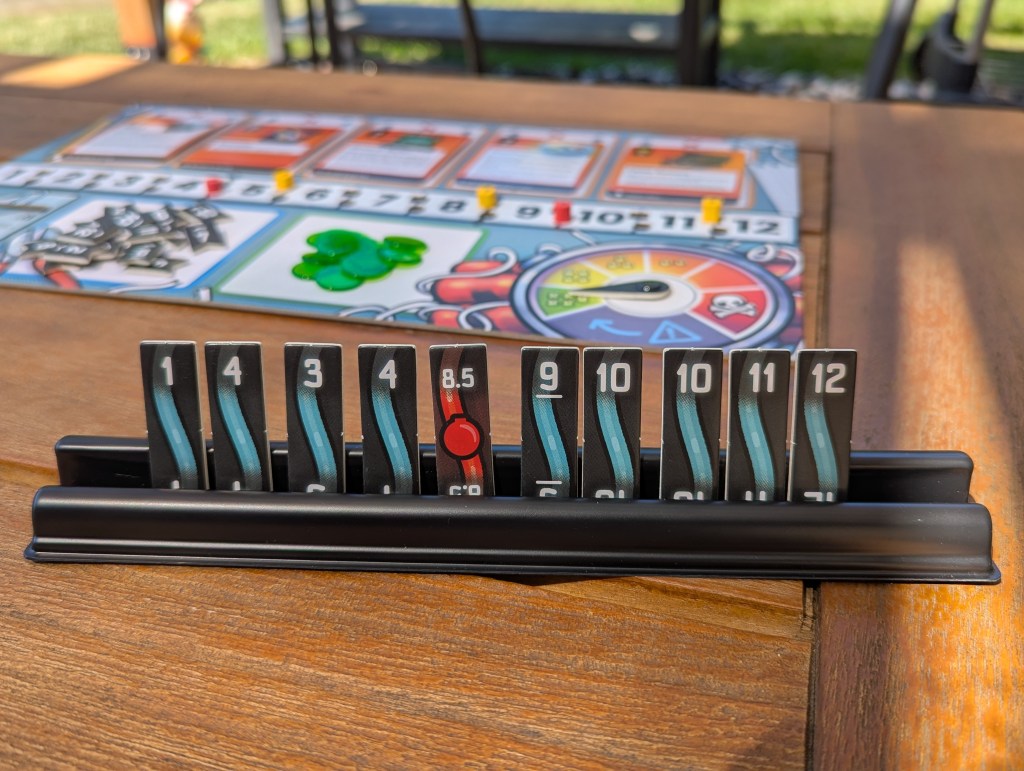
Yellow wires hide between blue ones, cleverly represented by being just a tenth higher than them (e.g. 1.1, 4.1) and can only be cut by being brave enough to declare “this is no integer at all! It’s a yellow wire!”
Red wires are even worse, requiring a player to have completely emptied their rack before being able to cut their own red wire themselves. They live in the exact midpoints between numbers, and attempting to make a cut and touching a red wire means the bomb has blown up. Suddenly, your ability to trim through wires and take 50/50s where you feel fairly certain gets muddied by the very real possibility of you ending the game by touching a red wire. If a yellow is 10.5 and a red 11.1, you’ll be afraid to snip any high-numbered wire anywhere. If you have a red wire, you’re afraid and trying to communicate that somehow through your actions. If you don’t have a red wire, it feels like everyone else does.
So, in response to those scenarios, Bomb Busters is a game about playing it safe. If you know where the red might be, just cut where it can’t possibly be, right? But when your turn comes around, you have to cut something. “Surely,” I think, “there’s something safe to be done somewhere. The three other players glaring through my forehead seem to think there is something obvious to do.” Sometimes, it suffices to take the safest plunge in an ocean of unknowns. Sometimes, though, you are caught up in the swirl of a vibe check and now it’s time to touch the middle-est wire on the most unknowable rack to crack the case wide open with pure intuition– or blow everybody up.
Bomb Busters packs a lot of enjoyment into this simple gameplay loop. The evergreen additions are the aforementioned yellow and red wires, as well as gadgets. Gadgets are one time opportunities to cheat, getting information or skipping a turn such that pure deduction isn’t the only way out. Even the weakest gadget will deploy like a lifesaver when you are otherwise lost.
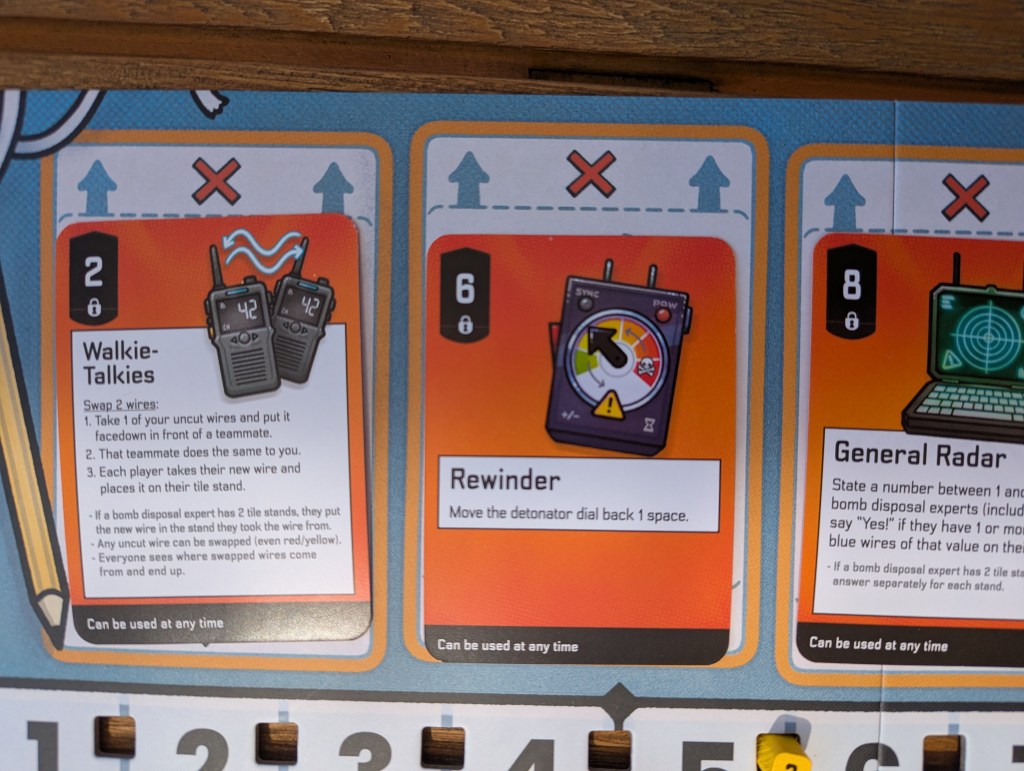
Not wanting to cheat you back, Bomb Busters even has a row of numbers to show what has been completely cut, so as to minimize issues where someone makes a misstep because they failed to recognize an obvious piece of information (that still happens, but it’s a deduction game, of course it does). And for a “simple” game loop, designer Hisashi Hayashi surely did not skimp out. 66 missions, all of them (that I’ve seen) providing harder difficulty, new rules, twists on existing rules– you could bust bombs for months, presumably.
I do feel, however, that the inclusion of so many missions dilutes the value I give to the core experience. Instead of playing the “base game” (Mission 8 is what I would consider the “evergreen” experience), I’m compelled to move onto Mission 11 or 12. When I do introduce the game to a new player, I hop back to Mission 8, but everyone else feels a little let down knowing we could be progressing and unlocking stickers instead. Mission 8 alone probably would have been enough for me to keep it around on my shelf, but I won’t know because I want to march on and open more boxes.
The moment-to-moment gameplay includes a lot of thinking and scanning the table, feeling cool and clever. However, there are frequent moments where one can sense there is an objectively safest, best move and if they study the game state for a few minutes they will find it. I want cleverness to prevail, yes, but I also want boldness to have a seat at the table. Turns out, when you’re trying not to blow up, overwhelming caution tends to win out as the dominant strategy. The cooperative nature of the game doesn’t help players’ timid tendencies, either. In other deduction games, you can use your turn taking wild stabs in the dark or trying to jump ahead three steps if, for instance, you’re behind and need to be drastic to catch up. Bomb Busters could be played with that disregard for safety but in practice you can simply take your time to avoid ruining the experience for everyone else.
In one game, our bomb was one tick away from exploding early on. The rest of the round was suitably tense. Each cut was like a negotiation between chance, what each person had silently communicated, and a little bit of reckoning that it might be the last cut we make. In the end, we had a massive sigh of relief and satisfaction when the last player defused their red wire. Every turn between “one-tick-from-lethality” and “we won” was ponderous and dripping with anticipation. A lot of people will enjoy that. I do, too. But by the end of it we had done so much staring and dreading at one another that we thought it best to pack it away before we tear each other’s heads off next round. Compare that to a shortlist of other cooperative games (such as the aforementioned The Gang or The Crew) for which we get stuck into loops of playing again and again, win or lose.
Setup factors into consideration, too. Bomb Busters‘ setup isn’t as seamless as other games that have a deck of cards instead of little cardboard wires. It’s a bit finnicky to dump out the blue wires from their baggie, grab some yellow wires and shuffle those up, do the same to the red, and make sure you are doing the correct setup for this new mission. I’ve setup worse, but it’s enough to dissuade me from playing a lot of rounds in a row or bringing it out everywhere.
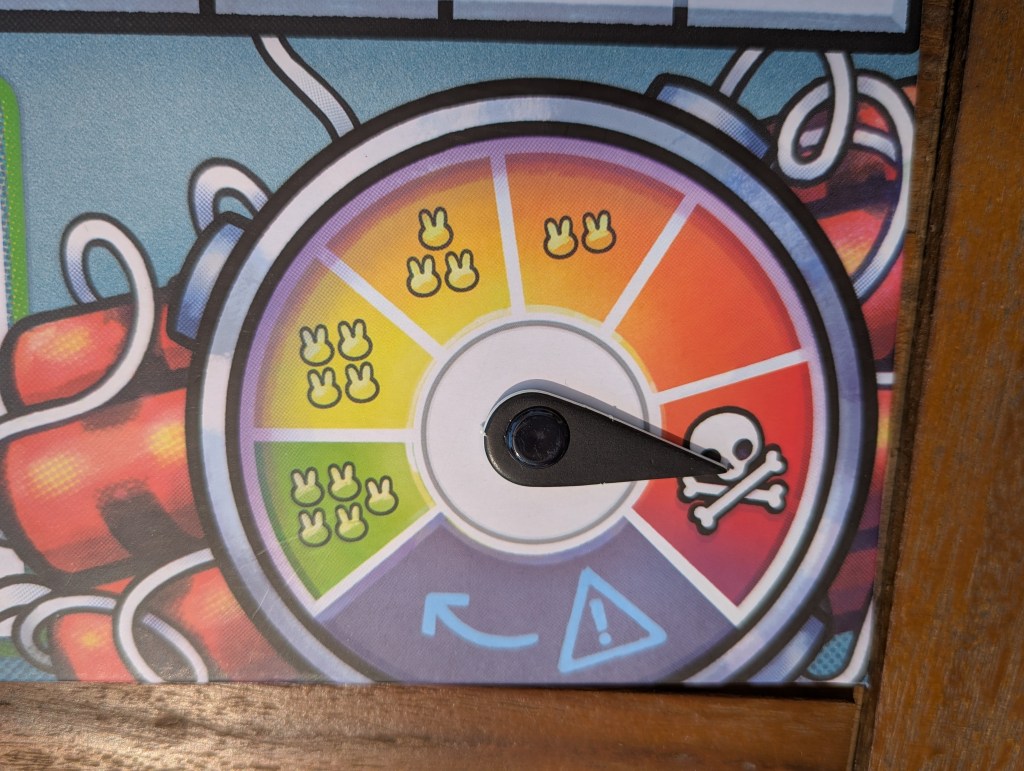
Still, there’s a reason this game just won the Spiel de Jahres. Breaking news live from this review: I think the game is good. While the little wires can be annoying to mess around with and deal to players without accidentally revealing them, the production is otherwise clean and feels almost extravagant considering the price and the size of the box. Dom2D’s art is, again, adorable. Personality is dripping off the cast of characters, the game board, and the cartoonish gadgets. I love the thrill of taking a 50/50, succeeding, and eliminating several other difficult possibilities in the process. I love seeing a move nobody else did, going to touch a wire and seeing everyone tense up and squeeze their eyes shut, and then nailing it– or not nailing it and making everyone laugh.
I see myself continuing to bring this out. While it may not be a heist movie, it’s a good enough thriller with a spoonful of comedy to make the tension sweeter. Whenever my playgroup is 5ish players and we are in the mood for a round or two of a thinky cooperative game, this will work. I know regardless of what mission we play, it will be fresh, tense, and full of pensively-arched eyebrows. I am not as completely enamored with Bomb Busters as others have been, but I still would recommend it to the right friend. This game proves not every cooperative deduction game needs to rewire your brain’s chemistry, even if a lot of them do. Hayashi crammed “deduce numbers” into a cute package along with 50 optional twists, and that’s honestly enough.
Rest assured, folks, those bombs are getting busted.

Leave a comment