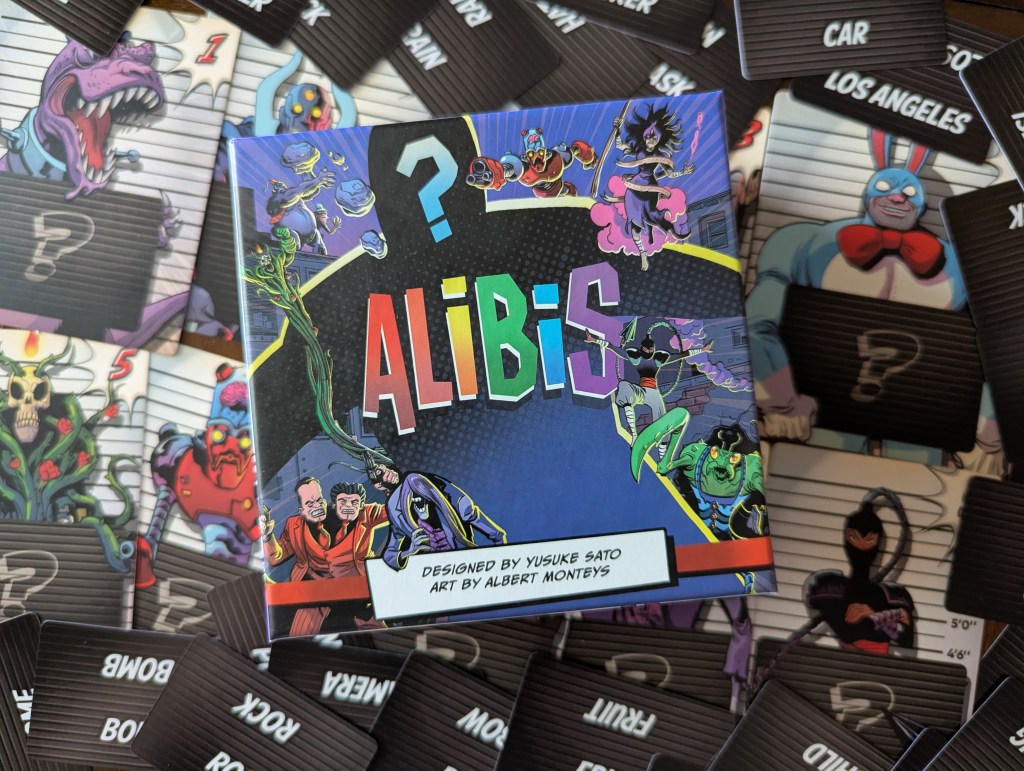

For my family, party games hit the table frequently. When I can wrangle together a group of my siblings, it is almost guaranteed that someone at the table will cap the type of game we play to something simple and short. Maybe my sister will tell us, as she is wont to do, “I don’t want to think at all” by which she means, “don’t make me strategize or internalize any new information.” Fair.
Allplay’s new line of “thinky family” games, then, seem like a shrewd proposition for my family. A handful of small games with little to no rules overhead; more than a party game but less than a family weight board game. We can get along with that. And so I’ve been bringing around Alibis.
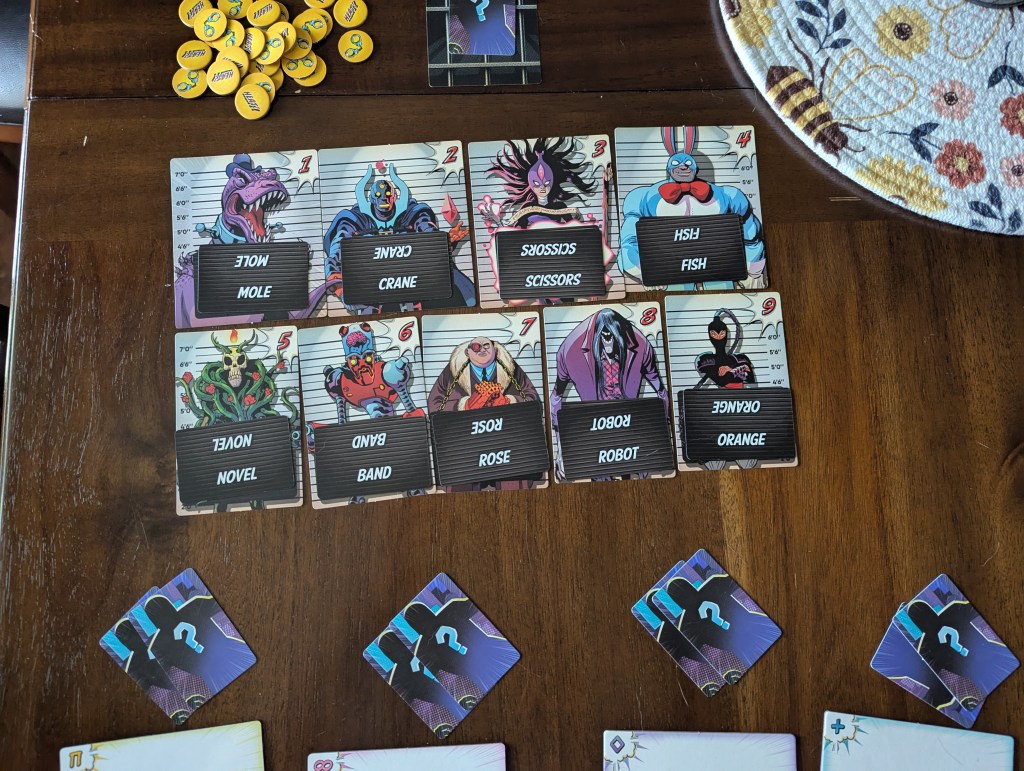
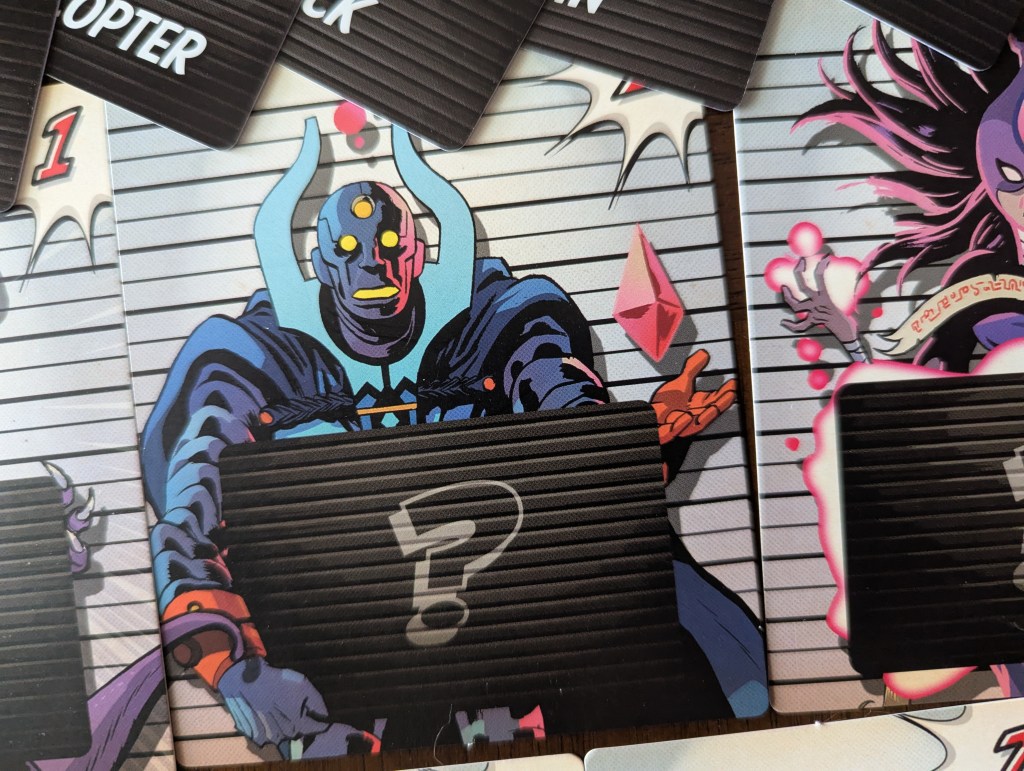
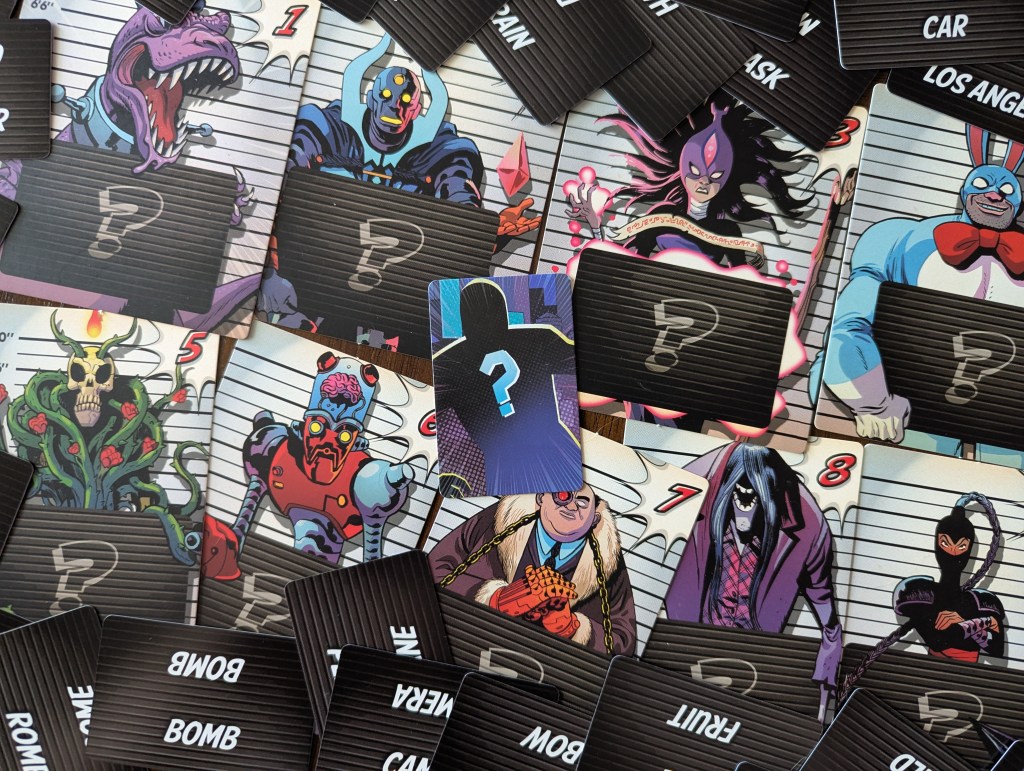
In Alibis, a police lineup of villains is on the table, each adorned with a random word (France, boat, top, etc.) and a corresponding number. Players will be coming up with a one word clue that exonerates two villains they were randomly dealt by word-associating them. Afterwards, players will reveal their clues and each detective individually tries to deduce what each player’s words were and, more crucially, what the one word not assigned to anyone was. This is the Perpetrator word and is worth the bulk of the cooperatively scored points. After three rounds, the group will have a final score graded by a perfunctory table in the rule book. There is a variant for two or three players, but the rules as described above are how the game is played for 4-6.
From the get-go, Alibis enters the (crime) scene with one major advantage. I taught this game to my sister by setting the game up and telling her she could pretend she’s playing Codenames. These villains out here have words on them, you were dealt two villains, come up with a Codenames-rules-compliant word that would perform well in Codenames, and I’ll teach the rest afterwards. The game is structurally much different, but what players do on a turn-by-turn basis is similar. Associate a couple words with a one word clue. Take in a one word clue and make some assumptions about what it’s trying to associate. Make sure your clue avoids a specific extra bad word. The devil, or I suppose the Supervillain in Alibis’ case, lies in the details.
Because most points are scored by identifying the one word perpetrator, players can contribute massively to the teams success even if they fail to put together any clue correctly. If someone thought you meant X instead of Y and she meant Y instead of X, they’ve landed on the same Z, so shower us in points all the same. Is it comforting knowing we only found the true perpetrator through blind luck? No, not really, but it is silly fun and gets people talking between rounds.
Thankfully, though, there isn’t a ton of downtime in between rounds. Everyone is giving clues and deciphering them all together. Instead of having to play the game back-to-back in order to do your favorite half of the word game equation, you get to do both parts three times over the course of a full play. The game also has pretty loose rules for how the “reveal clues” phase is meant to go, but my group tends to play this game rather briskly. Twenty-ish seconds after a player reveals their clue, we have the next player reveal their word, spilling more (perhaps contradictory) evidence on the table. You are allowed to erase and rewrite on your deduction board as much as you want before the round ends, so you are never beholden to a gut-check guess you made after the first reveal.

There are still moments where someone labors for five minutes overthinking at one point or another, doubting their initial hunches and slowing the game down. This has, in my experience, never been an outsized problem. But I’ve also never actually fully won a game of Alibis, so maybe we should be taking some more time to piece together evidence. I’ve still had a lot of fun vying for higher scores, even after falling short several times.
The scoring tokens, however, have been a minor problem for me. In a six player game, you count out 40 cardboard tokens and remove tokens to “score.” This creates instances where we worry we forgot to remove a token, or accidentally removed a token twice, or we lost count and started with one fewer than intended. It’s hard to see how well we are doing unless someone takes a moment to count the 25-odd yellow chits remaining. In the end, our measure of success is having moved a bunch of cardboard tokens from one pile to a different pile. Alibis is a word-association game with giant, quirky villains for the words to sit on and a dedicated 2-3 player mode, but I still sense a cut corner or two. I would have liked to see a competitive variant, especially since it’s reimplementing Nigoichi, a competitive game.
In Nigoichi, from what English translated rules I’ve seen, you score for identifying the perpetrator but lose points whenever someone misidentifies the perpetrator as one of your words. You are incentivized to give good exonerating evidence, but are hoping only you successfully identify the supervillain. That seems more thematic and potentially more interesting. Detectives competing on the case! Prove your guy innocent or lose points! Alas those rules are not present in the box of Alibis, but it would probably be easy enough to play with them.
I’ve enjoyed my time associating words and marking away at my deduction board in Alibis. It isn’t going to burn your brain or get you into heads-down-puzzling mode, but I prefer that for something of this size. There’s no limits to conversating– nobody has to be the clue-giver/ghost/quiet-one who has to hold a straight face the whole game. For my family, a side conversation debating how everyone in Alibis is canonically like 7 foot tall and thus could theoretically dunk is always brewing.
I recommend this one, despite my handful of quibbles. I must admit it has quite a lot of flavor and table presence for a word game. And, to my knowledge, Alibis isn’t planning to crossover with any wizarding worlds anytime soon. That’s a big plus.

Leave a comment