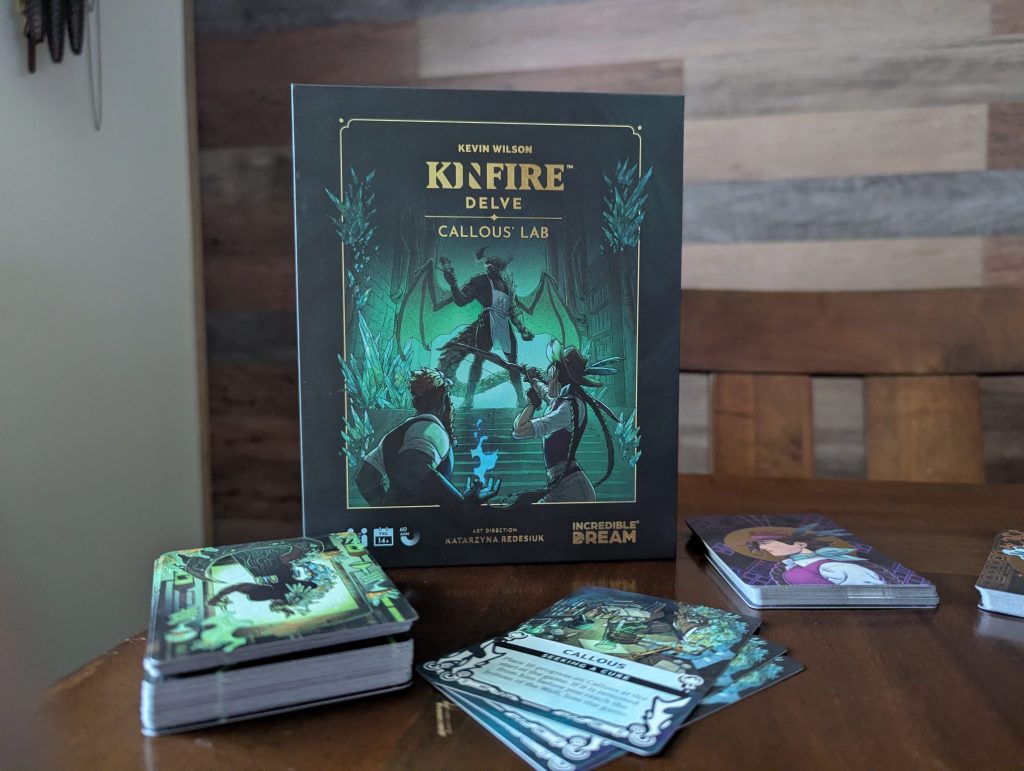

In Kinfire Delve: Callous’ Lab, I’ve been beset on all sides by half-finished science experiments called husks. I’ve been befuddled by a sapience test when a guardian stumbled upon me and drew my attention away. I’ve found moments of meditation that threatened to hypnotize and exhaust me whilst a mind parasite tried to sap my intelligence away. And I’ve found myself in a daring boss battle, completely outnumbered, against an immortal foe with hardly any weakness except for that one little thing.
If this sounds like I’m describing a massive dungeon crawl or perhaps even a Dungeons and Dragons campaign– I’m not. The Kinfire universe is massive, don’t get me wrong, and has sustained ventures that deep. Between a handful of these delves, the new political game Kinfire Council, and the fully fleshed out dungeon crawler Kinfire Chronicles, there’s a lot of world to crawl around in. Kinfire Delve is, by a wide margin, the smallest of Kevin Wilson’s offerings in this world. The game manages to condense the feeling of battling your way through a thick, varied dungeon into nothing more than two decks of cards and a svelte ruleset.

In Kinfire Delve, you (and maybe a friend) are a Seeker. You are going to be taking a magic lantern and going down a Well, which is essentially a dungeon in which a villain has sequestered away. You will be playing cards for their special effects and their numerical value, rolling dice or playing other cards to boost that value, and then adding your finished result as Progress to challenges. Like other more involved dungeon crawlers (e.g. Gloomhaven), this game presents itself primarily as a hand-management puzzle.
At any given time, four challenges are face up and you may attempt any of them. Spending two or three cards to guarantee you can get rid of an easier challenge is nice, but you don’t draw back up for free. Instead, the forces of the Well get their “turn” against you by forcing you to draw an Exhaustion card when you wish to replenish your hand. These Exhaustion cards represent the Well getting more dangerous or the Master lashing out at you in some way. Similarly, when you attempt but fail a challenge, there will be a penalty for not 100%ing said challenge. Your progress remains, but the hubris of thinking the dice would cover the one more progress you needed is punished by a point of damage or a couple of forced discards. This removes any admin work from the dungeon or its denizens taking their own bespoke turn; they simply react with a single symbol or line of text to the adventurers missing a step.

Kinfire Delve is to dungeon crawlers as something like Apocalypse World is to the world of RPGs. Gone are the advanced rules, edge cases, the simulation of carry weight, 12 different skills or lining up an attack on a square grid. You simply add Progress to obstacles, traps, or enemies, and then you either succeed or fail it. One character’s “Compassion” card, which one could imagine being narrowly defined in another game, can be used to deal with any challenge whatsoever. That same character’s Acid Arrow? It can’t quite be used for everything, but it does work for 2/3rds of the game’s challenges, no worries.
Callous’ Lab‘s two characters are plenty unique, too. Roland, who on the surface looks to be your typical bookish support-healer type, is much more. He wields fire and manipulates his discard pile to put out a staggering amount of Progress, potentially burning himself in return. Though he’s a scholar, he’s also tough, workmanlike, and his signature skill is being a True Friend.
Valora Helmsman, the other playable character, is a bow-wielding explorer-type (or else that’s what her hat indicates to me). She does the typical archer thing of striking from afar, which in this game manifests as her ability to multitask or get things done while out of harm’s way. She’s a bit more vanilla than Roland as far as fantasy archetypes go, but I do think she has plenty of personality that shines in her deck, too. You learn by some of her cards she is actually quite cautious despite her bravery, opting to only bite off exactly as much as she can chew. Her cards let you shimmy past challenges, avoid penalties for failure, and soften up challenges before you dive headfirst into them– you get the idea.
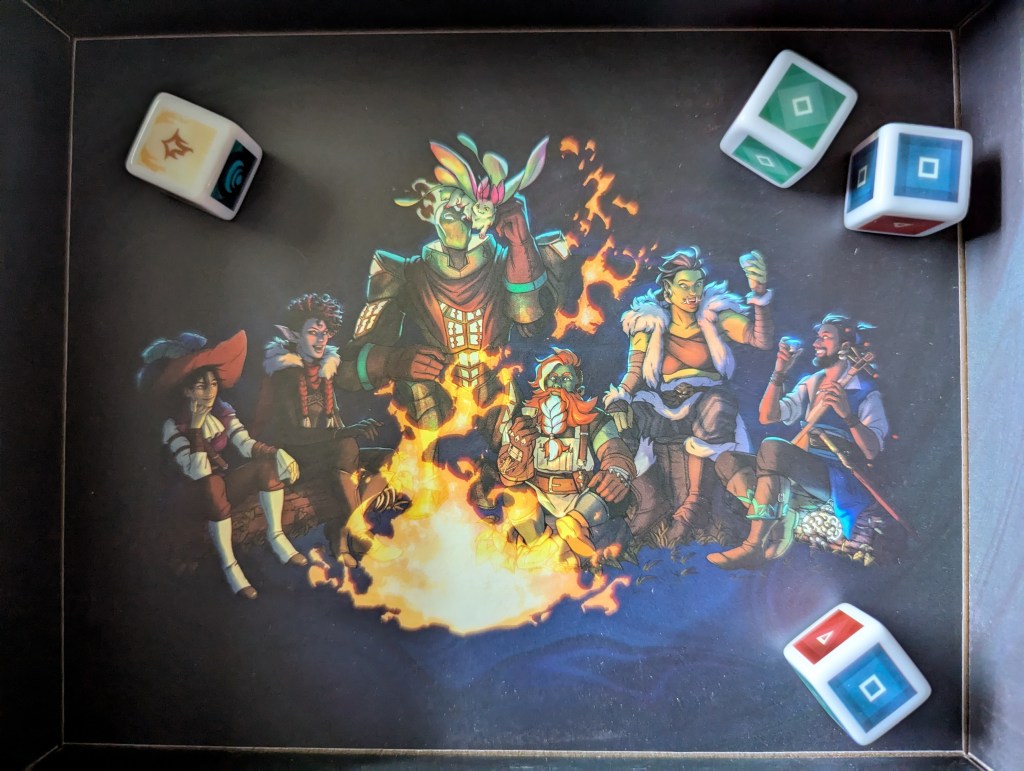
The art and the writing of Kinfire Delve is inspiring. Enough so that I’m convinced there’s plenty to be mined in all of the Kinfire universe’s various forms. However, after four trips through Callous’ Lab, I feel I have experienced enough of its corridors. I would go through this box again with a friend (I’ve only played it once cooperatively), but I’ve outwitted Callous enough times solo for him to not surprise me any more. There is a checklist of challenges in the rulebook, but I’m uninterested enough in pursuing all of those. Some of them don’t seem particularly “things you pursue” but rather “cool things that could happen,” anyway.
In a hobby full of dungeons and worlds of cardboard I will never fully complete, I’m happy to have completed this one. I definitely got my 20-odd dollars worth. And if someone wanted to hang out and go through this or one of the other quick dungeons in like 40-60 minutes, yeah, I’d be down. If someone else had one of the bigger box Kinfire experiences? I think I would be ecstatic to hop in, knowing the world is well cared for and expressive. That seems like a win for the series.

Leave a comment