
I used to keep some origami cranes in my wallet. Someone had made them from post it notes. They lived condensed back behind the dollar bills and so I’d sometimes accidentally drop one when I went to pay for pizza or something. I would recover them, of course. It’s surprisingly hard to get rid of an origami crane guilt-free. I did eventually get rid of them, but not on purpose. I got rid of that wallet and they, having lived there, went with it.
Some time later, I ordered a card game from Japan (hello from my Nanatoridori review) and when I opened the envelope, a half dozen origami cranes spilled onto my lap. Wow, I thought. Authentic Japanese paper.
For a gesture so small– the guy I ordered from thought it was cute because the game is about birds– I was genuinely touched. Perhaps it’s knowing origami is just paper, but someone took something ordinary and made it something cool, and they did that for me. He even wrote me a little blurb about what origami was. I was stoked about those birds.
All this to say, I am predisposed to liking Sea Salt & Paper. In lieu of the typical “all views are my own and unbiased” disclaimer you will have surely seen in other reviews, I will be employing a never before seen disclaimer:
Uncritical fan of inadvertently collecting papercraft aquatic birds, but no money changed hands.
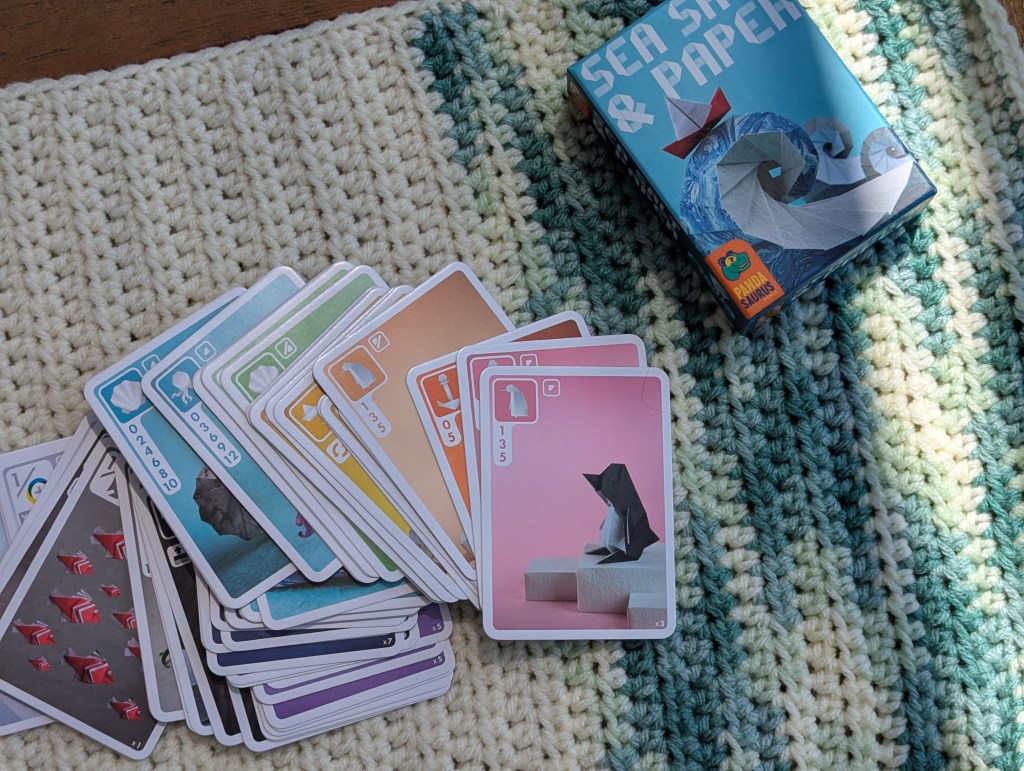
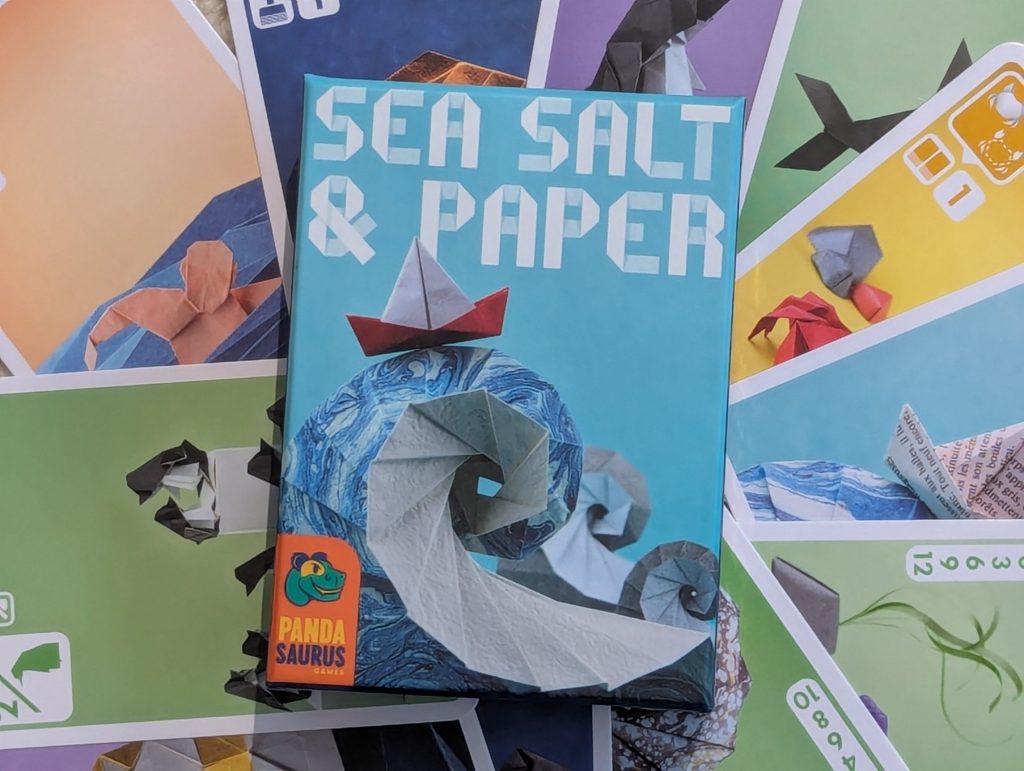
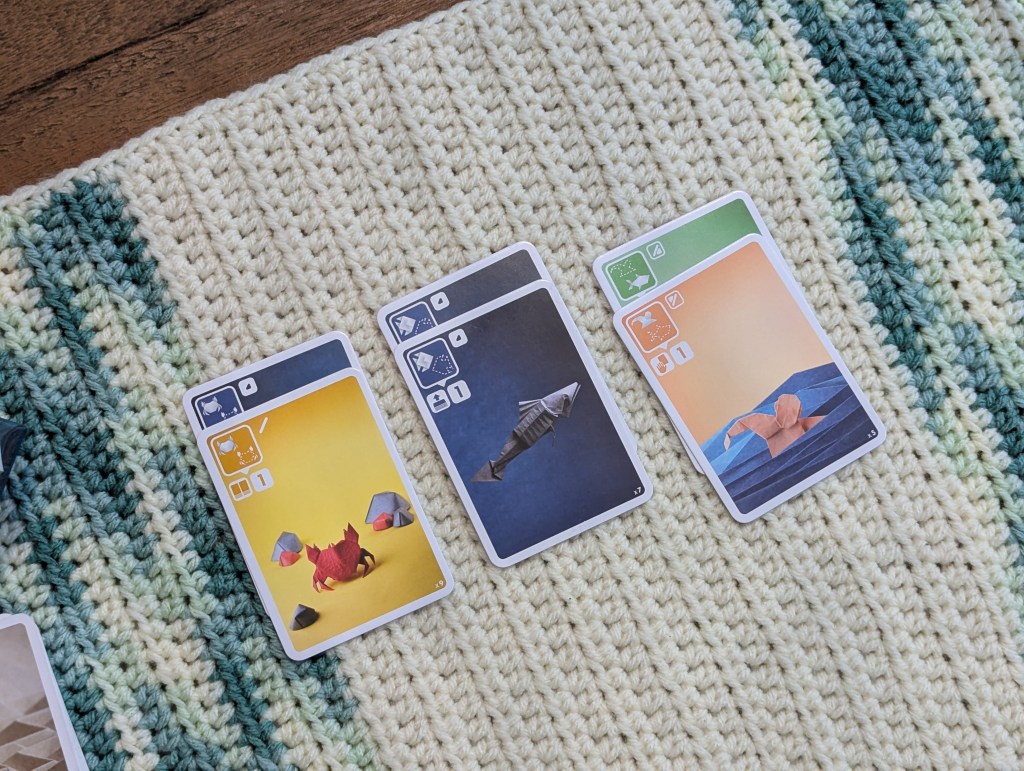
Sea Salt & Paper is a card game about origami aquatic creatures and the art of collecting them. In it, you will primarily be drawing two cards from a deck– a blue seashell and a pink crab, for example. You will weigh how valuable each of them are to your personal collection, pick one, and toss the other into the discard, burying whatever else was there beneath it. Points are awarded for having pairs, collecting bigger sets, and sometimes for having multiple cards of the same color.
The game offers no explanation for why you, a player, are doing what you are doing (or what the mechanics of the game are intended to represent) but I am unbothered by that. Bruno Cathala and Théo Rivière have a certain amount of confidence in this design, like it’s supposed to be a modern classic and any of your trepidation e.g. “why do I even want a bunch of octopi?” are assuaged by said octopi being perfectly origami’d by Lucien Derainne and Pierre-Yves Gallard.
So it is a game about assembling a collection. This collection is mostly secret, at least in the beginning, as you draw from a shared deck of unknowns. However, as you pick up more of your opponent’s refuse, they will start to form a picture of what you are collecting. Even more so when you play a pair, revealing the points you are holding but triggering an immediate ability like drawing another card from the deck. These abilities are powerful, but you may find yourself delaying showing your hand. Not specifically because your opponent may come to steal it (though, maybe), but because Sea Salt & Paper is a collection game where you want the strength of your collection to be unguessable.
At any time, once a player has seven points secretly in their hand or visible in their tableau of played pairs, they may declare the end of the round. They say “stop” if they want play to cease immediately and to begin counting score. Or they say “last chance,” if they want to wager they can beat the opponent’s hand, sweetening the pot but allowing them one more turn to play. The tension of the game hangs on this one interaction: when is this round ending, and how?
Perhaps you’ve gotten to seven points so quickly you should say stop and hold your opponent to a point or two. Maybe you have some seashells and want to play the long game of building up a collection, dreading your opponent will end the round before your more ambitious scoring kicks in. Or maybe you can weasel your way out a weak start by collecting all of the same color, effectively betting against yourself. When they take that bait and instead “last chance” you, they’ll be mildly annoyed when you pick up more than your fair share of consolatory points.
A lot of what players do in this game amounts to being a little annoying on purpose. When you snatch up the card your opponent just discarded for the fourth turn in a row, it will irk them. Yes we all know the adage, but how could one man’s trash be another man’s treasure again? Same goes for when someone intentionally buries a card, or stockpiles the ship cards and takes three turns in a row, etc etc. Every action you take or don’t take gets picked over by the vulture(s) you are playing against. The game is about assembling your collection on the beach, yes, but it’s also about keeping an obnoxiously-close eye on your opponent’s collection, too. And maybe knocking over their sandcastle if you can.
Even the simple mandatory discard after drawing two is loaded with opportunity to ruin an opponent’s plan. There are always two discard piles, so what you choose to cover up when discarding is a choice. If you have an inkling your opponent has a shark, you should cover up the swimmer. If you just drew an octopus, maybe you should discard that crab so it doesn’t cover another octopus. The choices are mostly binary, yes, but the simplicity helps to keep everyone’s actions bluff-able and readable.
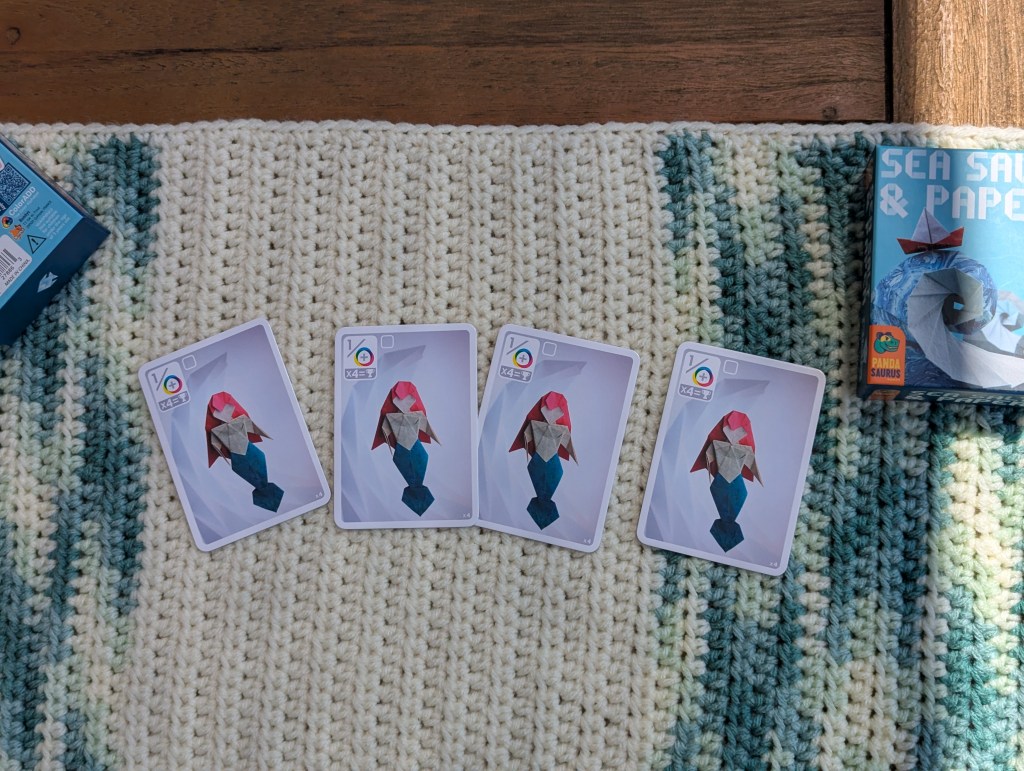
Sea Salt & Paper is not without its flaws. The mermaids, though they present a constant “threat” of an insta-win, have never materialized that threat in my roughly 20 plays. However, perhaps more problematically, individual mermaids provide huge amounts of points depending on the other color cards in your hand. In theory they provide a way to “shoot the moon,” but don’t punish you for taking a risk– they are the most points-efficient card on top of possibly ending the game immediately. I like what the mermaid does, especially the idea of the instant win, but ironically it’s “less powerful” effect tends to be the game deciding one.
I would be remiss not to mention the shark/swimmer pair as well, because they have their fair share of detractors. When played, they allow you to swipe one card at random from your opponent’s hand. I do not hate the shark, but it can be polarizing especially when a mermaid (the culprit again!) gets snatched and a 9 point swing happens by chance thievery. In a sea of passive-aggressive actions, the shark stands out as particularly pointed.
All in all, I like Sea Salt & Paper. I expected a simple and potentially shallow experience when I first picked it up, what with there being so few cards and card abilities. I am happy to report that is not the case. As I’ve played it more, the aforementioned meanness and ability to bluff has become more apparent and given the game newfound depth. Every few months I remember it’s on my shelf–like a little crane shoved back in a wallet– and I’m happy to pull it out.


Leave a comment