
If you need a little extra push to get into abstracts, I get it. I am happy to move chunky pieces around a grid and score for doing so. However, I would be happier if I was instead a druid or a tile-layer performing those same actions.
If you, similarly, ever recoil at the idea of a game of pure skill, I get it. It can suck when someone is strictly better than someone else in a game with no randomness or unknowns to shake up the proceedings. You either feel dumb, or you get to make someone else feel dumb.
Well, I have some good news. Santorini is an abstract game filled to the brim with chibi Greek gods, variable setup, and asymmetric player powers. All of these elements were honed to breach onto your casual gaming table without alienating the most competitive of your friends.
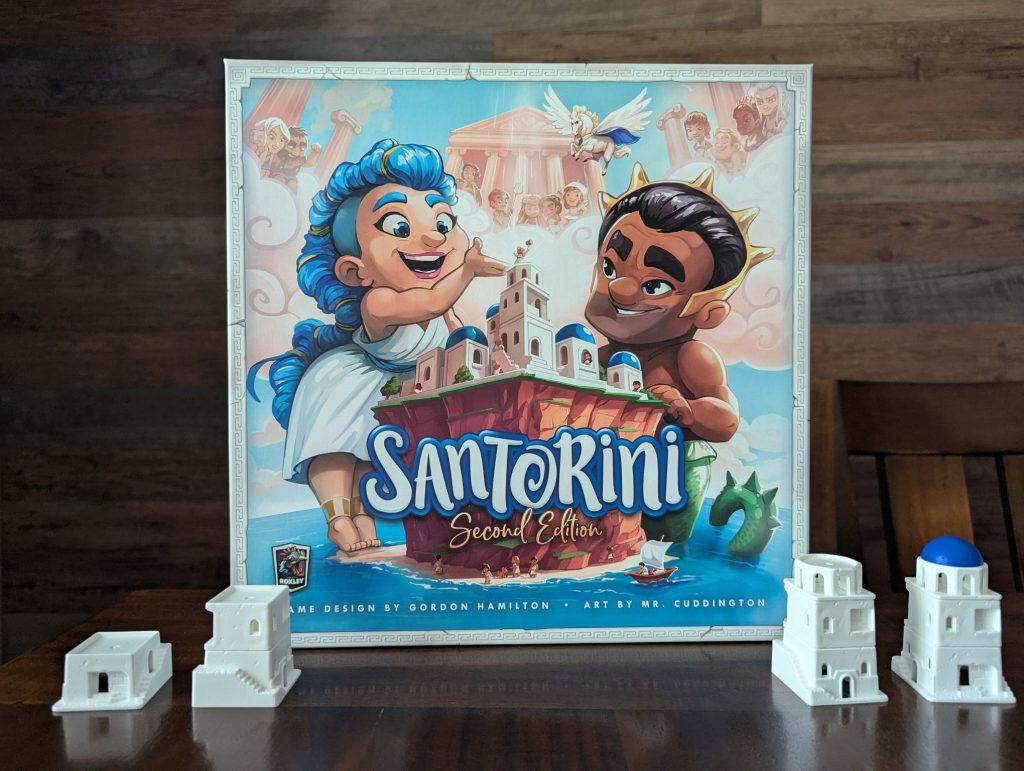
But let’s back up first. Santorini: Second Edition is a 2-4 player abstract game designed by Gord! (more designers should have an exclamation point in their name) and published by Roxley. In Santorini, players are Greek gods controlling little builders who want to build and then climb some Grecian buildings.
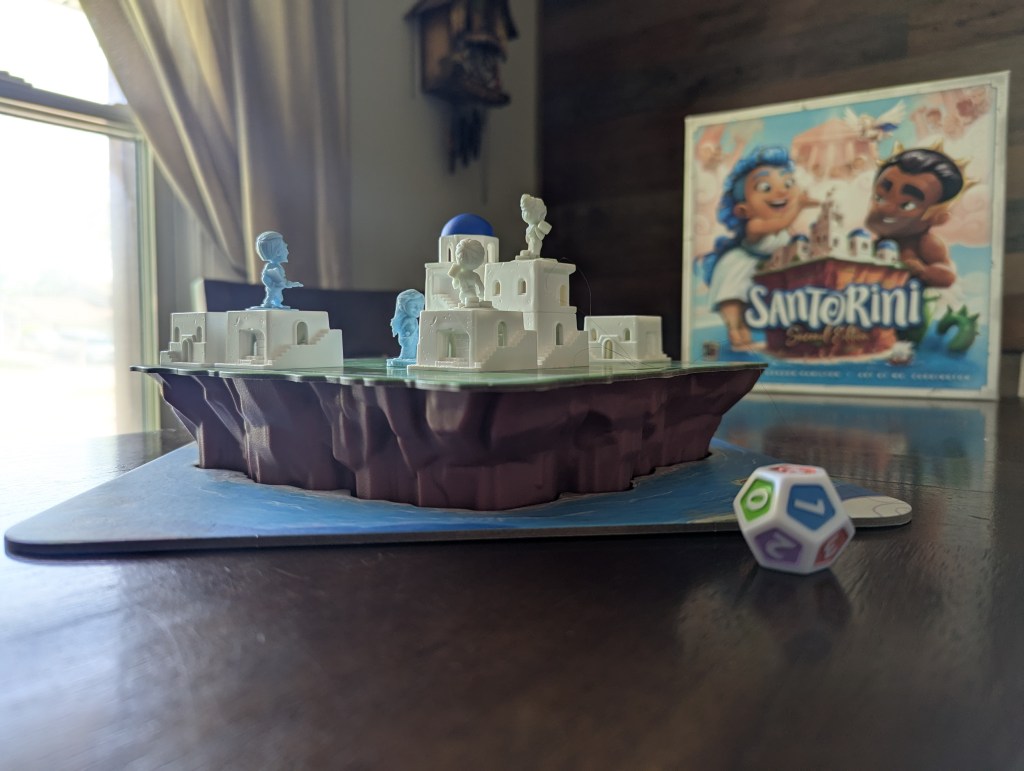
A player’s turn is dead simple: move one of their two builders one tile, and then that same worker builds on another neighboring tile. You can build on top of the ground or on any neighboring building at any height, but when moving you can only climb up one level at a time. A player wins by ascending one of their builders to a three story tall building. However, players can always build a fourth level onto a building, a dome, which effectively removes the location from play.
The “simple” game of Santorini follows the rules I stated above, but the game also features player powers represented by god cards. Each power is completely unique. Gods give you license to break any manner of rules I mentioned above or add rules of their own. What if you could move as much as you want on one turn, once per game, even climbing all the way up to a winning building? What if you could hop over other builders from any level to any level, ignoring the “having to climb up buildings” thing altogether if workers are positioned correctly? What if you spit domes everywhere, threatening to close up the board so much that legal moves are hard to come by? Each god presents a novel challenge both to your opponent and for you as their pilot.
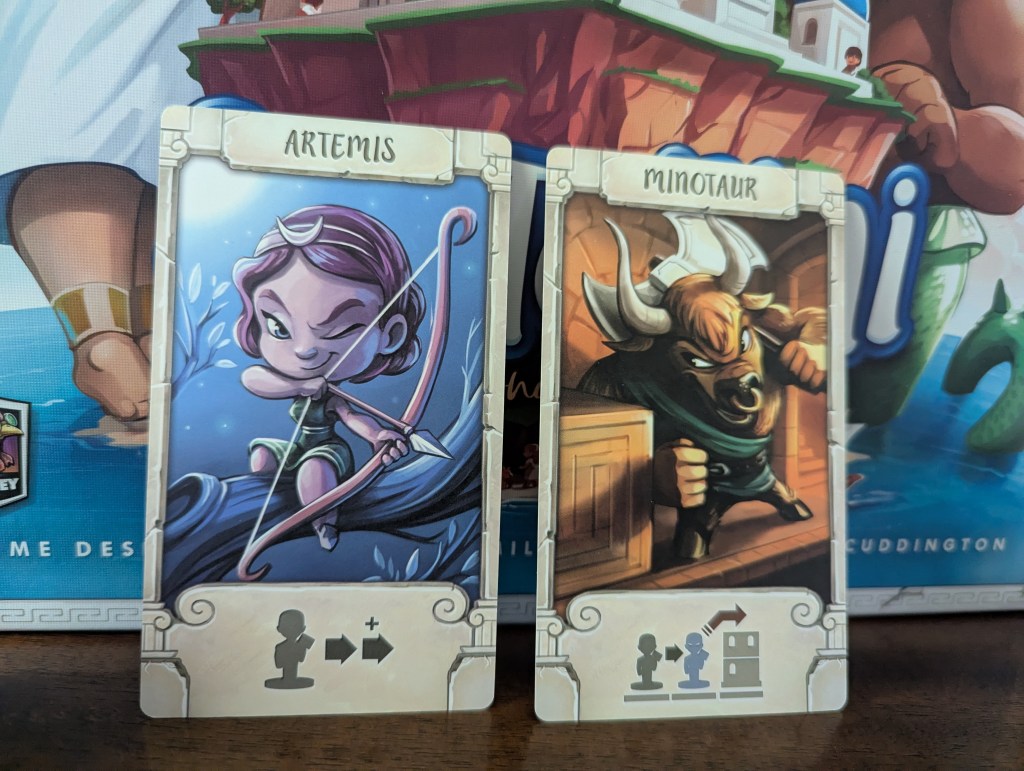
A god who reads as underpowered may, against a certain other god, completely dominate. Another god who seems simple to play may immediately create such head-scratching board states that you swear off using them ever again as to avoid embarrassing yourself. The diversity of powers evokes entering character select in a fighting game or MOBA– but while those characters need a dozen plus moves and stats to meaningfully differentiate themselves from the rest of the roster, Santorini‘s gods have a single line of text.
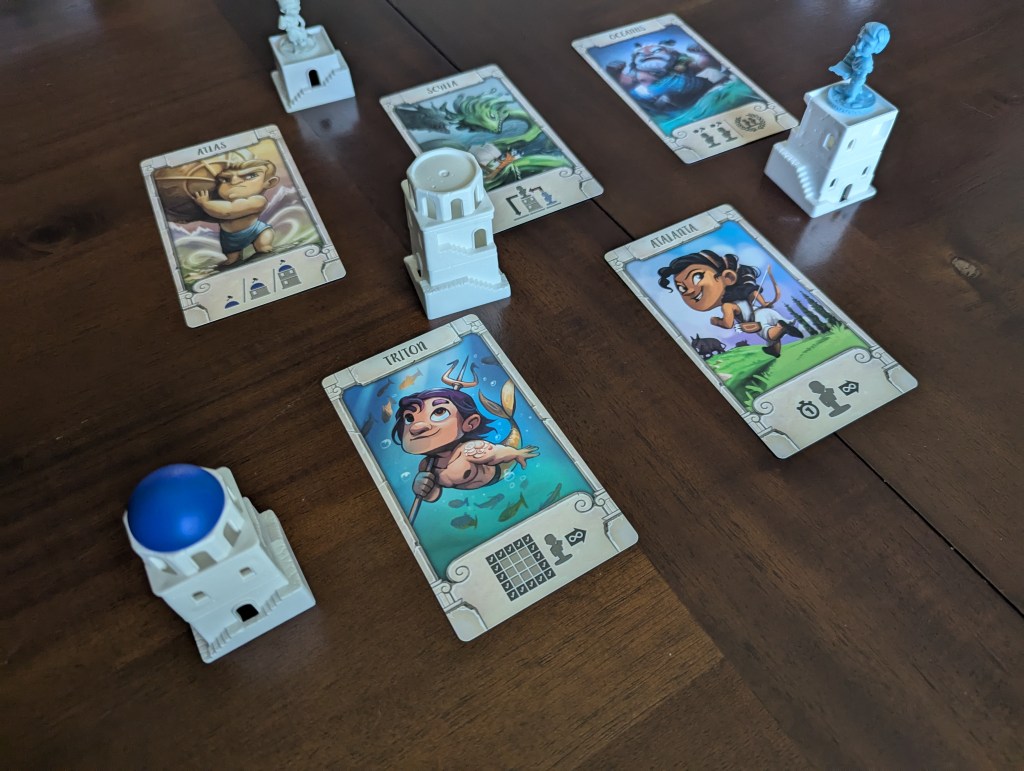
The standard mode of play for Santorini involves dealing out 5 of these gods randomly from the deck and having one player select which two will be present in the game. The other player selects which one they want to play as, and you go.
I won’t pretend to know anything about the balance of Santorini (or the balance of any game) but I do love how the game tantalizes me with too-good-to-be-true god powers. For instance, Hestia can build twice in one turn. We may accelerate into an endgame situation and who knows if I have the advantage, but- come on- I’m building twice per turn. You can only build once. Surely that’s great? Maybe? Or take Triton, who can keep moving his builders, over and over, as long as they remain on the perimeter. “How could anyone possibly lose with him?” I thought, before losing with him.
Win or lose, Santorini gives you plenty of opportunities to be clever. In no time at all you will be able to think a turn or two ahead, make preemptive defensive moves, and put your opponent in lose-lose situations. The “checkmate” scenarios play more like Chess than Connect Four, which I initially feared wouldn’t be the case.
You may have one worker dancing with theirs, following each other around the board capping off every 3-story tall building the other assembles. Eventually, someone will worm their way out of mutually assured dome-construction by applying a different pressure elsewhere. For a game with such simple geometry, Santorini‘s board never develops quite the same way.
Like many good games, there is a natural crescendo turn by turn. When buildings get taller and areas denser, the 5×5 grid seems to shrink. As the amount of moves you can safely make without giving your opponent the win dwindles, the game naturally speeds towards its conclusion.
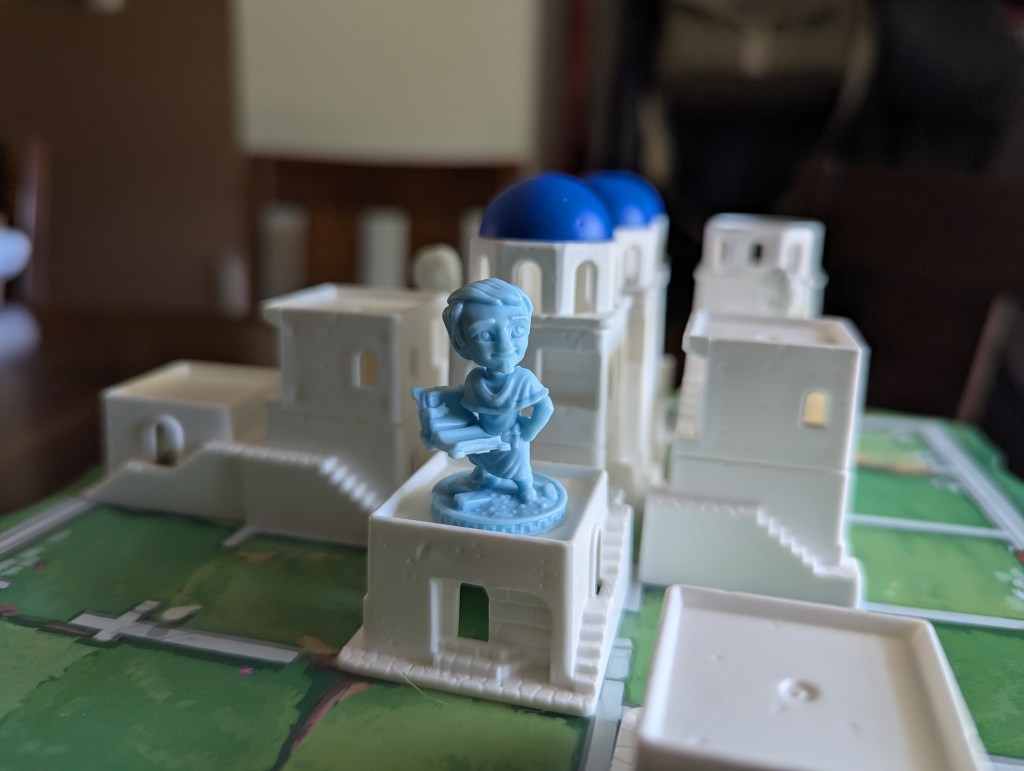
If this all sounds like normal abstract stuff, yeah. I am not immune to “put an abstract game in a cool skin and now I’m not treating it like an abstract” propaganda. Santorini, especially this new second edition, is interested in pulling out all the stops to elevate and almost obscure its chess-like gameplay. The non-deluxe version looks deluxe. The deluxe version, which I believe turns the playing surface into a lazy Susan so you get a 360 degree viewing angle of the 5×5 play grid, is a lot to behold.
When you mention Santorini, you are indeed discussing a game with approximately 5 rules, yes, but you’re also talking about a game immense with plastic and whose board is elevated over the table. Why does an elegant, beautiful game need instructions (albeit good ones) on how to get all of its bits back into the box? And I’m playing with the least-bitted version of the 2024 release?
Mom, can you pick me up? Board games are being board games again, I’m scared.
Would I have preferred the same game in a more manageable box? Yes, probably, but I like small boxes. However, I do also like the miniatures of your builders, and the finish on the oversized cards, and even how luxurious the cardboard box is, so maybe I should stop complaining. The disconnect for me is how it doesn’t seem premium in a “definitive edition of a classic” way but rather a “you bought this game because you like getting a big box full of stuff” sort of way.
As much as I love the variability of not knowing what gods are going to be drafted, I haven’t felt the need to add dozens more into it. Piling on expansions and having 100 different gods and 12 modes to choose from may provide variability, but I’m not sure more options at setup will make the game better. If I do end up getting an expansion for this, it will probably be because I wanted to open a new box and see the new guys and gals more than anything about making the game more fun. And that’s okay! I just feel a little bad about how consumerist it all is.
That doesn’t take away much from my enjoyment of the game, though. If you don’t already have a two player abstract game you know and love, Santorini is here and ready to fill that 5×5-grid-shaped hole in your heart. It may not be as minimalistic as some other 1v1 purely thinky games– not even close– but at Santorini‘s core is a competitive gameplay loop I would put against any game.

Leave a comment