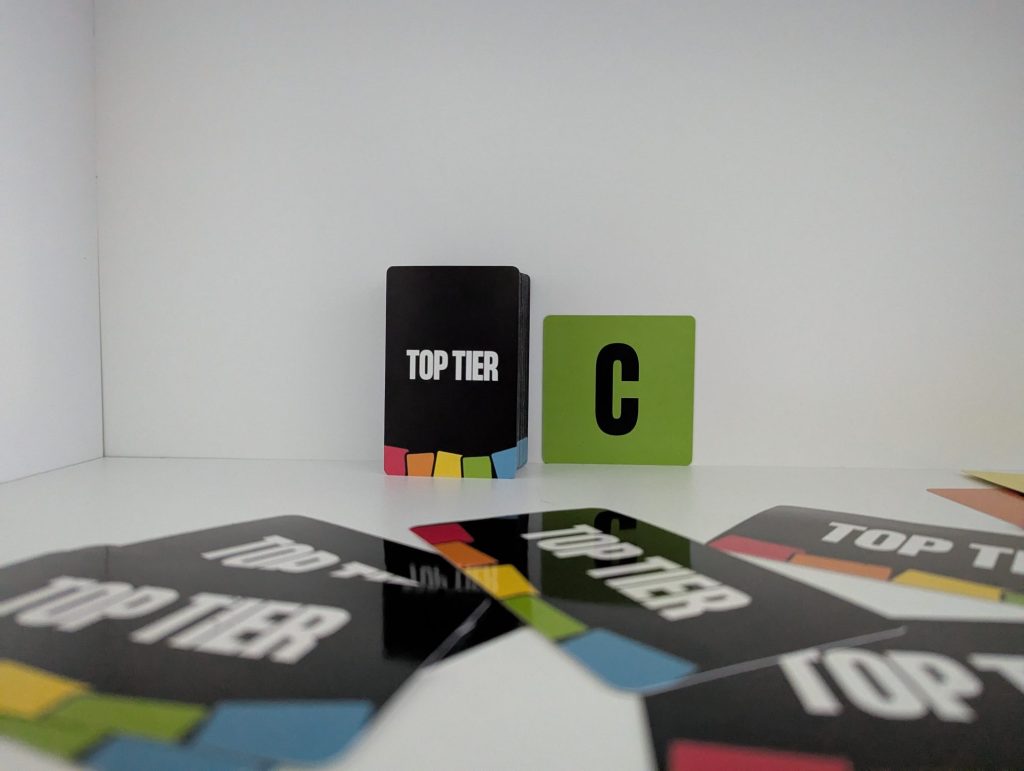

Every few months I put together a comprehensive tier list template and get my partner to rank every board game we have ever played. It’s a collaborative process, partially because some games we only played once three years ago and we have no chance of remembering them without putting our heads together. She gives it an earnest go and places them all. She not only puts games in the tiers, she renames the tiers themselves, trying to get the perfect balance between precision and having nicer names for lower tiers so I won’t be disappointed when my favorite games end up down there.
In the process, maybe a game I forgot about and was never going to revisit rises to the top. Games I thought she liked get put so low I almost feel the need to apologize between laughter. We learn something about each other, have fun, and nobody (definitely not me and my favorite games) gets their feelings hurt. Usually when we are finished with board games we will have had such a good time we’ll move on to doing one on Halloween candies or breakfast foods.

Top Tier by Amar Dzomba, Dom Korzecke, and Tyler O’Tsuji (published by Indie Boards & Cards) attempts to capture that magic and condense it into a package aesthetically adjacent to the mass market style Hitster or Hues & Cues. The production is minimal, out of the way, with no flourishes or theming to get between you and ranking stuff. In Top Tier, one player is the Tier Wizard (it being called the Tier Wizard might be the most, or only, fantastical part of this game) who has secretly received a category. The other players create a cast of 8 characters from any genre of fiction or history which the Tier Wizard will then put into tiers S through D. The Wizard reveals the category, and the other players work together to hopefully recreate the Tier Wizard’s list, scoring points for doing so accurately.
After my very first round playing with my siblings, my little brother was concerned. Were we going to be writing characters/historical figures on the cards again on the next round?
It’s a simple thing but, yes, it’s a game only about ranking characters. For some playgroups, this is probably fine. Ranking eight different characters on who would be best in a sitcom or who would run up the tab at a bar is exactly what you might want. For us, we immediately realized that we wanted to be ranking basically anything else at least some of the time. Animals. Restaurants. Sports teams. Oreo flavors.
We also wanted to have some hot takes, to get mad when someone put something in D when clearly its at least a B, to come to an agreement and understanding after debating for a minute, etc. When I think of tier lists, that’s exactly the conversations I’m imagining happening. Those happen in Top Tier but definitely not every round. Ranking eight characters on a random scale is fun, and there is some goofiness to be had by coming up with funny characters to throw in, but it never riled us up like we wanted or made us feel incredible for being on the same page. It all felt a touch too arbitrary, like it needed more guidance and structure so when we differed, it felt deserved. Instead: “Oh you put him in D?” Good a guess as any, our bad.
I get it– it is supposed to be silly. I love stumbling across those posts on social media where someone has created a tier list of all the Super Smash Bros. characters based on how likely they are to vote in the next mayoral election. Someone putting in the research and thought to make a tier list– it’s a good bit, no notes, and even better when the comments are full of people jokingly outraged at Bowser’s placement. Top Tier seems to hope you and your friends will spontaneously luck into those bits often enough for the game to be worth it.
In my experience, though, plays of Top Tier have not yielded the silliness nor the bonus impassioned debate that Ito or Wavelength spur every round. In those games, coming up with a creative clue has a gameplay advantage on top of getting the group to laugh, so you put in the extra effort. In Top Tier, when someone submits an off-the-wall character, it does make us smile. Then we get to making the tier list, AKA the whole game, and we quickly realize nobody has any strong opinion either way on where “The Map from Dora” goes.
Sometimes you get a couple dud rounds. You submit what you think is a good, divisive, debate-sparking character. Then the category comes out which seems tailor-made to exclude your person. Without second thought, everyone agrees its D tier and moves on. Sometimes that’s with a laugh, sometimes it’s with no fanfare whatsoever. Or maybe your Task Wizard comes up with their own category after drawing a couple they didn’t vibe with from the deck but the round still falls flat. Everyone is clueless and you get one or two pitiful points out of eight– not failing spectacularly like sometimes happens in Ito, just failing.
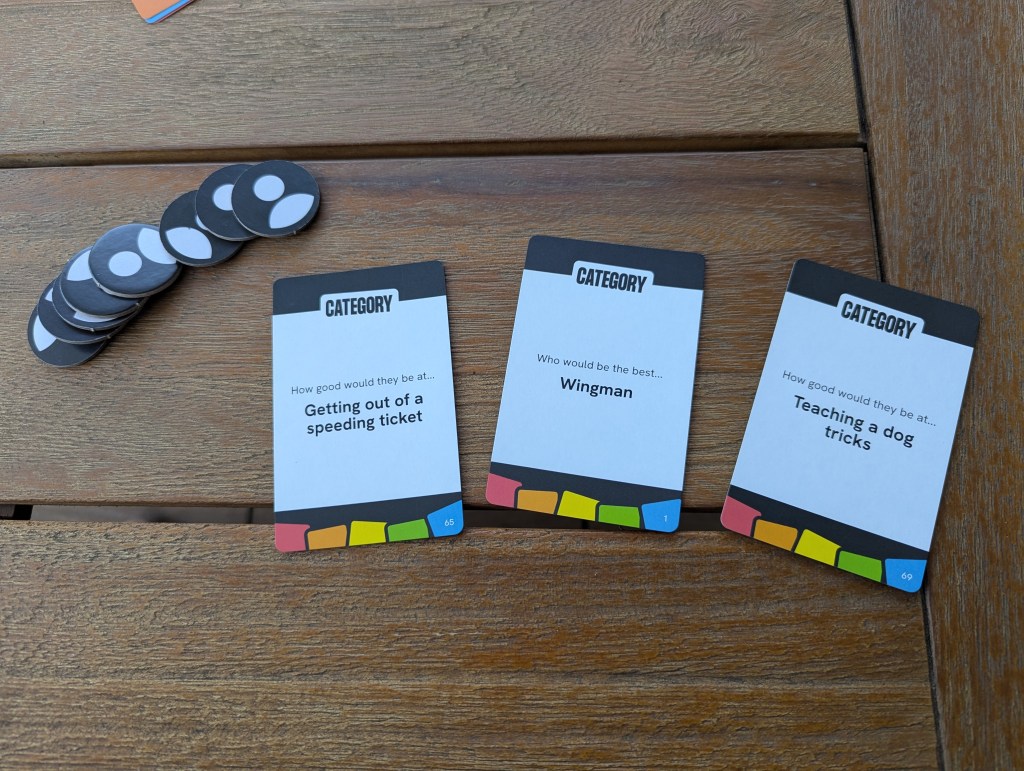
Coming up with your own category is still the best chance the game has to be great. My playgroups really did not find much of anything amazing in the game’s provided deck, even while scouring through it. Crafting a category that is something you want to talk about anyway, with characters chosen by your friends who are giving you things they want to talk about with you– all of this can combine into a fun and hilarious round, whether you score well or not.
Speaking of scoring, you are given the goal of perfectly recreating the Tier Wizard’s list. If you do, you get all eight points, but there’s really no structure or game outside of that. If you fail, play another round, or don’t. Points don’t carry over or result in anything. I’m probably one of the few people on Earth who plays Just One by the rules because I like my points adding up and having a definitive end point, even in party games.
I think this is a fine design choice for the type of game Top Tier is, though. You can stop whenever you want. The game stays out of the way and lets your creativity and conversation take over– it’s a blueprint lots of party games follow. One or two rounds, though, the conversation wasn’t being started and we wished the game itself would speak up from time to time and justify what we were doing. We did appreciate that there was an objective and points to be won– I admit I have an itch to go back because I believe the perfect storm could get us a great, fun round that also ends in a legendary eight-pointer.

Top Tier has its moments. For certain folks, this game could be a hit, I have no doubt. With some house rules, Top Tier could be made into any kind of tier list game you wanted. I can imagine people turning the game into a power-scaling argument generator, or using it in much the same way I use tier list websites to get lost in conversations about board games or basketball teams. Maybe those things will even happen emergently from playing the game rules-as-written, but it doesn’t happen often enough for me to add it to my collection.
In the end, I find Top Tier does everything in its power to minimize bloat and let you have fun doing the tier list-y thing. Unfortunately, the game has hitched its wagon to a core mechanism which does not sustain a whole game nor bring out the best in tier list hot-take cookery. You’ll get some good laughs and some good conversation, don’t get me wrong, but you can get that from a lot of games. If you adore this type of game and need a fourth or fifth one after the ones I mentioned earlier– or if putting a guy in S tier and another guy in D tier alone makes you happy– I would recommend it. Otherwise, we are going to slap this here bad boy in, say, C tier.

Leave a comment