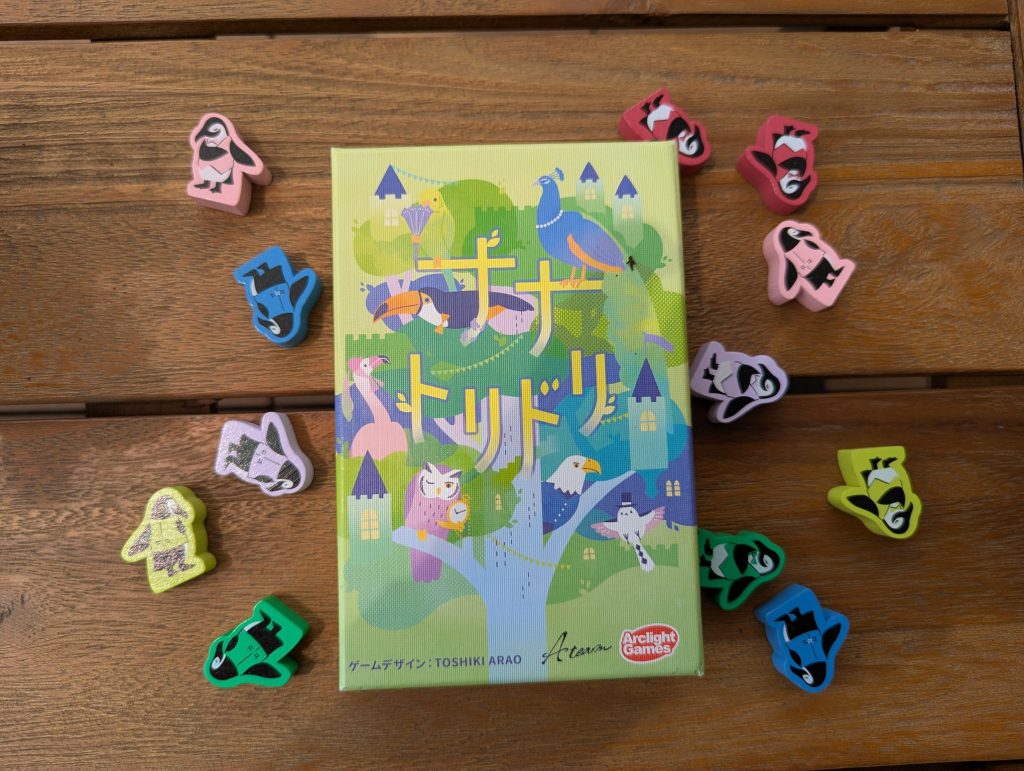

Nanatoridori is a game about playing collections of well-dressed birds onto the table, hoping your fellow players will be stunned into silence rather than scooping up your colony of flamingos and beating it with their army of peacocks. It is fun and reminds me, in a way, of the turn-your-brain-off simplicity of another card shedder: Uno. Say what you will about that game’s boardgame faux pas of a skipped turn or uncontrollable randomness or the always-present rules disagreements– Uno can be fun despite all of that. Nanatoridori, however, is a lot better and– for me– the king of simple card shedders.
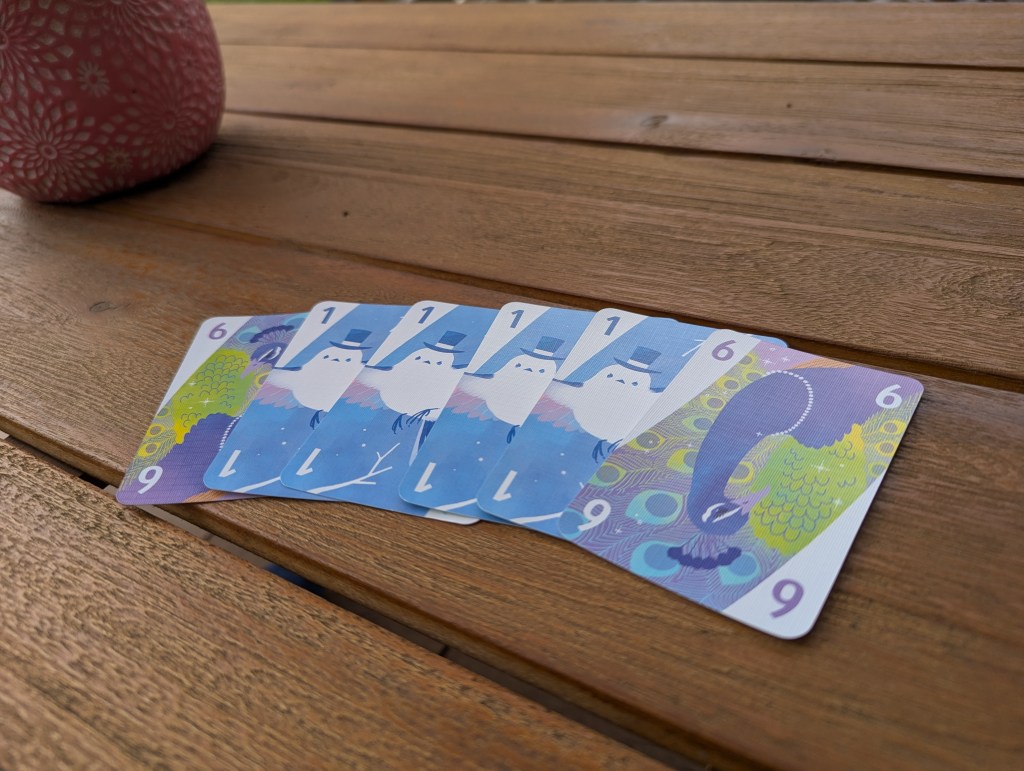
Players will be taking turns playing sets of like birds. Each bird here is represented by a number, and there are only seven numbers. The catch, like any good game hardened by many comparisons to Scout, is that you may not reorganize your hand once it’s been dealt to you and cards must be adjacent to form sets in your hand. Adding to this, whenever you beat the last played set of birds, you may choose to pick the whole thing up and plop it anywhere in your hand, bolstering your supply but getting you further from the ultimate goal of emptying your hand. If you cannot beat the current set, you draw— or not, you can choose to just immediately discard that card. A pair of any numbers beats any single number, and a trio any pair. That is practically every rule.
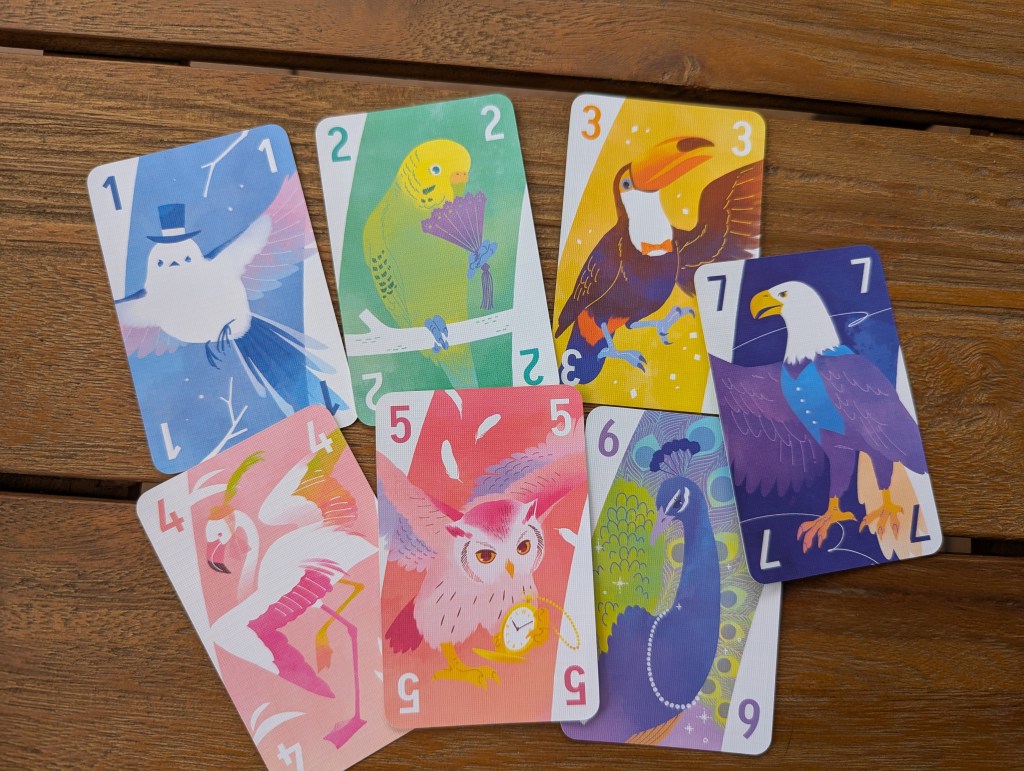
Nanatoridori (or Nana Toridori, as I have seen the name localized to as well) is a game where, within four minutes of being taught, you will bombastically announce the set you just played, your quartet of eagles arriving with so much fanfare that it feels like you just summoned a new Uno card titled, Everyone Draw 1, It’s my Turn Again, Thank You. It will be deserved when your smug grin is removed by the next player playing a flying-V of their own, taking their bow out of the hand.
The simplicity of the game lends it to being taught to anyone, anywhere, which I increasingly appreciate in card games like this. Other card shedders, trick-takers, and ladder-climbers add more wrinkles and twists that surely contribute to cleverness but constantly have me rethinking bringing them out with new players. There’s a reason Toshiki Arao (the game’s designer) has been able to get this game published multiple times with slight variations as Hachi Train and Jungo and is now bringing Nanatoridori to the U.S.
The mechanisms at play are simple and the motivations of the other players are easy to understand right away. Your opponents will wonder: did you just turn an innocuous two into a more worthy triplet of twos? Or did you just clear the morass in your hand, bulk it up on top of that, and set yourself up go out next turn? Do I have time to sit around and draw?
Or, they won’t think about that at all. That’s another plus of Nanatoridori compared to something like, say, Scout. Breezy is an understatement. Often, players are paying no mind to what anyone else is picking up or even how many cards are in their hands. Players are either fixated on their own tangled jungle of a hand or they’re vibing. Hanging out with your friends, playing it cool while you wait for one of them to play a big set so you can slam your even bigger one; it’s a good time. It feels, I’m sorry to say it, like stacking the fifth plus two as turn order circles back around to you or semi-spitefully playing a wild on a wild to pick your preferred color. Strategy be damned. I want to play seven ones and bow out of the round, even if it means I might lose before doing a single meaningful thing. However, since there is only one loser in Nanatoridori and everyone else wins, why not take a crazy shot this round? The game gives you leeway if want to do the funny play, and that same leeway is appreciated when you’re dealt a mediocre hand rather than a great one. It’s okay, you only need to avoid finishing last.
Nanatoridori does have a lot of competition in its niche, as I’ve alluded to briefly. For people who want some teeth to their easy card games, Nanatoridori’s gentle color palette and corresponding gameplay might be lacking. Odin is a variation on practically the same mechanisms that has more texture, if that’s your type of thing. Whereas Nanatoridori lets you coast along towards your ideal hand, never being forced to take a card you draw or a meld you beat, Odin wants you to think more tactically about when to win and when to pass. However, Odin lacks the dramatic moments of impending doom produced by Nanatoridori where someone joyously picks up another huge meld, heralding the second coming of the owl-apocalypse. Spared you from the pun, there.
Nanitoridori is a bit like a sweet treat, letting you do all the cool things you probably like in quick card games, all the time. If you like playing big sets and picking up big sets and triumphing over your opponents, the game says “here you go, do those things.” If you like narrowly escaping a hand after being dealt an objectively bad offering, you’ll probably like Nanatoridori. Hardcore gamers will find the game teetering on threadbare, likely preferring Scout and its extra mechanics and score tokens over the tuxedoed penguins. Me, though? That penguin and I have plans to hang after this.


Leave a comment