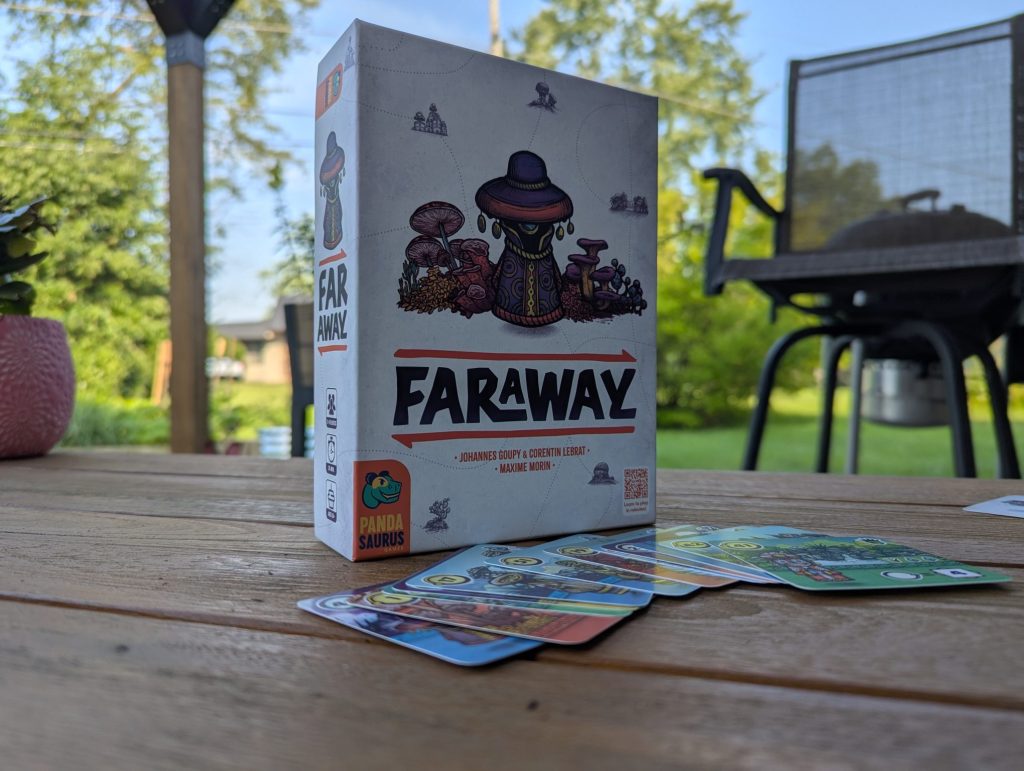

You probably have a lot of preconceived notions about what kind of things happen on an expedition to faraway lands. Spelunky, Indiana Jones, your own trip to Europe; you can probably even imagine what a board game version of said travels might entail. With my amateur gamer instincts, I would assume the most easily gamified elements would be navigation, discovery, and maybe managing resources so one doesn’t run out of supplies. I can think of a dozen games about a treasure to get to, a race to somewhere like El Dorado, or a trudge through someplace inhospitable.
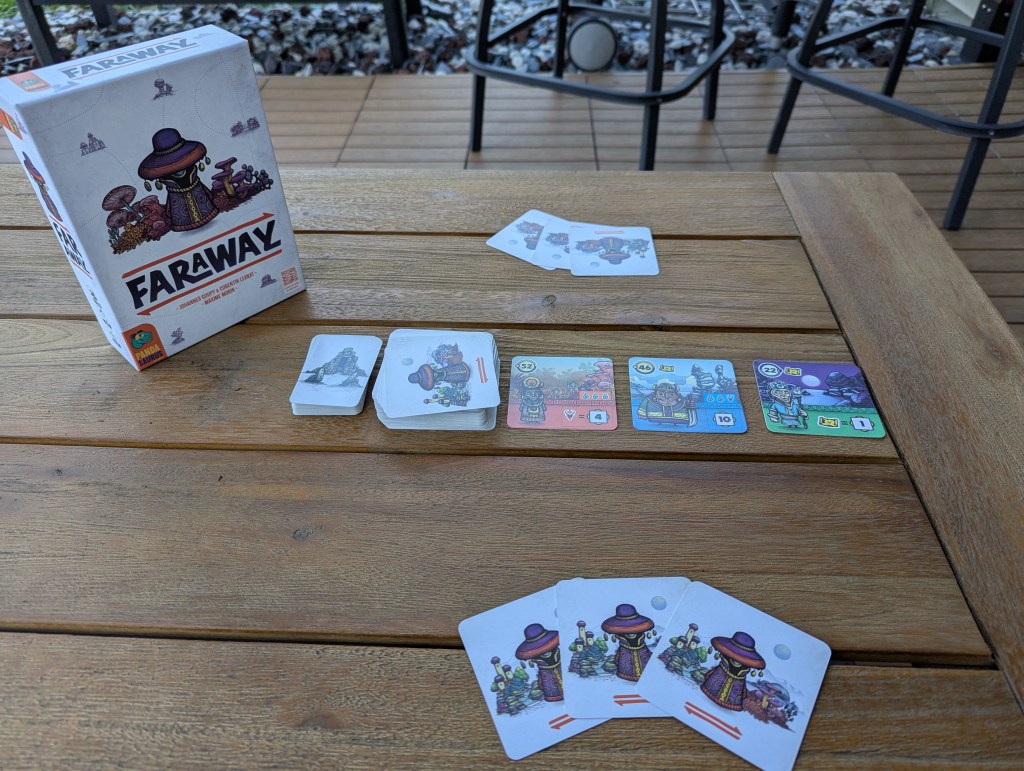
Faraway, designed by Johannes Goupy and Corentin Lebrat, is sort of like that. It is a game that asks you to travel, plot your journey, and to pick up requisite bits, bobs and experiences on your way. But instead of testing your survivability and resourcefulness, it provides an eccentric little puzzle. More than that, it offers a unique perspective on travel and long walks and the strangers you might meet on the way. A game this small, with like 100 cards and nothing else, has a perspective? Yeah. It’s a good game.
In Faraway, players will take turns selecting various locations they intend to visit. These locations may be in little cities, underwater, a desert, amidst mushrooms, or between a pile of ancient-looking stones. Most of these locations will provide the player with one or two of three distinct resources: uddu stones, okiko chimera, and goldlog thistle. The rulebook provides so much lore and set dressing for the world of Faraway, and I like it, but if you are anything like me you will refer to these resources as stone, beast, and plant.
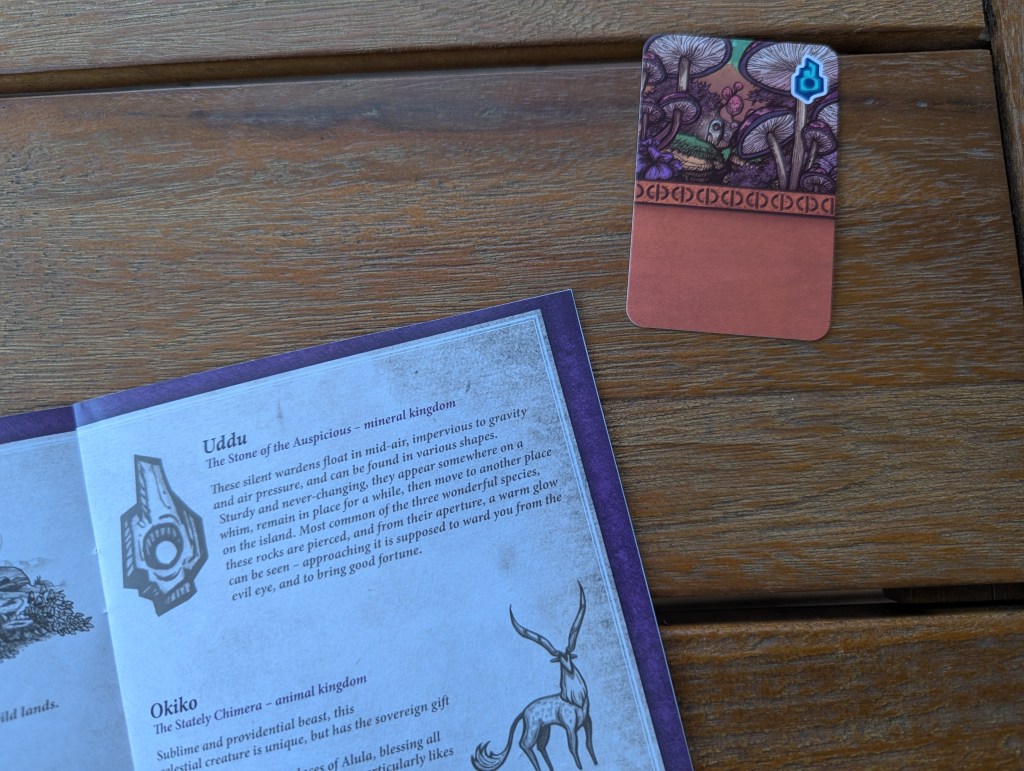
However, more interestingly, most locations will also have some person to meet. These denizens of the ever-changing lands of Faraway ask you favors in exchange for fame. On your way back home from your trip, you’ll show them you collected enough stone or plant to get points.
Did you catch that? “On your way back.” In Faraway, you are not on a trek to a specific destination you intend to colonize, nor are you merely traipsing through accumulating souvenirs on your way to a temple or Disney Land. You are visiting a bunch of places and then… heading back home. You stop and say goodbye to everyone you met on your way, showing them what you’ve got in the interim. You are accumulating fame in the most literal sense of, yeah, those seven people know you and will remember you.

I’ve perhaps buried the lede here, a little bit. At the end of Faraway, you flip over your entire tableau because you haven’t picked up anything yet (except what you found in Sanctuaries, if you were clever enough to visit those via a mechanic I’ll explain later). Instead, you will only fill your rucksack on the way back. One by one, you flip over each of your destinations in reverse order, scoring based only on what is visible when that card is flipped.
There it is. What could’ve been a simple tableau builder about getting enough blue bits to score for your green bits is instead complicated and made evocative. If I meet this guy early in my journey who wants me to get some rocks, he will let me score for every location I visited at night. But the rocks I left behind a couple locations back are no good– I won’t see them again between now and seeing my new friend on the way back home– but maybe I could find some just down the path. There’s a lot of room for strategy and decision making in such a simple game.
It is not at all uncommon for people I play this with to get downright terrible scores in their first play as their brains try to wrestle with these objectives. Often, they’ll get a bunch of plants to trigger scoring objectives, but miss that the point-getting parts of the scoring objectives were earlier in the journey. But it’s fine, because often an experienced player will also get a mediocre score, unable to deliver on their lofty promises of five rocks for this guy, five plant for that guy, and three beasts for her all before the crack of dawn.
There’s a lot more about Faraway’s thoughtful design I could go on about. For example, each location has a number which indicates how long it takes to get there. You get to visit Sanctuaries for going to locations in ascending order, which highly incentivizes you to play cards in an order that makes the game harder and your scoring more ambitious. It feels like trying to optimize a route through the grocery store while your shopping list is populating from turn to turn and you have no idea what’s in the next aisle.
In Faraway’s best moments, it has elements of push your luck, too. Players will be taking on big contracts with only two or three turns left with hopes of lucking out in the draft to score huge. Because of the fuzziness of the scoring and how hard it is to read other people’s fortunes during the game, Faraway is also a delight to score at the end. When your opponent scores a card that you thought they couldn’t possibly have fulfilled, you’re gagged. When their next four cards somehow score nothing, you can treat yourself to a wry smile, at least until you realize your tableau doesn’t score any cards other than the first three you placed.
I recommend Faraway. It does not have infinite depth nor is it free from a full serving size of luck, but its collection of quirky, elegant mechanics definitely has me charmed. It’s kept me captivated enough to play it 40-something times without getting bored or feeling I had it “figured out.” It also makes me want to go on a long walk and maybe look at a cool creek and say hello to the passersby. That’s worth something too.

Leave a comment