
In Canvas, players are expected to make art. For some players, that declaration alone may sound like a threat and reflexively trigger a “but I can’t draw,” or “can I do stick figures?” No worries. The drawings are already made for us, it is merely up to us to combine them, collage style, into something coherent, beautiful, and meaningful. What? That’s even scarier? Well what if I said you were doing this to match little symbols, not to be appraised by your fellow artists? Nobody will judge, we are all here to score points.
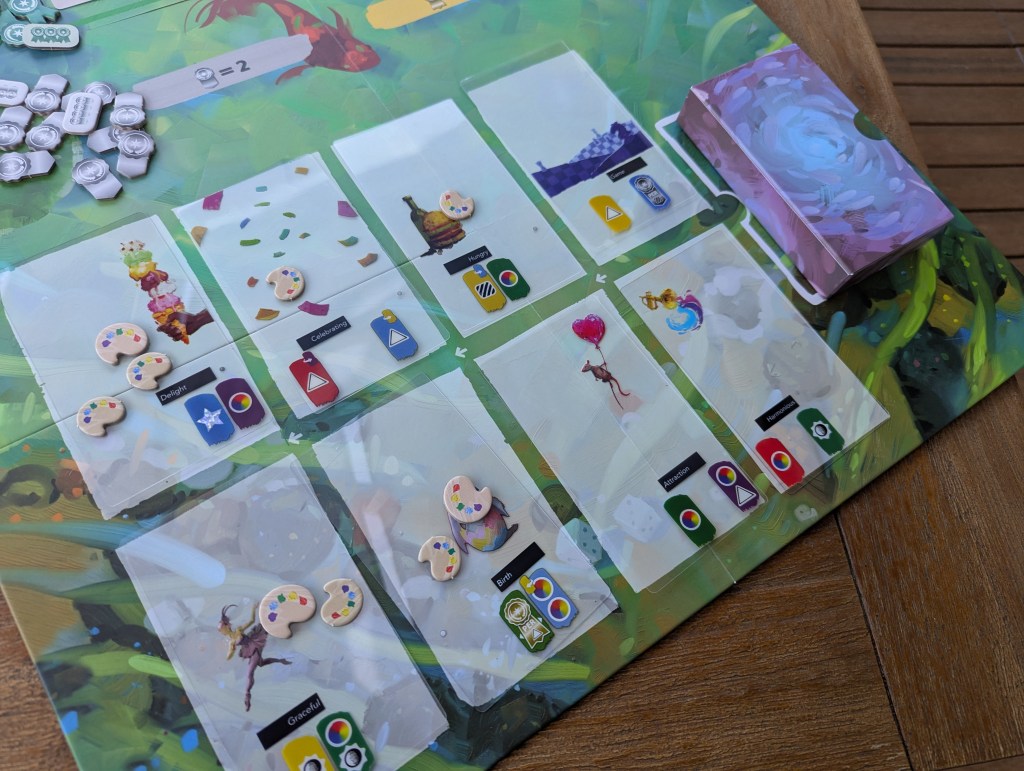
Paintings in Canvas (designed by Andrew Nerger and Jeff Chin) are made by sliding three translucent cards, each adorned with a character or frame or object or abstraction, into a card sleeve set against a background. The finished pieces in Canvas are often a glossy mess barely contained by the sleeve. But, I assure you, they are charming glossy messes.
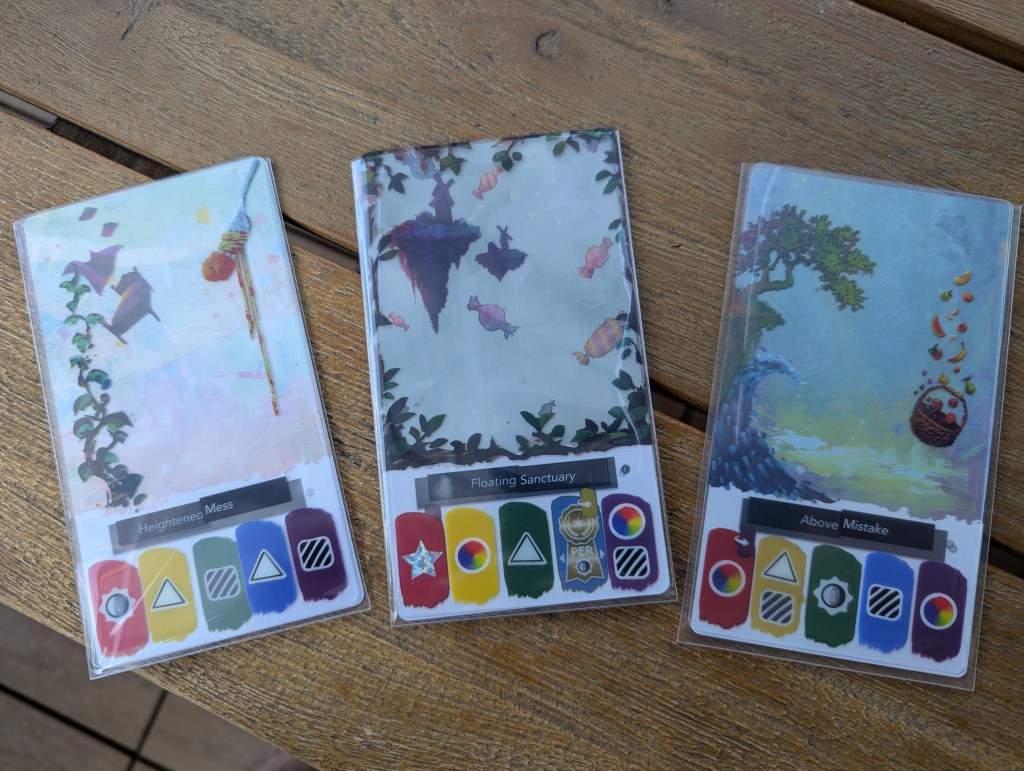
In my plays, we have delighted in the opportunity to look up from our maddened card organizing-and-reorganizing to show off our creations; read the name of it aloud, perhaps offer some sort of explanation which justifies the artwork beyond “I was trying to get these symbols on these swatches and what-not.”
This is often one of my favorite parts of any game: you un-focus your eyes from the mechanics for just a moment and notice you created something cool enough to show off when you’re done. Canvas realizes this and optimizes for it– instead of having one cool little thing at the end to look at it and say “I made this!” you get to do that three whole times. And maybe the best you’ll get from the finished piece is an “I’m 14 and this is deep”-style collage of people behind bars or a skull next to a hamburger overlapped slightly by a mouse– but hey, you’re an artist. You made a thing through play. Take a couple of your hard-earned ribbons signifying how good you were at Symmetry or Balance or Mise en Place (or one of the other many variable scoring conditions).
This neat card-crafting mechanism isn’t the only trick up Canvas‘s sleeve, either. While you are trying to craft the most ideal pieces of art by lining up the correct symbols along the bottom of a card’s swatches, you are doing so with a restrictive hand-size and a market where undesirable pieces get cheaper and reward you for taking them. Once a player has five pieces of art in their hand, they must finish a painting using exactly three of those cards. The game isn’t only being pushed along at a brisk pace, you are an artist on a deadline.
Sure, you could take a cheap card nobody else wanted– nabbing the inspiration tokens others used to pass over it while you’re at it– but that card is now an entire fifth of your hand, and there’s no discarding it. It’s now likely that undesirable art card you scooped up on turn three for some inspiration is going to find its way into your second or third painting, whether it was in the plans or not. I imagine the artist I am piloting in games of Canvas being overwhelmed by the inspirational idea of a cool turtle and not being able to hold a single more idea in their head until they get the turtle out onto the linen.
This also means the game has a pretty satisfying end. Instead of someone triggering the end of the game by completing their third painting or scoring X many ribbons, all players will get a chance to finish all three paintings. You aren’t punished for finishing all 3 paintings early because everyone else will be done very soon, anyway. Nor are you disproportionately rewarded for sticking around and taking your time; you will have at most a turn or two more than the first finisher, and their tokens leave the economy when they do, so you don’t get to clean house or maximize the market. There is probably some advantage to holding out that extra bit longer in case something unbelievable pops into the market, but the advantage wasn’t obvious enough for anyone I played with to insist on doing so.
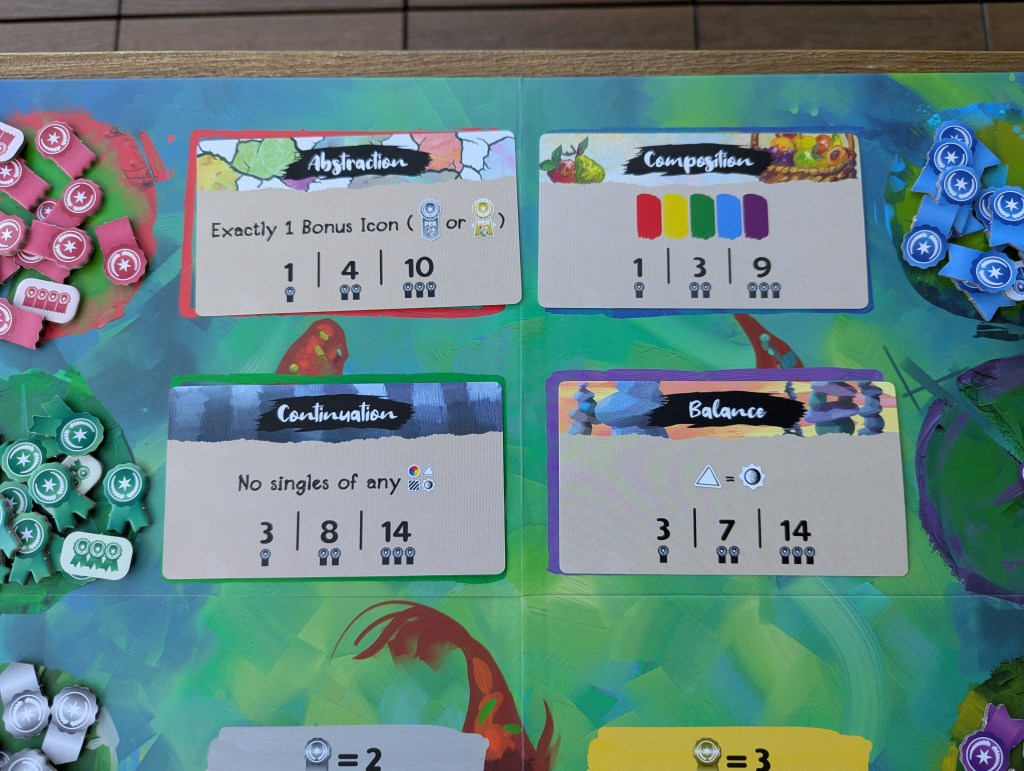
Canvas wouldn’t be a family-weight strategy game without a good helping of set collection. Your first painting to meet a criterion might score two, the second six, and the third eleven. If I layer my painting a certain way and miss out on a green ribbon with my first painting, it’s almost freeing. Instead of having 4 scoring conditions being worth essentially equivalent points relevant to effort, now green is way less desirable, and scoring purple, blue, and red has become integral. Ah! But in this game, maybe red ribbons are rewarded for having three entire Shading icons on cards, and another player is snatching all of them up. There’s tension, but it never feels impossible to recoup and it’s rare for someone to feel starved out of the “good” cards in the market.
The mechanisms in Canvas are simple, but the production and the premise is enough to make it stand out from others in the family-weight genre. For groups who just want a neat puzzle to compete at with their family, this game is probably good enough, even if you never show off your paintings or are jaded by the piles of plastic card sleeves. The spatial puzzle of trying to figure out how to get so-and-so symbols without covering up another symbol stands on its own.
The game also has special rules for two players if you find the market does not change enough, but I have played this primarily with just my partner and we have never found those additional rules necessary. If you find yourself wanting a little more sauce, the game also has a couple expansions worth considering.
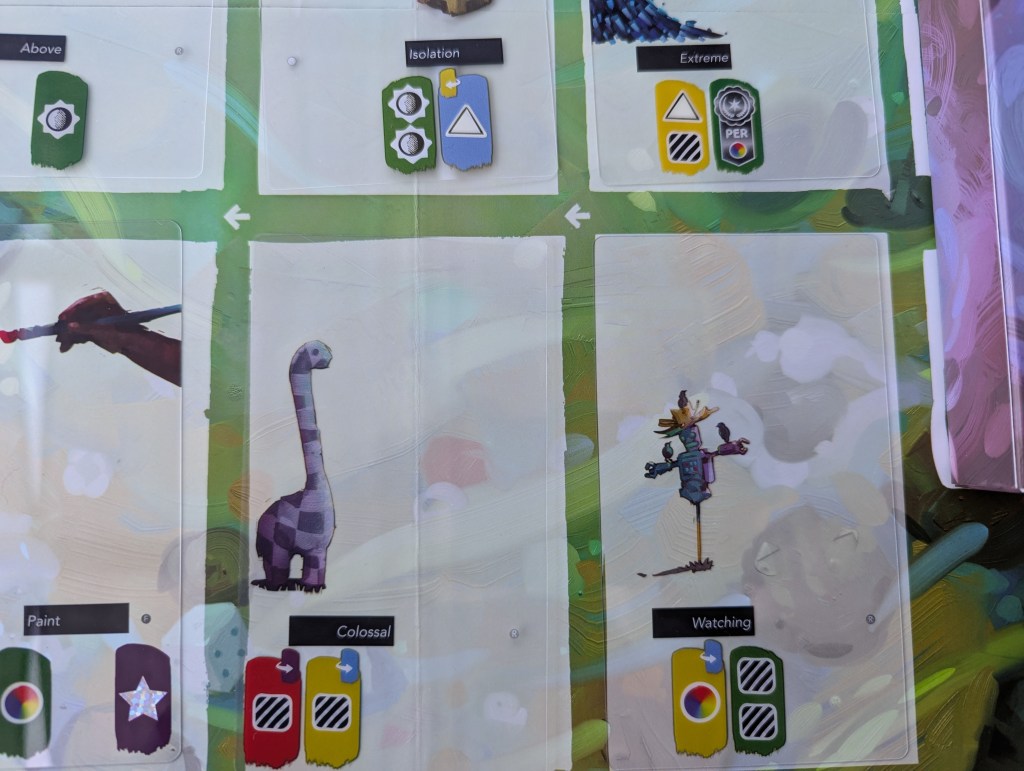
The first expansion for Canvas is Reflections. It replaces the cloth board with a full board (YMMV on which you prefer) that essentially doubles the amount of cards on offer at any given time, without getting rid of the satisfying Dutch auctions. Reflections also adds the proximity-based Gold ribbons and reversible art cards, both of which pair well with the addition of more placement-matters scoring conditions. The reversible art cards are especially a treat. While some are essentially just the same piece of art mirrored across the image, most are entirely different, such as a train on one side and a squarish but cute dog on the other. The interface and symbology on the cards shine in Reflections, as well– while it does add some complexity, the reversible cards are immediately readable and add practically no rules. I highly recommend it for any Canvas enjoyer.
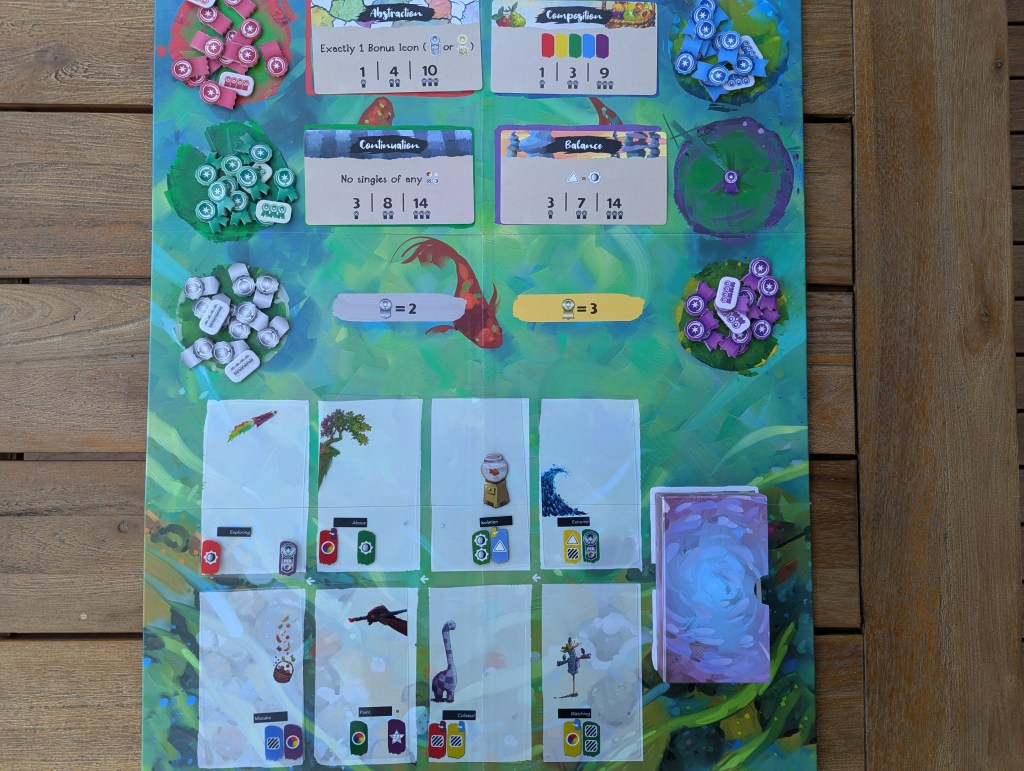
The other expansion, Finishing Touches, I have played less. It feels less essential, for sure, but I will leave my thoughts for a potential review later down the line once I have given it more of a shot. The additions are headlined by new frames players will be inserting their finished paintings in which give immediate points as well as bonus points if the paintings remains to the endgame. This mechanism provides the opportunity, of course, to kick people out of frames if your painting is more colorful or shapely. There are also new wild star symbols, which act precisely as you would expect a wild symbol in Canvas to act, and another symbol which duplicates the symbol to its left or right.
Neither of these expansions completely change the game or add a delirious amount of complexity, regardless of your family’s age or patience. I personally find expansions that add whole new modules doubling the amount of mental overhead obnoxious, especially when they are being applied to such simple games to begin with. Canvas‘s expansions don’t have that issue.
If you choose not to play with Finishing Touches‘ frames, the additions provided by the expansions boil down to: a new board which probably makes the game easier (by allowing for more choice, which in practice didn’t feel overwhelming but rather made it easier to always select something useful); a new ribbon which functions as slight twists on the pre-existing ribbons; and a whole ton of art cards and scoring conditions which merely get shuffled into their respective decks.
I was, as usual, late to the party on Canvas. It came out in 2021, right when I was getting back into board games and playing them a lot with my family, and it would have fit perfectly as one of the first handful of games in my collection. Even now, Canvas has earned its spot in my collection– more than that, it’s a rare game that I chose to give even more space on my shelf in the form of expansions. It’s a cozy game that plays well at two, three, and four while having an eye-catching gimmick, so it’s easy to justify bringing it out.

Leave a comment